
Non-FictionSelf-HelpAccountability
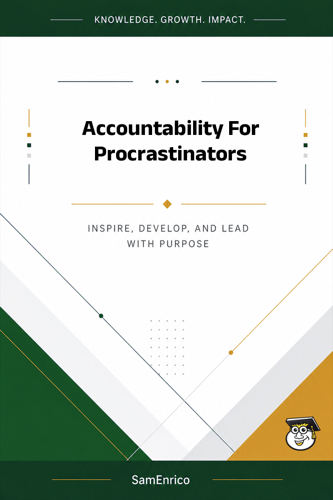
Accountability For Procrastinators eBook
Use social commitment to follow through on intenti
Use social commitment to follow through on intentions.
Formats
Free sample
Chapter 1: The Private Vow Fallacy--–- You have made thousands of promises to yourself this year. You have kept almost none of them. And you have convinced yourself that this is a moral failure—a lack of willpower, discipline, or character. What if the problem was never you?The Confession You Won't Say Out Loud Let me describe a scene, and tell me if it feels familiar.It is Sunday evening. You are sitting on your couch, scrolling through your phone, when a thought drifts into your mind: I really should start that project tomorrow.
First thing. No excuses.You feel a small surge of virtuous intention. You might even open your calendar and block out 9:00 AM to 11:00 AM. You label it “WORK ON PRESENTATION” in aggressive capital letters. You feel, for a moment, like someone who has their life together.Monday morning arrives.You wake up, make coffee, and sit down at your desk at exactly 9:00 AM.
You open your laptop. And then—something happens. Or rather, nothing happens. You check email. You read the news.
You reorganize your desktop folders. You watch a fourteen-minute video about restoring antique furniture, a topic you have never been interested in and will never be interested in again.At 11:00 AM, your calendar alert goes off. “WORK ON PRESENTATION.” You glance at it, feel a flicker of shame, and dismiss the alert. I’ll do it this afternoon, you tell yourself.This afternoon arrives. You do not do it.Tuesday arrives.
You do not do it.Friday arrives. Now you are staying late at the office, heart racing, palms sweating, producing something mediocre that you could have done beautifully if you had simply started on Monday morning.You swear you will never do this again.Next Sunday evening, the exact same cycle begins.If this scene describes you—or describes you more often than you would like to admit—then you have already tried every solution you know. You have tried to “just start.” You have tried breaking tasks into smaller pieces. You have tried reward systems, punishment systems, productivity apps with cute animations of growing trees. You have tried waking up at 5:00 AM, journaling, meditating, and drinking celery juice because someone on the internet said it would cure your executive function.None of it worked.
Or it worked for three days and then stopped.Here is the liberating truth this book will prove to you: You do not have a willpower problem. You have a commitment architecture problem. And the difference between those two things is the difference between a lifetime of shame and a practical, repeatable system that actually works.The Fundamental Mistake Almost Everyone Makes Most self-help books about procrastination begin with a premise that sounds reasonable but is actually disastrous. They assume that procrastination is a failure of internal management—that you simply need better habits, stronger discipline, or a more positive mindset.This premise leads to advice like: “Just do the first five minutes.” “Use the Pomodoro Technique.” “Visualize your future self.” “Forgive yourself and try again.”None of this advice is wrong, exactly. It is just incomplete.
And because it is incomplete, it fails for the specific psychological profile of the chronic procrastinator.Here is what those books misunderstand: Your brain treats private promises and social promises as two entirely different categories of reality.When you say to yourself, “I will exercise tomorrow morning,” your brain processes that statement as a preference. It is a wish. A nice idea. It carries no more weight than “I should really learn French” or “It would be nice to be the kind of person who flosses daily.” Your brain knows—at a level below conscious thought—that no one will ever know if you fail. There is no witness.
There is no consequence. There is no social pain.When you say to a friend, “I will meet you at the gym at 7:00 AM tomorrow,” your brain processes that statement as a commitment. It activates entirely different neural circuits—circuits associated with error detection, social pain, and reputation management. Your brain knows that someone will be waiting. Someone will notice your absence.
Someone will form a judgment.This is not a metaphor. This is neuroscience.The Neuroscience of the Commitment Gap In 2004, neuroscientists at University College London conducted a study that should be required reading for every procrastinator. They placed participants in f MRI scanners and asked them to make two kinds of promises: private promises to themselves and public promises to another person in the room.The results were striking. Private promises activated the prefrontal cortex—the part of the brain associated with planning and abstract reasoning. But they did not activate the anterior cingulate cortex (ACC), which is the brain’s error-detection and social-pain center.Public promises did the opposite.
They activated the ACC intensely, along with the insula (associated with emotional awareness) and the temporoparietal junction (associated with thinking about other people’s mental states).In plain English: Your brain literally does not register a private promise as something you must follow through on. It registers as a thought, not an obligation.This explains the single most frustrating experience in the procrastinator’s life: the feeling of meaning it this time. You genuinely intend to start the project. You genuinely feel motivated. And then, when the moment of action arrives, the motivation evaporates like morning dew.You were not lying to yourself.
You were not weak. You were simply using the wrong kind of promise.Let me name this phenomenon. We will call it the Commitment Gap.The Commitment Gap is the distance between knowing what you should do and doing it when no one is watching. It is not a gap in information (you know what to do). It is not a gap in skill (you know how to do it).
It is a gap in social architecture. The private vow is structurally incapable of producing reliable follow-through in the chronic procrastinator’s brain.Why Willpower Is a Weak Lever (And Why You Should Stop Blaming Yourself)If you have ever tried to “build willpower” or “develop discipline,” you have experienced the fundamental problem with willpower-based approaches: they deplete.The research on ego depletion—while contested in its extreme forms—clearly shows that self-control is a finite resource that fatigues with use. But this is not the most important problem with willpower. The most important problem is that willpower requires you to fight against your own brain’s default settings every single moment of every single day.Let me be explicit about what I am saying: The chronic procrastinator is not lazy. The chronic procrastinator is fighting a neurological system that was never designed to honor private vows.Evolution did not prepare you to write quarterly reports, file taxes, or go to the gym.
Evolution prepared you to conserve energy, seek immediate rewards, and avoid unnecessary effort. When you try to force yourself to do a difficult task using willpower alone, you are asking your ancient lizard brain to voluntarily override its core programming—without any external incentive or threat.That is not a character flaw. That is asking a fish to climb a tree.The solution is not to…
This is the end of the free sample. Get the eBook to keep going. Buy now
About this book
Details
- Author
- Giroux Selina
- Publisher
- SamEnrico
- Language
- English
- Genre
- Non-Fiction, Self-Help, Accountability
- Released
- 2026-06-10
- Pages (approx.)
- 155
- Available as
- eBook, Audiobook

Read better in the ZLOADR app
Your eBooks on your phone or tablet. Sign in with your SamEnrico account and start reading.
More by Giroux Selina
 Outbreak Inventory Management SystemGiroux Selina$11.99
 Macros for PregnancyGiroux Selina$11.99
 OKR for Sales TeamsGiroux Selina$12.99
 Workplace Journey Memory PathGiroux Selina$11.99
 The Foster Care College DreamGiroux Selina$11.99
 DEAR MAN Skill GuideGiroux Selina$11.99
 Career Monthly Review GuideGiroux Selina$11.99
 Grief and Cooking AloneGiroux Selina$11.99
 Loki’s Shadow: The Trickster’s African TrialGiroux Selina$11.99
 Service Providers Guide to Video TapingGiroux Selina$11.99
 A Collector's Handbook to the Morris Minor Mm TourerGiroux Selina$11.99
 Disaster Recovery for Offshore SupportGiroux Selina$12.99
You may also like
 Hong Kong Handover 1997Dunn Johnnie$11.99
 Zumba For Postnatal Recovery CourseNeal Christian$11.99
 Zumba for BeginnersLadner Nikia$11.99
 YouTube Comment Mining GuideHumes Pandora$12.99
 Worry Box MeditationCarlin Rudy$11.99
 Workplace Stress MeditationNguyen Lynn$11.99
 Workplace Stress and Sleep RepairHawley Ivory$11.99
 Workplace Perfectionism CureDelaney Jeffry$11.99
 Workplace Injustice Anger GuideWallen Isabelle$11.99
 Work Addiction and Burnout LinkGreenwood Ester$11.99
 Women in Yoga and WellnessBeattie Galina$11.99
 Women in Stand Up ComedyChun Evangeline$11.99