
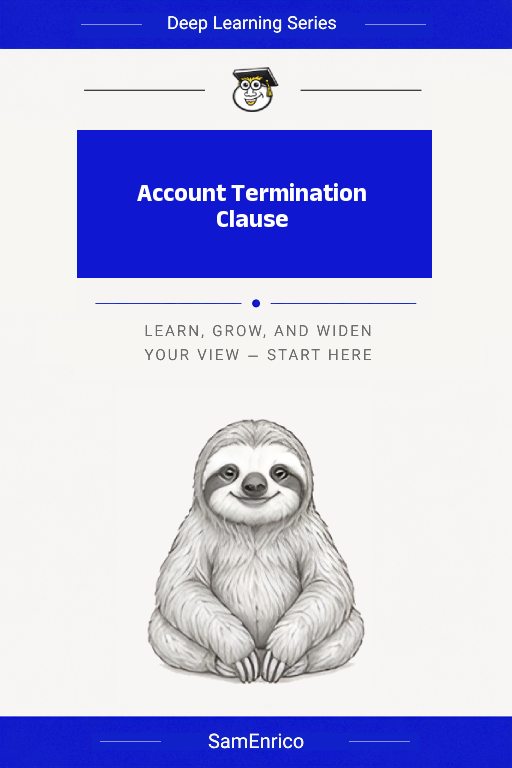
Non-FictionFirst 30 DaysTermination
Account Termination Clause eBook
Draft user account termination provisions includin
Draft user account termination provisions including grounds for termination and notice requirements.
Formats
Free sample
Chapter 1: The Illusion of Discretion--–- Most platform operators believe they hold absolute power over their users. They draft account termination clauses that read like royal decrees: “We may terminate your account at any time, for any reason or no reason, with or without notice.” For years, this language went unchallenged. Courts yawned. Users clicked “I agree.” Lawyers called it standard boilerplate. But the legal landscape has shifted dramatically.
What was once considered unassailable corporate discretion is now the fastest way to lose a lawsuit, attract regulatory scrutiny, and forfeit critical statutory immunities.This chapter dismantles the traditional “sole discretion” termination clause. It explains why unilateral discretion is not only legally vulnerable but commercially reckless. We will explore how the duty of good faith has quietly infiltrated contract law, how Section 230 of the Communications Decency Act rewards fair enforcement and punishes arbitrariness, and how a properly drafted preamble can transform a termination clause from a litigation magnet into a shield. By the end of this chapter, you will understand why the old way of drafting is dead—and how to build something far more durable in its place.The Death of “Any Reason or No Reason”For decades, technology platforms operated under a simple assumption: our service, our rules. Courts generally respected this premise, treating account termination as an exercise of discretionary authority akin to a private club refusing service.
The standard clause read like a variation of the following: “Company reserves the right to terminate or suspend your account at any time, for any reason or no reason, with or without prior notice.”This language drew its legal authority from the doctrine of unilateral discretion—the idea that a party providing a service could define its own right to cease providing that service without contractual constraint. In the physical world, a store owner could refuse service to anyone. The same logic, platforms argued, should apply to digital services.The cracks in this logic began appearing around 2015. Consumer protection lawsuits started challenging “no reason” termination clauses as substantively unconscivocalble. Plaintiffs’ lawyers argued that users had invested significant time, money, and emotional energy into building digital identities, social networks, and virtual assets.
To allow a platform to vaporize those investments without cause, they contended, violated fundamental notions of fairness.Courts began listening. In cases like Zakos v. Facebook (2017) and Harris v. Blockbuster (2019, consolidated opinion), judges expressed skepticism about absolute discretion clauses. The Zakos court noted that “unbridled discretion to terminate without cause, exercised arbitrarily, may constitute bad faith as a matter of law.” While these cases often settled or were dismissed on other grounds, the judicial signal was unmistakable: the era of “any reason or no reason” was ending.The regulatory response accelerated the trend.
The proposed TERMS Act (S. 2010), though not yet federal law, has already influenced state legislation and industry standards. It would require platforms to provide specific grounds for termination, advance notice, and meaningful appeal rights. California’s Consumer Privacy Act (CCPA) and the European Union’s General Data Protection Regulation (GDPR) have also constrained terminations by creating data portability and access rights that survive account closure.Today, a “sole discretion” clause is not merely aggressive—it is dangerous. It invites litigation, invites regulatory investigation, and, as we will see, may void the platform’s immunity under federal law.The Two Faces of Good Faith: Substantive and Procedural Before we can fix the termination clause, we must understand the concept that will replace “sole discretion”: good faith.
This term appears throughout contract law, but its meaning shifts depending on context. In the termination clause context, good faith has two distinct dimensions, and confusing them has been the source of endless drafting errors.Substantive Good Faith refers to the fairness of the termination decision itself. A platform acts with substantive good faith when it terminates a user for an actual violation of a published rule, applies that rule consistently across similar users, and does not invent reasons pretextually. Substantive bad faith would include terminating a user for a made-up violation, terminating a competitor’s account while ignoring identical conduct by a favored user, or terminating because a user posted criticism of the platform.Procedural Good Faith refers to the fairness of the termination process. This includes providing adequate notice, offering an opportunity to respond, and ensuring the user understands why termination occurred.
Procedural good faith asks not whether the decision was correct, but whether the process was fair.These two concepts are distinct but related. A platform could have substantive good faith (the user actually violated the rules) but procedural bad faith (the platform terminated without notice and refused to explain why). Conversely, a platform could follow perfect procedure but act with substantive bad faith (terminating for a pretextual reason while going through the motions of notice and appeal).The distinction matters tremendously for legal liability. Substantive good faith is primarily relevant to breach of contract claims and consumer protection statutes. Procedural good faith is central to compliance with the TERMS Act and similar notice-based regulations.
A well-drafted termination clause must address both.Section 230(c)(2) Immunity: The Good Samaritan’s Shield Few provisions in American law have generated as much litigation as Section 230 of the Communications Decency Act. Section 230(c)(1) protects platforms from liability for user-generated content. But subsection (c)(2) is the provision most relevant to termination clauses. It states:“No provider or user of an interactive computer service shall be held liable on account of any action voluntarily taken in good faith to restrict access to or availability of material that the provider or user considers to be obscene, lewd, lascivious, filthy, excessively violent, harassing, or otherwise objectionable, whether or not such material is constitutionally protected.”This “Good Samaritan” provision immunizes platforms from lawsuits brought by users who claim they were wrongfully terminated or blocked. If a user sues for defamation, breach of contract, or emotional distress after being banned, Section 230(c)(2) can provide a complete defense—but only if the platform acted in good faith.The good faith requirement in Section 230(c)(2) has been interpreted by courts to encompass both substantive and procedural dimensions.
In Zango v. Gist (2010), the court held that a platform that terminated a user based on a “mistaken but good faith belief” remained immune. But in J.S. v. Village Voice (2002), the court suggested that arbitrary, discriminatory, or bad-faith terminations might fall outside the immunity.Recent cases have sharpened the analysis.
In Enigma Software v. Malwarebytes (2020, Ninth Circuit), the court emphasized that “good faith” requires an honest, subjectively sincere belief that the restricted material falls within the statutory categories. The platform need not be correct, but it cannot act with an improper motive.What does this mean for termination clause drafting? A platform that reserves “sole discretion” to terminate for any reason or no reason creates a record that undermines a good faith defense. If the termination clause explicitly disclaims any need for cause, a plaintiff can argue that the platform’s own contract admits that terminations may be arbitrary.
Arbitrariness is the opposite of good faith.Conversely, a termination clause that commits the platform to enforce specific rules, provide notice, and allow appeals creates a paper trail supporting a good faith defense. When…
This is the end of the free sample. Get the eBook to keep going. Buy now
About this book
Details
- Author
- Gatlin Vannesa
- Publisher
- SamEnrico
- Language
- English
- Genre
- Non-Fiction, First 30 Days, Termination
- Released
- 2026-06-01
- Pages (approx.)
- 160
- Available as
- eBook, Audiobook

Read better in the ZLOADR app
Your eBooks on your phone or tablet. Sign in with your SamEnrico account and start reading.
More by Gatlin Vannesa
 Pomodoro Technique Remote WorkGatlin Vannesa$11.99
 Tone of Voice GuideGatlin Vannesa$11.99
 Protect Deep Work BlocksGatlin Vannesa$11.99
 Climate Risk in Retirement HousingGatlin Vannesa$11.99
 The Resilience GymGatlin Vannesa$11.99
 Remote Work Travel GuideGatlin Vannesa$11.99
 Estate Settlement GriefGatlin Vannesa$11.99
 Personal Branding for VeterinariansGatlin Vannesa$11.99
 The Whispering Fingerprints: The First Forensic Breakthrough in the Victorian EraGatlin Vannesa$11.99
 The Celestial Architects: Designing the Future of HumanityGatlin Vannesa$11.99
 How to Start a Esters of Methacrylic Acid Business (Beginners Guide)Gatlin Vannesa$11.99
 How to Produce Water Filter HousingsGatlin Vannesa$11.99
You may also like
 Hong Kong Handover 1997Dunn Johnnie$11.99
 Zumba For Postnatal Recovery CourseNeal Christian$11.99
 Zumba for BeginnersLadner Nikia$11.99
 YouTube Comment Mining GuideHumes Pandora$12.99
 Worry Box MeditationCarlin Rudy$11.99
 Workplace Stress MeditationNguyen Lynn$11.99
 Workplace Stress and Sleep RepairHawley Ivory$11.99
 Workplace Perfectionism CureDelaney Jeffry$11.99
 Workplace Injustice Anger GuideWallen Isabelle$11.99
 Work Addiction and Burnout LinkGreenwood Ester$11.99
 Women in Yoga and WellnessBeattie Galina$11.99
 Women in Stand Up ComedyChun Evangeline$11.99