
Non-FictionBusiness BriefUniversal Design
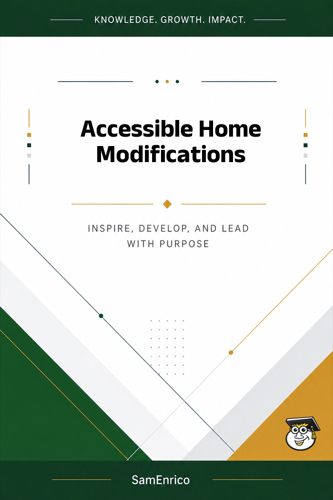
Accessible Home Modifications eBook
Retrofit smaller spaces for aging in place safety
by Tomlin Sana
Retrofit smaller spaces for aging in place safety and mobility.
Formats
Free sample
Chapter 1: The 500-Square-Foot Lie--–- The real estate listing said "charming fixer-upper with endless potential." What it didn't say was that the bathroom door was 24 inches wide, the hallway turned at a right angle so tight you couldn't carry a laundry basket through it, and the previous owner had spent their last three years confined to the living room because the bedroom was up six stairs that might as well have been a mountain.That listing was for the home where I met Margaret. She was 78, a retired librarian with hands gnarled by rheumatoid arthritis and a spirit that refused to quit. She had lived in her 620-square-foot bungalow for forty-two years. Her husband had died in that living room. Her children had been raised in those cramped bedrooms.
And she was determined to die there too – just not yet.Margaret had spent $11,000 on home modifications before I walked through her door. A contractor had installed grab bars in her bathroom – all of them screwed into drywall anchors because he "didn't want to cut into the plaster." He had built a wooden ramp over her front steps that was so steep her grandson's skateboard rolled down it faster than her walker could safely descend. He had replaced her beautiful old doorknobs with ugly lever handles that clashed with everything, then charged her $400 for the privilege.Six months later, Margaret fell anyway. Not because of her arthritis or her failing eyesight. She fell over a stack of library books on her bedroom floor."I just didn't have anywhere else to put them," she told me from her hospital bed, where she was recovering from a broken hip that would eventually lead to pneumonia and, eight weeks later, her death.Margaret's story is not unusual.
It is, in fact, the rule. Every year, one in four Americans over 65 falls. For those over 80, it's one in three. Of those falls, nearly half happen inside the home – not on the stairs, not in the shower, but on flat, familiar ground, tripped by something that had no business being on the floor in the first place.The home modification industry has sold us a lie. It's a seductive lie, wrapped in before-and-after photos of gleaming curbless showers and gleaming stainless steel grab bars.
The lie is this: with enough money and enough contractors, you can retrofit any home to be safe. You just need the right products. The right professionals. The right budget.Bullshit.The truth – the hard, inconvenient, liberating truth – is that most home modifications fail because they address the wrong problem. We install grab bars but leave clutter on the floor.
We widen doorways but ignore the narrow hallway that connects them. We spend thousands on accessible showers while the path from the bedroom to the bathroom remains a minefield of pet bowls, yoga mats, and extension cords.And for people living in small spaces – apartments under 800 square feet, bungalows from the 1920s, row houses built before wheelchairs were invented – the lie is even more dangerous. In a small space, you cannot simply "add" a ramp or "install" a wider door. Every inch is contested territory. Every modification trades off against something else.
A wider doorway means a narrower wall for bookshelves. A curbless shower means losing the linen closet. A stairlift means you can no longer store your vacuum cleaner on the landing.This book exists because Margaret deserved better. Because the thousands of Margarets reading this right now – or more likely, their adult children reading it for them – need a different approach. Not the "more money, more contractors, more stuff" approach.
Something smarter.Something that works in 500 square feet.The Three Numbers That Will Save Your Life (or Tell You to Move)Before you spend a single dollar on modifications – before you call a contractor, before you buy a single grab bar, before you reorganize a single closet – you need to measure three things. These three measurements will determine everything. They will tell you whether your home can be made safe, whether you should pursue a partial retrofit, or whether you need to relocate entirely.I am not being dramatic. I have watched families pour forty thousand dollars into homes that could never, ever be made accessible. I have watched them choose sentiment over geometry, love over physics.
And I have watched them watch their parents fall anyway.So get a tape measure. A cheap one from the hardware store is fine. And measure these three things:Number One: Your Doorway Width Stand in front of the door to your bedroom, your bathroom, and your front entrance. Measure the clear opening – that's the distance from the edge of the door (when fully open) to the opposite side of the frame. Do not measure the door itself.
Measure the space you actually walk through.Here is the brutal truth, broken down by what you actually use:If you use a standard wheelchair: You need 32 inches. Not 31. Not "almost." 32 inches is the minimum clear width for a standard wheelchair to pass through without scraping your knuckles or catching your wheels. If your doorways are 30 inches or less, a standard wheelchair will not fit. Period.If you use a narrow "transport chair" (the kind you see at airports): You need 30 inches.
These chairs are narrower but also less stable. They are designed for short trips, not full-time use.If you use a walker or rollator: You need 29 inches. Most walkers are 24-26 inches wide, but you need clearance for your hands on the grips and for your feet to navigate without clipping the frame.If you use a cane or nothing yet: You need to think about the future. Doorways under 29 inches will become a problem if you ever need a walker. Plan accordingly.What if your doorway is smaller than these numbers?
Don't panic yet. Chapter 9 of this book is entirely dedicated to the art of gaining inches without moving walls. Swing-clear hinges can add two inches. Offset hinges can add one inch. Removing the door entirely (and replacing it with a curtain) adds up to four inches.
These are real solutions that work.But – and this is critical – they only work if your doorway is within about three inches of the target. A 24-inch doorway can never become 32 inches, no matter what hinges you use. You cannot cheat geometry. If your bedroom door is 24 inches wide and you need a wheelchair, you will never, ever get that wheelchair through that door without demolishing the wall. That is not pessimism.
That is physics.Number Two: Your Bathroom Turning Radius Go into your bathroom. Close the door. Now imagine you are in a wheelchair. You need to turn around. Maybe you need to turn from the sink to the toilet.
Maybe you need to back out because you cannot turn around at all.The gold standard – what the Americans with Disabilities Act requires for public bathrooms – is a 60-inch by 60-inch clear floor space. That's five feet by five feet of completely empty floor, no fixtures, no cabinets, nothing.I just heard half of you laugh. A five-by-five empty space in a bathroom? In a small home? That's absurd.
And for most readers, it is. So let me give you real numbers that actually work in small spaces:Full wheelchair…
This is the end of the free sample. Get the eBook to keep going. Buy now
About this book
Details
- Author
- Tomlin Sana
- Publisher
- SamEnrico
- Language
- English
- Genre
- Non-Fiction, Business Brief, Universal Design
- Released
- 2026-06-10
- Pages (approx.)
- 140
- Available as
- eBook, Audiobook

Read better in the ZLOADR app
Your eBooks on your phone or tablet. Sign in with your SamEnrico account and start reading.
More by Tomlin Sana
 Shift Work Partner Support GuideTomlin Sana$11.99
 Self Esteem After Retirement WorkbookTomlin Sana$11.99
 Peg System for Memorizing PoetryTomlin Sana$11.99
 The Remote Worker NetworkTomlin Sana$11.99
 The Quantum Gardener: How a Forgotten Genius Grew the FutureTomlin Sana$11.99
 The Forgotten Cartographer: Diogo Cão and the Secrets of the CongoTomlin Sana$11.99
 Understanding Euhidrotic Ectodermal DysplasiaTomlin Sana$17.99
 ToS for Educational SitesTomlin Sana$12.99
 CV Writer Intensive RetreatsTomlin Sana$12.99
 Motorcycle StuntsTomlin Sana$11.99
 How to Become a MosaicistTomlin Sana$11.99
You may also like
 Hong Kong Handover 1997Dunn Johnnie$11.99
 Zumba For Postnatal Recovery CourseNeal Christian$11.99
 Zumba for BeginnersLadner Nikia$11.99
 YouTube Comment Mining GuideHumes Pandora$12.99
 Worry Box MeditationCarlin Rudy$11.99
 Workplace Stress MeditationNguyen Lynn$11.99
 Workplace Stress and Sleep RepairHawley Ivory$11.99
 Workplace Perfectionism CureDelaney Jeffry$11.99
 Workplace Injustice Anger GuideWallen Isabelle$11.99
 Work Addiction and Burnout LinkGreenwood Ester$11.99
 Women in Yoga and WellnessBeattie Galina$11.99
 Women in Stand Up ComedyChun Evangeline$11.99