
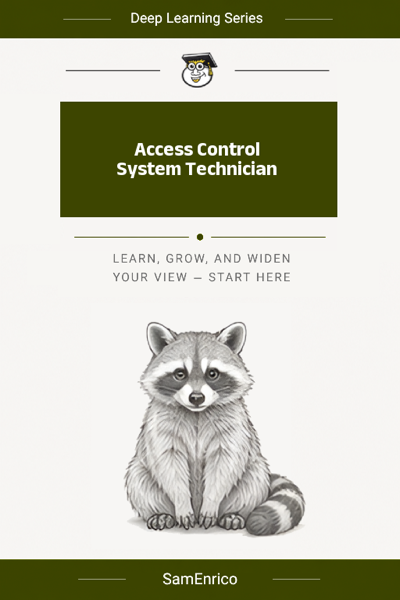
Non-FictionInformativeEducational
Access Control System Technician eBook
A Coursebook on Access Control System Technician
by Payne Marcos
A Coursebook on Access Control System Technician
Formats
Free sample
Chapter 1: The Unlocked Door...--The service call came in at 2:47 AM on a Tuesday. A regional medical center had lost access control to its entire east wing—twelve doors, including two operating suites and the pharmacy. The on-call technician arrived to find a facility manager pacing outside a locked server room, a security guard manually checking ID badges at a stairwell entrance, and three nurses frustrated that their prox cards had stopped working on the maternity ward doors. The previous technician had been there four hours earlier, declared the problem "a network issue," and left. The real problem?
A single loose neutral wire on a power supply that had been installed incorrectly eighteen months ago. That loose wire cost the hospital $14,000 in overtime labor, annoyed thirty-seven staff members, and delayed one emergency surgery by twenty-two minutes. No one was fired. But no one was promoted, either.This book exists because of that 2:47 AM service call. Not that specific call—there are thousands like it every day across the country.
But every single one of those calls shares a common root cause: someone, somewhere, didn't understand how the pieces of an access control system actually work together. They knew how to mount a reader. They knew how to terminate a wire. They knew how to add a user in the software. But they didn't know how to think about the system as a system.
And that gap between "knowing tasks" and "understanding ecosystems" is what separates a button-pusher from a true access control technician.This chapter is not about wiring diagrams or lock types or software menus. Those will come, and they will be covered in exhaustive detail in the chapters ahead. This chapter is about something more fundamental: the mental model you must build before you touch a single tool. It is about understanding what access control actually is, why it exists, who depends on it, and where your role fits into the larger security ecosystem. If you skip this chapter—or skim it while thinking "I already know this stuff"—you will become the technician who causes the next 2:47 AM service call.
Not because you are incompetent, but because you never built the conceptual framework that turns technical knowledge into professional judgment.Let us begin with a definition. Access control, despite the fancy cards, biometric scanners, and networked panels, is remarkably simple at its core. It is the selective restriction of movement through a portal. That is it. A locked door with a key is access control.
A gate with a guard is access control. A turnstile that only opens when you insert a coin is access control. The technology changes, but the fundamental question never does: Should this person be allowed to go through this opening at this moment?The three parts of that question—person, opening, moment—map directly to the three core concepts that every technician must internalize. These concepts borrow from the world of information technology, because physical access control and cybersecurity are converging faster than most technicians want to admit. The concepts are Authentication, Authorization, and Accounting.
Together, they are often called the AAA triad, and they are the skeleton upon which every access control system is built.Authentication answers the question: "Who are you?" It is the process of presenting a credential—a card, a fingerprint, a PIN, a smartphone—to a reader. The system reads the credential, extracts an identifier (typically a number), and confirms that this identifier belongs to a known user in the database. Authentication is about identity, not permission. A janitor and a CEO can both authenticate successfully; their credentials will both be read and accepted as valid. Authentication alone does not grant access.
It only says "I know who this is."Authorization answers the question: "Are you allowed?" Once the system knows who you are, it checks whether that identity has permission to pass through this specific door at this specific time. Authorization is where the security policy lives. The janitor might be authorized to enter the supply closet but not the data center. The CEO might be authorized to enter the boardroom but not the chemical storage area. Both authenticated successfully; only one is authorized for each door.
Authorization is also where schedules come into play. A shipping dock door might authorize access only between 6 AM and 6 PM on weekdays. An employee who swipes their card at 6:01 PM might authenticate successfully but will be denied because authorization fails.Accounting answers the question: "What happened?" Every time someone authenticates and every time a door opens—or tries to open—the system should record an event. Who swiped? Which reader?
At what time? Was access granted or denied? If granted, how long did the door stay unlocked? If denied, was it because of invalid credential, wrong time, or a door that was already forced open? Accounting is often treated as an afterthought in technician training, but it is actually the most valuable feature of any access control system.
Without accounting, you cannot investigate a security incident, you cannot prove compliance with regulations, and you cannot diagnose intermittent failures. The logs are your memory. Treat them accordingly.These three concepts—Authentication, Authorization, Accounting—are not just abstract ideas to be memorized for a certification exam. They are the diagnostic framework you will use when something breaks. A door won't open.
Is it an authentication problem (the reader isn't reading cards)? An authorization problem (the user's access level is wrong)? An accounting problem (the logs show the door did open, but the user says it didn't)? The AAA triad gives you a systematic way to isolate failures before you ever open a panel or pull out a multimeter. That systematic approach is what separates the technician who fixes the problem in fifteen minutes from the technician who spends four hours chasing a "network issue" that never existed.Now let us complicate things.
Because access control does not exist in a vacuum. It exists within a larger security ecosystem that includes multiple layers of protection, each with its own purpose, its own vulnerabilities, and its own interaction with the others. Understanding these layers is essential because a failure in one layer often masquerades as a failure in another.Imagine a facility as an onion. The outermost layer is the perimeter: fences, gates, walls, and the property line itself. This layer is about deterrence and delay.
A fence will not stop a determined intruder, but it will slow them down and make their intrusion more obvious. The next layer is the building envelope: exterior doors, windows, loading docks, and roof access points. This is where most access control systems do their primary work. The innermost layer is interior zones: server rooms, laboratories, executive suites, supply closets, and any other space that requires additional restriction beyond the building entry. A well-designed system uses different authentication and authorization rules at each layer.
The loading dock might require only a proximity card. The server room might require a card plus a PIN plus a fingerprint. The CEO's office might have a simple keypad because the real security is elsewhere.The technician's job is to understand how these layers interact. If you install a high-security biometric reader on…
This is the end of the free sample. Get the eBook to keep going. Buy now
About this book
Details
- Author
- Payne Marcos
- Publisher
- SamEnrico
- Language
- English
- Genre
- Non-Fiction, Informative, Educational
- Released
- 2026-06-02
- Pages (approx.)
- 116
- Available as
- eBook, Audiobook

Read better in the ZLOADR app
Your eBooks on your phone or tablet. Sign in with your SamEnrico account and start reading.
More by Payne Marcos
 Secondhand Family LifePayne Marcos$11.99
 Gratitude for FamiliesPayne Marcos$11.99
 Senior Opinion Esteem GuidePayne Marcos$11.99
 Emotional Intelligence for ManagersPayne Marcos$11.99
 The Self Esteem After Partner's BetrayalPayne Marcos$11.99
 Banksy: The Unseen Hand - How a Mysterious Artist Shaped Modern Protest ArtPayne Marcos$11.99
 How to Start a Music Directors - Independent BusinessPayne Marcos$11.99
 AMD SWOT Analysis GuidePayne Marcos$12.99
 Accounting Formulas for Exam SuccessPayne Marcos$12.99
 Understanding Myelodysplastic SyndromesPayne Marcos$17.99
You may also like
 Hong Kong Handover 1997Dunn Johnnie$11.99
 Zumba For Postnatal Recovery CourseNeal Christian$11.99
 Zumba for BeginnersLadner Nikia$11.99
 YouTube Comment Mining GuideHumes Pandora$12.99
 Worry Box MeditationCarlin Rudy$11.99
 Workplace Stress MeditationNguyen Lynn$11.99
 Workplace Stress and Sleep RepairHawley Ivory$11.99
 Workplace Perfectionism CureDelaney Jeffry$11.99
 Workplace Injustice Anger GuideWallen Isabelle$11.99
 Work Addiction and Burnout LinkGreenwood Ester$11.99
 Women in Yoga and WellnessBeattie Galina$11.99
 Women in Stand Up ComedyChun Evangeline$11.99