
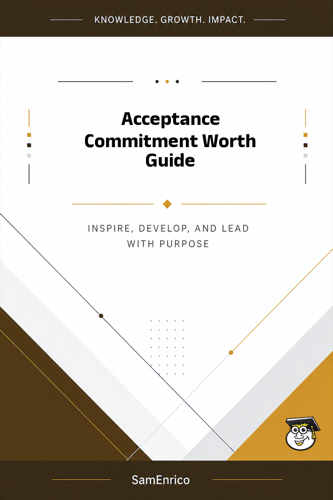
Acceptance Commitment Worth Guide eBook
Uses ACT to accept worthlessness thoughts without
Uses ACT to accept worthlessness thoughts without acting on them.
Formats
Free sample
Chapter 1: The Worthiness Chase--–- You have been running a race you were never meant to win. The finish line keeps moving. The rules keep changing. And every time you think you have finally arrived—finally feeling worthy, finally enough, finally secure in your value—the ground shifts beneath your feet. Within hours, sometimes minutes, the old familiar feeling returns.
The hollow ache in your chest. The quiet voice whispering, “Who do you think you are?” The crushing certainty that you are, at your core, not enough.This is not a personal failing. It is not evidence that you are uniquely broken or especially worthless. It is evidence that you have been given a faulty map. The map most of us receive from parents, teachers, self-help books, and culture at large says the same thing: First, fix how you feel about yourself.
Then, you can live your life. First, build self-esteem. First, eliminate the worthlessness. First, become confident. Then, and only then, can you ask for the promotion, go on the date, start the business, speak your mind, or be truly happy.This chapter is going to show you that this map is not just unhelpful.
It is actively harmful. It is the source of your exhaustion. It is the reason you have tried so hard for so long with so little lasting change. And most importantly, it is completely optional. You can put down this map at any time.
But first, you have to see it for what it is.The Hidden Assumption You Have Never Questioned Every strategy you have ever used to manage feelings of worthlessness rests on a single, unexamined assumption. Here it is, stated plainly: Uncomfortable thoughts and feelings are dangerous and must be controlled, reduced, or eliminated before I can live well.This assumption is so deeply embedded in our culture that it rarely gets spoken aloud. It is the water we swim in. From the time we are children, we learn that sadness should be cheered up, anger should be calmed down, fear should be overcome, and worthlessness should be replaced with self-esteem. We learn that good feelings are desirable and bad feelings are problems to be solved.In Acceptance and Commitment Therapy (ACT), this assumption has a name.
It is called the Control Agenda. And it is the single biggest obstacle between you and the life you want.On the surface, the Control Agenda sounds perfectly reasonable. If something hurts, you try to stop the pain. If a thought says you are worthless, you try to argue it away. If a feeling makes you want to hide, you try to distract yourself.
That is what any sensible person would do. And here is the cruel trick: the Control Agenda works beautifully for external problems. If there is a tiger in front of you, controlling the situation by running away works perfectly. If you are hungry, controlling the situation by eating works perfectly. If you are cold, putting on a coat works perfectly.But the Control Agenda catastrophically backfires when applied to internal experiences.
Why? Because you cannot run away from your own skin. You cannot fight a thought without giving it more attention. You cannot suppress a feeling without that feeling returning with greater intensity. The tools that work on the outside world do not work on the inside world.
They do the opposite.The Paradox of Escape Consider what happens when you try to escape the thought “I am worthless.” You might argue with it: “That is not true. I graduated college. I have friends. I have done good things.” For a moment, the argument seems to work. The thought quiets down.
You feel a brief sense of relief. But then, often within minutes or hours, the thought returns. And this time, it comes back with a new weapon. Now it says, “You are so worthless that you have to argue with yourself just to feel okay. A truly valuable person would not need to do that.”The argument did not eliminate the thought.
It strengthened it. It gave the thought more airtime, more energy, more importance. You fed the very monster you were trying to starve.The same pattern plays out with distraction. You feel the worthlessness rising, so you open social media. You scroll.
You watch videos. You eat something sweet. For a few minutes, you feel numb. But the moment you put down the phone or finish the snack, the worthlessness is still there. And now it has brought shame along for the ride.
“You are so worthless that you cannot even sit with your own feelings for five minutes,” the voice says. “You have to numb yourself like an addict.”The escape attempt did not work. It made everything worse.This is the paradox at the heart of human suffering. The more you try to avoid an unwanted thought or feeling, the more present and powerful it becomes. Every avoidance behavior is a teacher.
It teaches your brain that the thought or feeling is truly dangerous. It teaches your brain to scan for it more vigilantly. It teaches your brain to react more strongly when it appears.The Chinese Finger Trap: A Lesson in Letting Go There is an old toy called a Chinese finger trap. It is a small woven cylinder. You insert one finger into each end.
When you try to pull your fingers apart to escape, the trap tightens around them. The harder you pull, the tighter it grips. The more you struggle, the more trapped you become. Panic sets in. You pull harder.
It tightens more.But there is a secret to the Chinese finger trap. You do not escape by pulling away. You escape by pushing into the trap. You relax your fingers, push them closer together, and the woven cylinder loosens. Your fingers slide out effortlessly.
The trap releases you exactly when you stop fighting it and move toward it.The feeling of worthlessness is a Chinese finger trap. Your instinct—the Control Agenda—tells you to pull away, to fight, to escape, to eliminate. Every time you do that, the feeling tightens its grip. You feel more worthless. You try harder.
It tightens more. Round and round you go, exhausting yourself in a battle you cannot win because the battle itself is the problem.The solution is not what you expect. The solution is to stop pulling. To stop fighting. To, in a sense, push into the feeling—not because you like it or agree with it, but because struggling against it is what gives it power.
This is not resignation. This is not giving up. This is strategic surrender. It is the most powerful move you can make, and it is available to you right now.Why Fighting Worthlessness Makes It Stronger Let us get more precise about why the Control Agenda fails. There are three mechanisms at work, and understanding them will help you see why your past efforts have not worked.Mechanism One: Thought Suppression Rebound.
Psychologists have known for decades that trying to suppress a thought makes it more likely to return. In the famous “white bear” experiment, participants were told not to think about a…
This is the end of the free sample. Get the eBook to keep going. Buy now
About this book
Details
- Author
- Berrios Kimberely
- Publisher
- SamEnrico
- Language
- English
- Genre
- Non-Fiction, Self-Help, ACT
- Released
- 2026-06-06
- Pages (approx.)
- 141
- Available as
- eBook, Audiobook

Read better in the ZLOADR app
Your eBooks on your phone or tablet. Sign in with your SamEnrico account and start reading.
More by Berrios Kimberely
 Adaptability Stress ResilienceBerrios Kimberely$11.99
 Global Talent Migration and Political StabilityBerrios Kimberely$11.99
 Friend Suicide LossBerrios Kimberely$11.99
 The Patrick Lumumba False AccusationBerrios Kimberely$11.99
 Ibn al-Nadim: The Scholar Who Chronicled the Umayyad WarsBerrios Kimberely$11.99
 One Page Crisis Marketing ManualBerrios Kimberely$12.99
 Real Estate Title Tech GuideBerrios Kimberely$12.99
 Understanding Leukodystrophy, SudanophilicBerrios Kimberely$17.99
 How to Start a Open Air Museums Business (Beginners Guide)Berrios Kimberely$11.99
 Dachshund BreedingBerrios Kimberely$11.99
You may also like
 Acceptance Commitment Therapy PainWofford Ariel$11.99
 Senior Acceptance Commitment GuideHardy Opal$11.99
 Pain Acceptance CommitmentMireles Lane$11.99
 Acceptance Commitment Therapy GuideBeall Lessie$11.99
 Work Stress Acceptance CommitmentJefferies Angelia$11.99
 Cognitive Defusion for RageRichter Wilmer$11.99
 Acceptance Commitment GuideSchott Charline$11.99