
Non-FictionHealth & WellnessNeurochemistry
Acamprosate Guide eBook
Teaches using Campral to restore brain balance aft
Teaches using Campral to restore brain balance after detox.
Formats
Free sample
Chapter 1: The Broken Garage...--–- The first time Mark tried to stop drinking, he lasted eleven days. He endured the sweats, the shaking hands, the sleepless nights where his own heartbeat sounded like a drum corps marching through his skull. On day twelve, he felt better—clearer, even proud. He told his wife, "I think I've got it this time." Three days later, he was drunk at 10:00 AM, hiding bottles in the laundry room. He called himself weak.
His sponsor called it a moral failure. His doctor called it a return to baseline.The second time Mark tried to stop, he lasted three weeks. The withdrawal was worse. By day five, he experienced visual disturbances—shadows moving in peripheral vision that vanished when he turned his head. The anxiety was so profound that he couldn't sit still for more than thirty seconds.
He white-knuckled through it, attended ninety meetings in ninety days, and relapsed on day twenty-two after a fight with his teenage son. This time, he didn't even feel shame. He felt resignation. "My brain is broken," he told himself. "And broken things don't get fixed."Mark was wrong about the broken part.
But he was absolutely right about what was broken.For decades, the recovery community and the medical establishment told people like Mark that alcoholism was a disease of willpower, or character, or spiritual emptiness. The solution, accordingly, was more willpower, more meetings, more moral inventory. And for some people, that works. But for millions of others—people who genuinely want to stop, who have every incentive to stop, who have lost marriages, jobs, custody of children, and still cannot stop—the problem is not in their character. The problem is in their chemistry.This book is about that chemistry.
Specifically, this book is about a medication called Acamprosate (brand name Campral) that was approved by the FDA in 2004 and has been largely ignored by the general public ever since. It is not a sedative. It is not a replacement for alcohol. It does not make you sick if you drink, like Disulfiram (Antabuse). It does not block the reward of drinking, like Naltrexone.
What Acamprosate does is something far more subtle and, for many people, far more necessary: it restores the brain's chemical balance after alcohol has spent years or decades dismantling it.To understand why that matters, you need to understand what alcohol actually does to your brain—not the moral interpretation, not the spiritual interpretation, but the raw neurochemical reality. And that reality begins with two molecules you have probably never heard of: glutamate and GABA.The Neurochemistry You Never Learned in School Every thought you have, every emotion you feel, every decision you make, and every craving you experience is the product of electrical signals traveling between neurons. Those signals don't jump through empty space. They cross tiny gaps called synapses, and they are carried across those gaps by chemical messengers called neurotransmitters.Think of your brain as a massive network of roads. The cars are electrical impulses.
The neurotransmitters are the traffic signals telling the cars when to go and when to stop. Two neurotransmitters control almost all of that traffic: glutamate is the gas pedal, and GABA is the brake.Glutamate is the brain's primary excitatory neurotransmitter. When glutamate is released into a synapse, it tells the receiving neuron to fire. More glutamate means more firing, more energy, more alertness, more anxiety, more restlessness. Glutamate is why you wake up when the alarm rings.
It's why your heart races when you hear bad news. It's why you can't sleep when you're stressed. Glutamate is activation.GABA (gamma-aminobutyric acid) is the brain's primary inhibitory neurotransmitter. When GABA is released, it tells the receiving neuron to calm down, to stop firing, to rest. GABA is why you feel relaxed after a meal.
It's why deep breathing slows your heart rate. It's why alcohol—which we will discuss in a moment—makes you feel less anxious. GABA is sedation.In a healthy brain, glutamate and GABA exist in a delicate balance. When you need to be alert, glutamate rises and GABA falls. When you need to rest, GABA rises and glutamate falls.
The balance shifts constantly throughout the day, but it always returns to equilibrium. Your brain is a self-correcting machine, constantly adjusting the ratio to keep you functional.Alcohol hijacks that machine.What Alcohol Actually Does to Your Brain When you drink alcohol, the molecules cross your blood-brain barrier within minutes. Once inside, alcohol binds to GABA receptors and makes them more sensitive. In simple terms, alcohol amplifies your brain's natural brake pedal. That is why the first drink feels relaxing.
Your GABA system is being artificially boosted, and the resulting inhibition reduction is what you experience as "buzzed" or "mellow."But here is where the hijacking begins. Your brain is designed to maintain homeostasis—a stable internal environment. When you repeatedly introduce alcohol, your brain notices that GABA receptors are being artificially stimulated. It adapts by reducing its own GABA production. Why should your brain bother making GABA when alcohol is doing the job for you?
At the same time, your brain compensates for the sedation by increasing glutamate production, trying to fight through the fog and keep you alert.This adaptation happens slowly, over months or years of regular drinking. You don't notice it happening because the alcohol is still present, still artificially boosting GABA and suppressing the effects of rising glutamate. You feel normal when you drink. The problem comes when you stop.When you remove alcohol after your brain has adapted to its presence, you are left with a brain that has downregulated its own GABA production (low brakes) and upregulated its glutamate production (high gas pedal). You are, neurochemically speaking, driving a car with no brakes and a stuck accelerator.
This state is called alcohol withdrawal, and it is not merely uncomfortable—it is potentially fatal.The mild symptoms of withdrawal include anxiety, insomnia, tremors, and sweating. These are not psychological weaknesses. They are the direct result of a brain that has lost its ability to calm itself down. As withdrawal progresses, the glutamate surge can trigger seizures, hallucinations, and a condition called delirium tremens, which has a mortality rate of up to 5% even with medical treatment.This is why medically supervised detox is not optional for heavy drinkers. It is a medical necessity.But here is the part that most people—including many doctors—do not fully understand.
The acute withdrawal phase lasts about five to seven days. After that, the physical danger passes. The seizures stop. The shakes subside. The patient is discharged from detox and told, "You're through the worst of it."That is a lie.
Not an intentional lie, but a dangerous half-truth.The Kindling Effect: Why Each Withdrawal Gets Worse Mark, the man who opened this chapter, experienced something that millions of alcohol-dependent people experience but cannot explain: each withdrawal attempt was harder than the last. His first withdrawal was unpleasant. His second was brutal. If he had attempted a third, it would have been even worse. This is not subjective.
This is a well-documented neurological phenomenon called the kindling effect.Kindling was first studied in epilepsy research. Scientists observed that when…
This is the end of the free sample. Get the eBook to keep going. Buy now
About this book
Details
- Author
- Weatherly Carisa
- Publisher
- SamEnrico
- Language
- English
- Genre
- Non-Fiction, Health & Wellness, Neurochemistry
- Released
- 2026-06-06
- Pages (approx.)
- 159
- Available as
- eBook, Audiobook

Read better in the ZLOADR app
Your eBooks on your phone or tablet. Sign in with your SamEnrico account and start reading.
More by Weatherly Carisa
 Miranda Lambert Crazy Ex GirlfriendWeatherly Carisa$11.99
 Contact Lens Subscription ChurnWeatherly Carisa$11.99
 After the Fight GuideWeatherly Carisa$11.99
 Between Two Cultures MemoirWeatherly Carisa$11.99
 NASCAR Charter SystemWeatherly Carisa$11.99
 Psychosis Care Without HospitalsWeatherly Carisa$11.99
 Mamie Eisenhower First LadyWeatherly Carisa$11.99
 The Siege of Peking: The Boxer Rebellion's Last Stand (1900)Weatherly Carisa$11.99
 The Golden Hands of Teotihuacan: The Sculptors Who Built an Ancient EmpireWeatherly Carisa$11.99
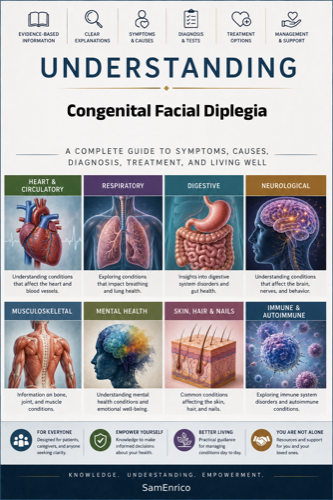 Understanding Congenital Facial DiplegiaWeatherly Carisa$11.99
 Business Credit Scoring ModelsWeatherly Carisa$12.99
 Stock Footage Channel Brand DealsWeatherly Carisa$12.99
You may also like
 Hong Kong Handover 1997Dunn Johnnie$11.99
 Zumba For Postnatal Recovery CourseNeal Christian$11.99
 Zumba for BeginnersLadner Nikia$11.99
 YouTube Comment Mining GuideHumes Pandora$12.99
 Worry Box MeditationCarlin Rudy$11.99
 Workplace Stress MeditationNguyen Lynn$11.99
 Workplace Stress and Sleep RepairHawley Ivory$11.99
 Workplace Perfectionism CureDelaney Jeffry$11.99
 Workplace Injustice Anger GuideWallen Isabelle$11.99
 Work Addiction and Burnout LinkGreenwood Ester$11.99
 Women in Yoga and WellnessBeattie Galina$11.99
 Women in Stand Up ComedyChun Evangeline$11.99