
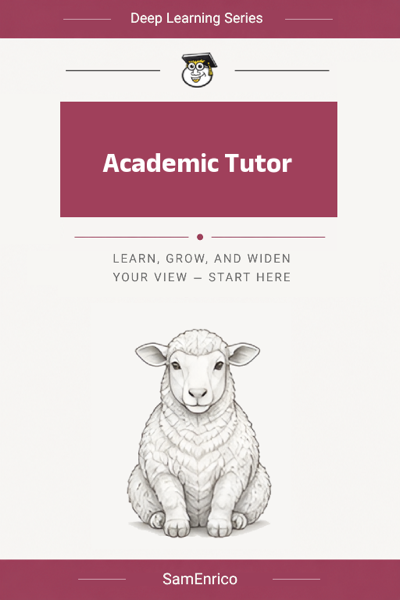
Non-FictionInformativeEducational
Academic Tutor eBook
A Coursebook on Academic Tutor
by Kroll Leigha
A Coursebook on Academic Tutor
Formats
Free sample
Chapter 1: The Expert's Curse...--– You know the material. That is exactly why you are about to fail as a tutor. Let me tell you about my first session.I was a straight-A junior in college, double majoring in mathematics and physics. My GPA was 3.94. I had tutored exactly zero human beings before, but I had helped plenty of friends who "just didn't get it" by explaining things very clearly and patiently.
Or so I believed.The session was arranged through the university's tutoring center. A freshman named Marcus was failing Calculus I. He had scored a 42 on his first midterm. The coordinator looked at my transcript, nodded approvingly, and said, "You're perfect for this."Marcus arrived ten minutes early. He sat down, pulled out a thick spiral notebook covered in red ink, and looked at me with an expression I now recognize as desperate hope.
At the time, I mistook it for readiness.I opened his textbook to the chapter on derivatives. I pointed to a problem. "Okay, let's start here. This is a simple power rule. You just bring down the exponent and subtract one.
Like this." I solved the problem in thirty seconds. "See? Easy."Marcus nodded slowly. He wrote down what I had written. He did not speak."Try the next one," I said.He stared at the page for forty-five seconds.
He wrote the first step correctly – copying the problem. Then his pencil stopped. His breathing changed – slightly faster, shallower. I did not notice this at the time.I leaned over. "You just do the same thing.
Bring down the exponent. Three times x squared. Right?"He wrote "3x²" and then stopped again."Now subtract one from the exponent," I said, pointing. "So it becomes 3x¹, which is just 3x."He wrote "3x." Then he looked at the next line of the problem – which required him to do something with the constant term – and his pencil hovered.I sighed. Not a big sigh.
A tiny one. A "come on, this is easy" sigh that lasted maybe half a second. I do not remember sighing. He remembers it perfectly. He told me two years later."The constant term," I said, "just goes to zero.
Derive of a constant is zero. So the final answer is 3x."He wrote "3x." He did not ask why a constant becomes zero. He did not ask why we were subtracting one from the exponent. He did not ask anything. He just copied.We did this for forty-five minutes.
I solved problem after problem, explaining each step with what I believed was crystal clarity. Marcus copied my work onto his notebook. Every few minutes, I would ask, "Does that make sense?" And every time, he would nod and say, "Yeah, I think so."At the end of the session, I gave him a practice problem to do on his own. "Try this one before next time. It's just like the ones we did."He took the paper, folded it carefully, and put it in his backpack.
"Thanks," he said. "This really helped."He walked out. I closed the door, leaned back in my chair, and thought: I am going to be very good at this.Three days later, the tutoring center coordinator called me. "Marcus withdrew from the course," she said. "He said tutoring made him feel worse.
He said he left your session crying in the stairwell and didn't come back."I sat in silence for a long time.I had not seen him cry. I had not heard his breathing change. I had not noticed that his "yeah, I think so" was the response of a student who had learned, from years of schooling, that the fastest way to end the discomfort of not understanding was to pretend to understand. I had not realized that my explanations – which felt so clear to me – were incomprehensible to him because I was skipping steps that I did not even know existed.I had the curse of knowledge. And I had no idea.The Curse You Didn't Know You Had The curse of knowledge is a cognitive bias discovered by economists Colin Camerer, George Loewenstein, and Martin Weber in 1989.
In their experiments, people who knew the answer to a problem could not imagine what it was like not to know the answer. They consistently overestimated how easy the problem would be for others. Once you know something, you cannot unknow it. And more dangerously, you cannot remember what it felt like to be confused.This is not a character flaw. It is a feature of how human brains work.
When you master a skill – solving quadratic equations, writing a thesis statement, balancing chemical reactions – your brain compresses the steps. What once required conscious effort becomes automatic. The intermediate steps disappear from your awareness. You see the problem and the answer appears, with nothing in between.When you try to teach that skill to someone else, you naturally skip the steps you no longer see. You say "it's obvious" or "you just do it" or – most damningly – you say nothing at all because you assume the student can see what you see.They cannot.The curse of knowledge is the single biggest predictor of tutoring failure.
It explains why high-achieving students make terrible tutors until they learn to compensate. It explains why Marcus left my session crying. It explains why millions of homework arguments between parents and children end in tears and slammed doors.And it is the reason this book exists.What This Chapter Will Teach You By the end of this chapter, you will:Understand exactly why content expertise is necessary but insufficient for effective tutoring Learn the Three Pillars Framework that replaces the "expert myth" with a sustainable model of tutoring Complete a diagnostic activity that reveals your own curse-of-knowledge blind spots Leave with a concrete First Session Blueprint that prevents the disasters I experienced with Marcus Understand the core methodology of this entire book: Read, Practice, Reflect, Apply But first, we need to dismantle something you probably believe.The Expert Myth: Why Being Smart Isn't Enough Here is a dangerous belief that almost every new tutor holds: I understand this subject well. Therefore, I can teach it to others.This is false. It is not partially false or true under certain conditions.
It is completely, demonstrably false.Consider the research. In a 2014 study published in the Journal of Experimental Psychology, researchers asked expert chess players to teach a simple chess strategy to novices. The experts were given exactly the same instructional materials. The only difference was how well the experts remembered being a beginner. The experts who had learned chess more recently – and therefore still had some memory of confusion – produced significantly better student outcomes than the lifelong experts who had forgotten what it felt like to learn.Your expertise is actually working against you.
The longer you have known something, the harder it becomes to explain it to a beginner.Think about the last time you heard a professional explain something in their field. The doctor who says "you have a slight arrhythmia" as if that explains anything. The mechanic who says "your alternator is failing" as if everyone…
This is the end of the free sample. Get the eBook to keep going. Buy now
About this book
Details
- Author
- Kroll Leigha
- Publisher
- SamEnrico
- Language
- English
- Genre
- Non-Fiction, Informative, Educational
- Released
- 2026-05-18
- Pages (approx.)
- 159
- Available as
- eBook, Audiobook

Read better in the ZLOADR app
Your eBooks on your phone or tablet. Sign in with your SamEnrico account and start reading.
More by Kroll Leigha
 Anger Journal for EmployeesKroll Leigha$11.99
 Wrecks Submarine ArchaeologyKroll Leigha$11.99
 Forgiving Parents For DivorceKroll Leigha$11.99
 Overcoming Workaholism HandbookKroll Leigha$11.99
 The Being Chased Dream GuideKroll Leigha$11.99
 The Ghosts of Actium: Cleopatra’s Last StandKroll Leigha$11.99
 Desk Based Nervous System RegulationKroll Leigha$12.99
 Tanzania Cooperative GuideKroll Leigha$12.99
 How to Start a Churns Made of Iron or Steel Business (Beginners Guide)Kroll Leigha$11.99
 Understanding Split Hand Split Foot X LinkedKroll Leigha$17.99
You may also like
 Hong Kong Handover 1997Dunn Johnnie$11.99
 Zumba For Postnatal Recovery CourseNeal Christian$11.99
 Zumba for BeginnersLadner Nikia$11.99
 YouTube Comment Mining GuideHumes Pandora$12.99
 Worry Box MeditationCarlin Rudy$11.99
 Workplace Stress MeditationNguyen Lynn$11.99
 Workplace Stress and Sleep RepairHawley Ivory$11.99
 Workplace Perfectionism CureDelaney Jeffry$11.99
 Workplace Injustice Anger GuideWallen Isabelle$11.99
 Work Addiction and Burnout LinkGreenwood Ester$11.99
 Women in Yoga and WellnessBeattie Galina$11.99
 Women in Stand Up ComedyChun Evangeline$11.99