
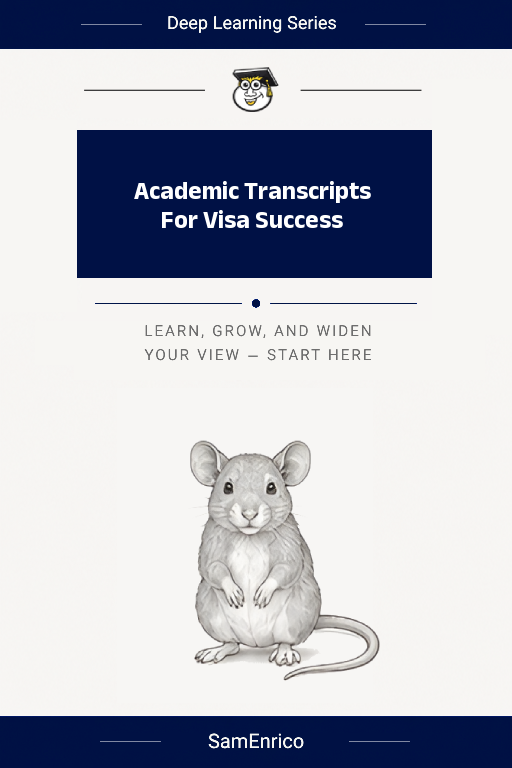
Academic Transcripts For Visa Success eBook
Organize sealed transcripts and explain any gaps o
by Shafer Bell
Organize sealed transcripts and explain any gaps or low grades before the visa officer asks.
Formats
Free sample
Chapter 1: The 5-Second Judgment--The moment your transcript lands on the visa officer's desk, you have already lost—or won—before you speak a single word.This is not hyperbole. This is not fear-mongering. This is the operational reality of every student visa processing center in the world, from a Canadian visa office in New Delhi to a US consulate in Lagos to an Australian embassy in Manila. Visa officers are trained to identify risk patterns in documents before they read a single sentence of explanation. And the most dangerous pattern of all lives inside a file you probably thought was nothing more than a historical record: your academic transcript.Most applicants approach their transcript the way they approach a high school yearbook—as a static document that simply records what happened.
"These are my grades," they think. "I cannot change the past. The officer will see them and decide." This passive mindset is the single most expensive mistake in the study visa application process. It has cost thousands of students their dreams, their tuition deposits, their years of preparation, and their non-refundable application fees.Here is what those rejected students never understood: the visa officer is not a historian. The officer is a forecaster.
Your transcript is not a report card of your past. It is a crystal ball the officer uses to predict your future behavior—specifically, whether you will violate immigration laws by working illegally, overstaying your visa, or failing to pursue genuine studies. And like any forecaster, the officer makes predictions based on patterns. When your transcript contains unexplained red flags, the officer predicts failure. When your transcript shows a clear upward trajectory with honest explanations, the officer predicts success.This chapter will transform how you see your transcript.
You will learn the legal foundation that allows officers to reject applicants with acceptance letters. You will understand the psychological differences between US, Canadian, UK, and Australian visa officers. And you will discover the "5-Second Rule"—the single most important concept in this entire book—which explains why your explanation must reach the officer's eyes before your bad grades do.By the end of this chapter, you will never look at your transcript the same way again. You will see it not as a wound to hide but as a weapon to wield.The Bona Fide Student Test: Why an Acceptance Letter Is Not Enough Imagine you have done everything right. You studied for months and passed the IELTS with a 7.5.
You researched universities and received an acceptance letter from a respected institution. You saved money, showed bank statements, paid your tuition deposit. You have followed every rule, checked every box, submitted every document.Then the visa officer writes a single sentence: "Refused. Low previous academic history casts doubt on bona fides."You read it again. "Bona fides." You look it up.
It means "good faith" or "genuine intent." The officer has determined that you are not a genuine student—even though a real university accepted you. How is this possible?The answer lies in the legal framework that governs student visas in every major English-speaking destination. In Canada, the relevant provision is R216(1)(b) of the Immigration and Refugee Protection Regulations, which requires an officer to be satisfied that the applicant "will leave Canada by the end of the period authorized for their stay." But the courts have interpreted this to mean more than just intent to leave. It also requires the officer to assess whether the applicant is a "bona fide student"—someone who has the academic capability and genuine intention to pursue their stated course of study.In the United States, the equivalent standard comes from INA 214(b) , which creates a presumption that every visa applicant is an intending immigrant unless proven otherwise. For student visas (F-1), the applicant must overcome this presumption by demonstrating both non-immigrant intent and academic capability.
A low GPA or a pattern of academic struggles can be used by the officer to conclude that you are not a genuine student—that your real intention is to work or immigrate, not to study.In the United Kingdom, the Immigration Rules Appendix Student requires the officer to assess whether the applicant is a "genuine student." The Home Office guidance explicitly instructs officers to consider "the applicant's academic progression, including any gaps or discrepancies in their study history." Low grades alone are not automatic grounds for refusal, but unexplained low grades in core subjects are.In Australia, the Genuine Student Test (GST) replaced the old Genuine Temporary Entrant (GTE) requirement in 2024. Under the GST, officers must assess whether the applicant is likely to be a "genuine student" based on their academic history, career progression, and ties to their home country. A transcript showing declining grades or repeated failures is a significant negative factor.Here is what these laws mean for you, stripped of legal jargon: A university acceptance letter proves that an institution wants your tuition money. It does not prove that you will succeed academically or that you will follow immigration laws. The visa officer is the gatekeeper who decides whether your past performance predicts future compliance.This is not an unfair system.
It is a logical system. Universities are in the business of education; they have financial incentives to accept students. Visa officers are in the business of immigration enforcement; they have legal obligations to refuse applicants who present risk. The two roles conflict by design. Your job is not to complain about this conflict.
Your job is to navigate it.The Three Embassies: Different Psychologies, Same Scrutiny One of the most common mistakes applicants make is assuming that all visa officers think the same way. They do not. The national culture, legal framework, and institutional incentives of each country create distinct officer psychologies. Understanding these differences will help you tailor your transcript defense to your destination.United States: The Intent Officer The US visa officer's primary concern is non-immigrant intent. The legal presumption under INA 214(b) is that every applicant intends to immigrate.
To obtain an F-1 student visa, you must overcome this presumption by demonstrating strong ties to your home country—family, property, employment, or other obligations that will bring you back.How does your transcript fit into this? Indirectly, but powerfully. A weak transcript can be used by the officer to support an inference that you are not a genuine student. The logic goes: "If this applicant were truly serious about studying in the US, they would have performed better in their previous studies. Their low grades suggest their real intention is not academic success but immigration." This is not always fair, but it is how officers are trained to think.For US applicants, your transcript defense must be paired with a strong home-ties argument.
You cannot simply say "my grades improved." You must say "my grades improved because I became committed to a specific career path that requires a US degree, and I will return home to pursue that career because [specific reason]."Canada and the United Kingdom: The Capability Officer Canadian and UK officers operate under a different legal framework. While both consider intent to leave, their primary focus is on academic capability and career progression. The…
This is the end of the free sample. Get the eBook to keep going. Buy now
About this book
Details
- Author
- Shafer Bell
- Publisher
- SamEnrico
- Language
- English
- Genre
- Non-Fiction, Student's Shortcut
- Released
- 2026-06-01
- Pages (approx.)
- 141
- Available as
- eBook, Audiobook

Read better in the ZLOADR app
Your eBooks on your phone or tablet. Sign in with your SamEnrico account and start reading.
More by Shafer Bell
 Confronting Medical Error With DoctorShafer Bell$11.99
 Performance Hypnosis ScriptsShafer Bell$11.99
 Respiratory Muscle Training for Rib PainShafer Bell$11.99
 The Time Blocking Tool KitShafer Bell$11.99
 IBS Intimacy Relationship GuideShafer Bell$11.99
 Persuasion For Sales GuideShafer Bell$11.99
 Slack and Chat Interruption Fix WorkbookShafer Bell$11.99
 The Side Hustle Network GuideShafer Bell$11.99
 Therapy for Chronic RageShafer Bell$11.99
 The Shaking Earth: Aboriginal Seismology and the First Global Quake RecordsShafer Bell$11.99
 The Sagas of the North: Viking Wisdom and the Birth of Scandinavian PhilosophyShafer Bell$11.99
 The Poker King Who Built a Tech Empire: How a Gambler Outplayed Silicon ValleyShafer Bell$11.99
You may also like
 Hong Kong Handover 1997Dunn Johnnie$11.99
 Zumba For Postnatal Recovery CourseNeal Christian$11.99
 Zumba for BeginnersLadner Nikia$11.99
 YouTube Comment Mining GuideHumes Pandora$12.99
 Worry Box MeditationCarlin Rudy$11.99
 Workplace Stress MeditationNguyen Lynn$11.99
 Workplace Stress and Sleep RepairHawley Ivory$11.99
 Workplace Perfectionism CureDelaney Jeffry$11.99
 Workplace Injustice Anger GuideWallen Isabelle$11.99
 Work Addiction and Burnout LinkGreenwood Ester$11.99
 Women in Yoga and WellnessBeattie Galina$11.99
 Women in Stand Up ComedyChun Evangeline$11.99