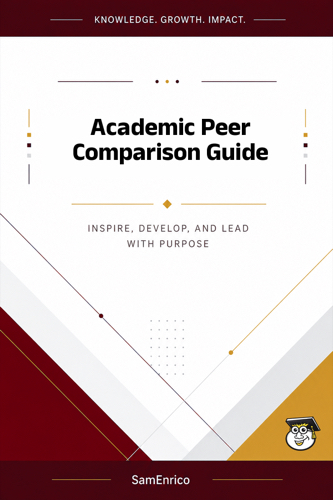
Academic Peer Comparison Guide Audiobook
Stop feeling less intelligent after seeing classma
by Bell Leo
Stop feeling less intelligent after seeing classmates' achievements posted online.
Formats
Free sample
Chapter 1: The Fossil Reflex--–- The first time Alex felt stupid in public, it wasn’t because of a grade. It was the spring of sophomore year, in a fluorescent-lit study lounge, when a classmate named Priya casually mentioned that her summer research proposal had just been funded. Priya wasn’t bragging. She was exhausted, barely looking up from her laptop. But within three seconds, Alex’s stomach tightened, his jaw clenched, and a voice inside whispered: You should have applied for that.
You’re falling behind. Everyone else is figuring it out except you.Alex had just scored an 87% on an organic chemistry exam—a solid B+, perfectly respectable. But the B+ no longer existed. In the theater of his mind, only Priya’s funded proposal remained, lit up like a billboard advertising his own inadequacy. He spent the next hour scrolling Linked In, where another peer had posted about a “humbling experience” at a neurology lab, and a third had shared a photo of an acceptance letter for a study abroad program.
Each post was a small hammer. By midnight, Alex felt intellectually hollow.This book is not for people who never feel insecure. It is for people who feel insecure despite abundant evidence that they are intelligent, hardworking, and capable. And the first thing you need to understand—the foundational truth upon which every subsequent chapter rests—is that this feeling is not a character flaw. It is not low self-esteem.
It is not weakness. It is a fossil reflex, a biological survival mechanism that evolved in a world that no longer exists.You are not broken. Your brain is just doing its ancient job in a modern environment it never evolved to handle.The Default Mode Network: Your Brain’s Ancient Radar To understand why a peer’s internship post can trigger a full-body emotional collapse, you have to go back roughly two hundred thousand years. The human brain evolved on the savannas of Africa, where survival depended on accurate social ranking. Who is faster?
Who knows where the water is? Who has favor with the group leader? Answering these questions correctly meant food, safety, mating opportunities, and protection from predators. Answering them incorrectly meant ostracism, starvation, or death.The neural machinery that performs this social calculus is called the default mode network (DMN). The DMN is a connected set of brain regions—including the medial prefrontal cortex…
This is the end of the free sample. Get the Audiobook to keep going. Buy now
About this book
Details
- Author
- Bell Leo
- Publisher
- SamEnrico
- Language
- English
- Genre
- Non-Fiction, Self-Help, Academic Anxiety
- Released
- 2026-06-11
- Pages (approx.)
- 130
- Available as
- eBook, Audiobook

Listen in the VoxFlicks app
Audiobooks and audio dramas wherever you go. Sign in with your SamEnrico account and press play.
More by Bell Leo
 Academic Comparison OnlineBell Leo$11.99
 Parental Control Gaming LimitsBell Leo$11.99
 Children's Trauma NightmaresBell Leo$11.99
 The Incest Survivor Worth GuideBell Leo$11.99
 Grit Cheat SheetBell Leo$11.99
 The Typhoid Vaccine GuideBell Leo$11.99
 Air Traffic Controller StressBell Leo$11.99
 The Plague Doctors of Florence: Renaissance Medicine's Dark TriumphBell Leo$11.99
 Imposter Syndrome For MusiciansBell Leo$11.99
 Whispers in the Quilt Codes: The Secret Language of FreedomBell Leo$11.99
 Sisters in the Shadows: The Untold Story of the 1963 Birmingham Sit-InsBell Leo$11.99
 How to Start a Hobby in Car RacingBell Leo$11.99