
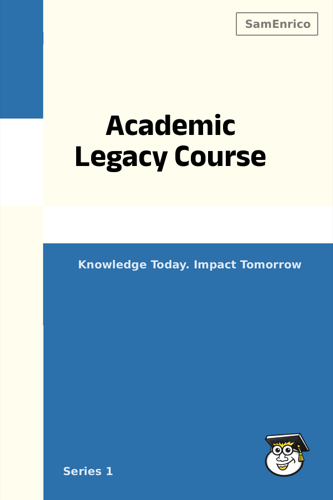
Academic Legacy Course eBook
Publishes research, mentors students, or endows sc
by Gagne See
Publishes research, mentors students, or endows scholarships.
Formats
Free sample
Chapter 1: The Obituary Test--What would your department write about you if you died tomorrow? Not the official obituary—the sanitized one drafted by the communications office that lists your degrees, your publications, and your service on three committees. The real one. The one whispered in hallways and typed in late-night emails between colleagues who actually knew you. Would it say, “She had an H-index of 32 and secured two NSF grants”?
Or would it say, “She was the reason six first-generation students finished their doctorates. She started a small fund that still sends graduate students to conferences fifteen years later. Her methods outlived her because she trained people who trained people”?This book is not about getting tenure. It is not about increasing your citation count by seventeen percent or landing a keynote at the flagship conference. Those are transactional victories.
They expire. This book is about building something that survives your retirement, your memory loss, or your death—something that breathes without you. It is about becoming the kind of scholar whose influence grows in the decade after they stop publishing, not the kind whose name vanishes from citation lists within three years of their last paper.Let me tell you about two scholars. I will call the first one Robert. Robert was brilliant by every conventional metric.
He published twenty-seven peer-reviewed articles between ages thirty-five and fifty-five, including four in the field’s top journal. His H-index peaked at forty-one. He secured over three million dollars in grant funding. When Robert died of a heart attack at sixty-two, his department held a memorial. People spoke kindly.
They mentioned his meticulous data collection and his sharp questions at colloquia. Then the memorial ended. Within eighteen months, no one cited Robert’s work anymore. Why? Because his methods were complex and poorly documented.
His data disappeared into a hard drive that his family threw away. He mentored twelve doctoral students, but he treated them as research assistants rather than as future carriers of his intellectual flame. They graduated, scattered, and never spoke of him again. Robert built a career. He did not build a legacy.The second scholar I will call Patricia.
Patricia published fewer papers than Robert—only fourteen. Her H-index peaked at nineteen, which is respectable but not star-level. She never secured a grant larger than one hundred thousand dollars. But Patricia did something Robert never understood. She treated every graduate student as a potential node in a network that would outlast her.
She insisted that her Ph.D. students learn not just her methods but also how to teach those methods to others. She took one hundred dollars from every small grant she received and put it into a coffee can labeled “Future Scholars Fund.” By the time she retired, that coffee can had grown into a properly endowed, university-managed scholarship fund of sixty thousand dollars—enough to send one graduate student to a conference every year in perpetuity. Patricia died at seventy-eight. Five years after her death, her former students had produced forty-three publications citing her methods.
Two of her academic grandchildren had started similar scholarship funds in her honor. Her name appears on a small plaque in the department lounge, but more importantly, it appears in the acknowledgments of dissertations written by people who never met her.This book is the Patricia method. And it begins with a single, uncomfortable exercise: the Obituary Test.The Premise: You Cannot Build What You Cannot Imagine The premise is simple. You cannot build a legacy if you do not know what you want it to look like. Most academics stumble into legacy accidentally—or, more commonly, they do not stumble into it at all.
They assume that if they publish enough, teach well enough, and serve on enough committees, some vague immortality will follow. It will not. Universities are machines designed to forget. They remember buildings, endowed chairs, and the occasional textbook that survives a curriculum change. They do not remember your teaching evaluations or the year you chaired the graduate admissions committee.
Legacy requires intentionality. It requires you to write the obituary you want, then work backward to make it true.So here is your first exercise. Take out a blank document. At the top, write “Obituary for [Your Name] – 2045.” Then write one paragraph describing what the academic world will say about you twenty years from now. But here is the constraint: you cannot mention your publication count, your grant dollars, your awards, or your administrative titles.
You can only mention three things: the impact of your students, the survival of your research methods, and the scholarships or funds you seeded. If you cannot write that paragraph, you have no legacy plan. And if you have no legacy plan, you are Robert, not Patricia.I have watched hundreds of academics perform this exercise in workshops. The results are always the same. Junior faculty panic because they have not thought beyond tenure.
Mid-career faculty freeze because they realize their career has been a series of reactive decisions rather than a strategic arc. Senior faculty weep—literally weep—because they see the gap between the obituary they want and the one their current trajectory will produce. Do not let that be you. Let that be fuel.Why Traditional Metrics Lie to You You will notice that the obituary exercise prohibits you from mentioning traditional metrics. That is deliberate.
The academic measurement system is optimized for a world that no longer exists—a world in which universities were stable, publications were scarce, and a scholar’s influence could be measured by counting library holdings. That world is gone. In its place is a hyper-competitive, metrics-obsessed, short-termist culture that rewards volume over substance and individual achievement over collective impact. The system is not designed to help you build a legacy. It is designed to extract your labor and discard you.
If you want a legacy, you must build it yourself, often in opposition to the incentives around you.Consider the half-life of a typical academic publication. A 2019 study in PLOS ONE examined citation patterns across forty-five disciplines and found that the median citation half-life for peer-reviewed articles is just four to seven years, depending on the field. In the natural sciences, half of all citations to a given paper occur within the first five years after publication. In the social sciences, it is slightly longer—around seven years. By year fifteen, the typical paper is cited less than once annually.
By year twenty, it is functionally dead. This means that the vast majority of what you publish will be forgotten within a single presidential administration. That is not a legacy. That is a rental agreement.But here is the counterintuitive finding from the same study: a small minority of papers—about five percent—continue to accumulate citations for decades. These are not always the papers published in the highest-impact journals.
They are not always the papers with the flashiest findings. Instead, they tend to share three characteristics. First, they are synthetic rather than novel—review articles, meta-analyses, methodological primers, and theoretical integrations. Second, they are attached to open data or open-source tools that other scholars depend on. Third, they are written in a…
This is the end of the free sample. Get the eBook to keep going. Buy now
About this book
Details
- Author
- Gagne See
- Publisher
- SamEnrico
- Language
- English
- Genre
- Non-Fiction, Self-Help, Academia
- Released
- 2026-06-12
- Pages (approx.)
- 151
- Available as
- eBook, Audiobook

Read better in the ZLOADR app
Your eBooks on your phone or tablet. Sign in with your SamEnrico account and start reading.
More by Gagne See
 Affirmation Group PracticeGagne See$11.99
 The ED Vascular Causes GuideGagne See$11.99
 Overcoming Procrastination AnxietyGagne See$11.99
 Malaysian Business GuideGagne See$11.99
 Codebreaker's Gambit: The Anonymous Architect of BitcoinGagne See$11.99
 Information Systems Security OfficerGagne See$11.99
 BOP Water Product GuideGagne See$12.99
 Anticipating Promotion ObjectionsGagne See$12.99
 Understanding Vacuolar MyopathyGagne See$17.99
 How to Become a Lock-corner-machine OperatorGagne See$11.99
You may also like
 Hong Kong Handover 1997Dunn Johnnie$11.99
 Zumba For Postnatal Recovery CourseNeal Christian$11.99
 Zumba for BeginnersLadner Nikia$11.99
 YouTube Comment Mining GuideHumes Pandora$12.99
 Worry Box MeditationCarlin Rudy$11.99
 Workplace Stress MeditationNguyen Lynn$11.99
 Workplace Stress and Sleep RepairHawley Ivory$11.99
 Workplace Perfectionism CureDelaney Jeffry$11.99
 Workplace Injustice Anger GuideWallen Isabelle$11.99
 Work Addiction and Burnout LinkGreenwood Ester$11.99
 Women in Yoga and WellnessBeattie Galina$11.99
 Women in Stand Up ComedyChun Evangeline$11.99