
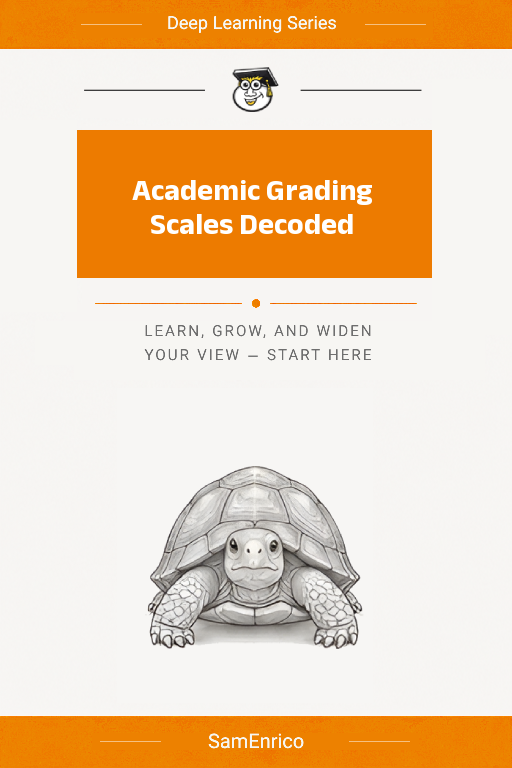
Academic Grading Scales Decoded eBook
Convert UK classification, US GPA, and Australian
by Gooch Shyla
Convert UK classification, US GPA, and Australian WAM grades for job applications, understanding what constitutes a first class or honors degree.
Formats
Free sample
Chapter 1: The 68% Lie--You have been lied to about your grades. Not by your professors, not by your university, and not by your parents. The lie is older and more insidious than any single person or institution. It is the unspoken assumption that a number on a piece of paper means the same thing everywhere in the world. That assumption is wrong, and it is costing you job opportunities, graduate school admissions, and professional credibility.Consider this.
A student in London refreshes their final exam results and sees a 68 percent. Their heart sinks. They were aiming for a First Class degree, but 68 percent is an Upper Second, a 2:1. Still respectable, they think, but not the top tier. Halfway across the world, a student in Sydney sees the same number: 68 percent.
Their heart leaps. That is a Distinction, comfortably above a Credit, putting them in the top twenty percent of their cohort. Meanwhile, a student in Chicago opens their transcript, sees 68 percent, and their stomach drops. That is a D plus. Depending on their major, they may be on academic probation or required to retake the course.Three students.
Three different countries. Three completely different emotional reactions. One number: 68. This is not a glitch in the matrix. This is the fundamental reality of international grading systems, and it is the first thing you must understand if you want to succeed in the global job market.Welcome to Academic Grading Scales Decoded.
This book exists because the world has become smaller, but the transcripts have not. Every year, over six million students study outside their home country. Millions more graduate from domestic universities and apply for jobs abroad. They all face the same brutal realization: recruiters do not understand their grades.The London student with a 68 percent applies for a job in New York. The recruiter sees “68%” and assumes it is a low C or high D.
The resume goes in the rejection pile. The Sydney student with the same 68 percent applies for a consulting role in London. The British recruiter has never heard of a Weighted Average Mark. They see “68” and assume it is a middling score, not the top-tier Distinction it actually represents. The Chicago student with the D plus applies for a graduate program in Melbourne.
The Australian admissions officer converts the US GPA using an outdated online calculator and rejects the application without understanding that the student was in a grade-deflating program at a rigorous institution.These are not hypothetical scenarios. They happen every single day. And they happen because the people evaluating your grades are not malicious. They are simply busy, overworked, and trained to recognize only the system they grew up with. A British recruiter knows that 70 percent is a First.
They have no idea that an Australian 68 is a Distinction. An American recruiter knows that 3.5 is a good GPA. They have no idea that a British 2:1 is a remarkable achievement. Your job is not to complain about this unfairness. Your job is to fix it.The Core Problem: Different Philosophies, Different Numbers The confusion begins with a simple question that has a complex answer: what does a percentage actually measure?
In the United Kingdom, a percentage measures how close you came to perfection on an exam that was designed to be nearly impossible to perfect. British examiners start from the assumption that a score of 70 percent represents excellence. Scores above 80 percent are rare enough that they are often considered “publication quality.” Scores above 90 percent are almost unheard of, except in mathematics or highly structured disciplines. This is not because British students are worse at taking exams. It is because British exams are designed differently.
They are longer, harder, and graded more stringently. A question that asks you to “critically evaluate” is not looking for a right answer. It is looking for a nuanced argument that engages with contradictory evidence. Even the best students will drop points because there is always room for improvement.In the United States, the philosophical assumption is almost the opposite. An American percentage typically measures how much of the material you have mastered.
A score of 90 to 100 percent is an A, meaning excellent. Eighty to 89 percent is a B, meaning good. Seventy to 79 percent is a C, meaning average. Sixty to 69 percent is a D, meaning poor but passing. Below 60 percent is an F, meaning failing.
These thresholds are so deeply embedded in American education that they appear in student handbooks, course syllabi, and even state laws governing high school graduation. An American student who scores 68 percent on an exam does not celebrate. They worry about their GPA dropping below 2.0.Australia takes a third path. The Weighted Average Mark, or WAM, is a percentage that averages all of your subjects, weighted by credit points. But the meaning of each band is different from both the UK and the US.
An Australian score of 85 percent or above is a High Distinction, meaning outstanding. Seventy-five to 84 percent is a Distinction, meaning excellent. Sixty-five to 74 percent is a Credit, meaning good. Fifty to 64 percent is a Pass, meaning satisfactory. Scores below 50 percent are failing.
Notice the difference. An Australian 68 is a solid Distinction, just seven points below the High Distinction threshold. An Australian 68 is a grade that would make most students reasonably happy. The same number in the UK is a 2:1, not a First, but still a strong performance. The same number in the US is a D plus, a grade that triggers academic warnings.This is not a matter of one country being “right” or “wrong.” It is a matter of different educational traditions, different exam designs, and different cultural expectations about what grades are for.
The British system treats grades as a measure of near-perfection in a challenging environment. The American system treats grades as a measure of mastery against a fixed standard. The Australian system treats grades as a weighted average that rewards consistency across an entire degree. All three approaches are internally coherent. They only become incoherent when you try to compare them without translation.The 2025–2026 Job Market: Why Translation Is No Longer Optional If you graduated twenty years ago, you might have gotten away with submitting your transcript as-is and hoping for the best.
The global job market was smaller, competition was less intense, and recruiters had more time to scrutinize individual applications. That world is gone. The 2025–2026 job market is defined by speed, automation, and volume. A single job posting at a company like Google, Mc Kinsey, or Unilever can receive ten thousand applications. No human being reads all of them.
Instead, your resume is processed by an Applicant Tracking System, or ATS, which scans for keywords, numbers, and formatting before deciding whether to pass your application to a human recruiter.These ATS systems are not designed to understand international grading nuances. They are programmed to recognize specific strings of text. An American ATS might look for “GPA 3.5” or “cum laude.” A British ATS might look for “First Class Honours” or “2:1.” An Australian ATS might look for “WAM 75” or “Distinction average.” If your resume contains the wrong format, the ATS will simply reject you. It does not know that your “68% (UK)” is equivalent to a US…
This is the end of the free sample. Get the eBook to keep going. Buy now
About this book
Details
- Author
- Gooch Shyla
- Publisher
- SamEnrico
- Language
- English
- Genre
- Non-Fiction, Student's Shortcut
- Released
- 2026-05-30
- Pages (approx.)
- 134
- Available as
- eBook, Audiobook

Read better in the ZLOADR app
Your eBooks on your phone or tablet. Sign in with your SamEnrico account and start reading.
More by Gooch Shyla
 Parenting With PurposeGooch Shyla$11.99
 Lung Cancer Screening and CessationGooch Shyla$11.99
 Design Thinking for Grant WritingGooch Shyla$11.99
 Radical Candor GuideGooch Shyla$11.99
 Call Center Night ShiftGooch Shyla$11.99
 The Step Eight List GuideGooch Shyla$11.99
 Teen Parent Time ManagementGooch Shyla$11.99
 NVC Empathy Buddy SystemGooch Shyla$11.99
 The Siege of Perekop: The Cossacks' Last Stand Against the TsarGooch Shyla$11.99
 Rebuilding Paradise: The Social Media Architect Who Redesigned ChristchurchGooch Shyla$11.99
 A Collector's Handbook to the Hotchkiss Am2Gooch Shyla$11.99
 Portfolio Career for Semi RetirementGooch Shyla$12.99
You may also like
 Hong Kong Handover 1997Dunn Johnnie$11.99
 Zumba For Postnatal Recovery CourseNeal Christian$11.99
 Zumba for BeginnersLadner Nikia$11.99
 YouTube Comment Mining GuideHumes Pandora$12.99
 Worry Box MeditationCarlin Rudy$11.99
 Workplace Stress MeditationNguyen Lynn$11.99
 Workplace Stress and Sleep RepairHawley Ivory$11.99
 Workplace Perfectionism CureDelaney Jeffry$11.99
 Workplace Injustice Anger GuideWallen Isabelle$11.99
 Work Addiction and Burnout LinkGreenwood Ester$11.99
 Women in Yoga and WellnessBeattie Galina$11.99
 Women in Stand Up ComedyChun Evangeline$11.99