
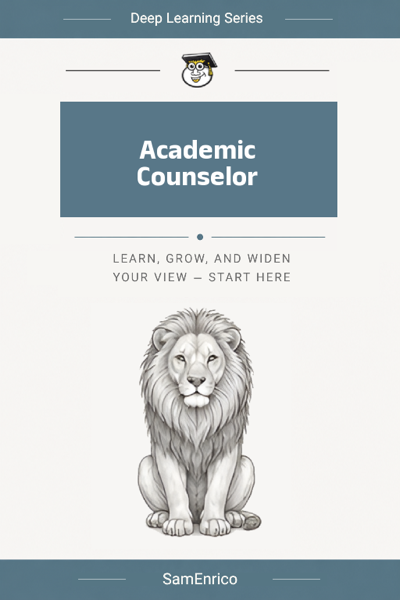
Non-FictionInformativeEducational
Academic Counselor eBook
A Coursebook on Academic Counselor
A Coursebook on Academic Counselor
Formats
Free sample
Chapter 1: The Quiet Crisis...--The academic counselor sits at a cluttered desk in a windowless office, surrounded by filing cabinets that predate the students they serve. On the computer screen, a blinking cursor waits next to a student’s name—Maria, nineteen years old, undeclared major, currently on academic probation. The counselor has fifteen minutes before her next appointment. She has 347 other students in her caseload. Somewhere in the building, a set of parents is demanding to see their son’s grades.
A professor has just emailed asking why a student wasn’t flagged earlier for missing six consecutive classes. And Maria, the student on the screen, hasn’t responded to three outreach emails.This is the quiet crisis of academic counseling in the twenty-first century.For most of the public, the image of a school counselor or academic advisor comes from outdated television shows or high school career days—a kindly figure handing out college brochures, fixing a schedule conflict, or writing a letter of recommendation. But the reality of the profession, as practiced by hundreds of thousands of professionals across K-12 schools, community colleges, and universities, bears almost no resemblance to this caricature. The modern academic counselor is expected to be a retention specialist, a mental health first responder, a data analyst, a financial aid interpreter, a career coach, a compliance officer, and, increasingly, a surrogate parent to students who have no one else to turn to.And yet, despite these expanding responsibilities, the foundational training for academic counselors remains fragmented, inconsistent, and often entirely missing. Most enter the profession through side doors—a master’s in school counseling, a pivot from teaching, a promotion from the registrar’s office—and learn the job through trial by fire.
The result is a profession in crisis, suffering from burnout rates that exceed those of emergency room nurses, serving students who are themselves more anxious and disconnected than any generation in recorded history, and operating within institutions that measure success by graduation rates while starving the very systems that produce those graduates.This book is not another feel-good manual of advising strategies or a collection of inspirational stories about life-changing conversations. It is a coursebook—a rigorous, evidence-based, deeply practical guide to the craft of academic counseling as it exists today, not as we wish it existed. It synthesizes the top ten best-selling books in the field, from the developmental psychology of Chickering and Reisser to the data-driven interventions of Hatch and the trauma-informed frameworks of van der Kolk. It acknowledges the brutal realities of impossible caseloads and underfunded offices while refusing to abandon the ideal of what academic counseling could be.Chapter 1 begins where any honest exploration of this profession must begin: with the evolution of the role itself. Before we can understand what academic counselors do today, we must understand how they got here—how a job that was once about counting credits and enforcing rules transformed into a profession tasked with holding together the entire architecture of student success.The Registrar’s Shadow: Origins of Prescriptive Advising In the early twentieth century, American higher education was a radically different landscape.
Fewer than five percent of the population attended college, and those who did were overwhelmingly white, male, and wealthy. The curriculum was rigid, the faculty were distant, and the concept of “student services” did not yet exist. When students needed help navigating course requirements, they visited the registrar—a bureaucratic functionary whose job was to ensure compliance with rules, not to support personal growth.This original model, now known as prescriptive advising, treated the advisor as an expert who possessed knowledge that the student lacked. The student came with a problem (“I don’t know which classes to take”), and the advisor provided a solution (“You need English 101, Math 110, and a lab science”). The interaction was transactional, brief, and entirely focused on the curriculum.
There was no discussion of the student’s goals, fears, or life circumstances. There was no attempt to teach the student how to make their own decisions in the future. The advisor’s job was to point, and the student’s job was to follow.This model persisted, largely unchallenged, for nearly six decades. It was efficient. It was scalable.
And it was perfectly suited to a student body that was homogeneous, supported by family wealth and social capital, and attending college primarily for social credentialing rather than survival.But as the student body changed, the prescriptive model began to crack.The Developmental Revolution: Crookston and the Shift to Advising as Teaching In 1972, a scholar named Burns Crookston published an article that would fundamentally alter the trajectory of academic counseling. In “A Developmental View of Academic Advising,” Crookston argued that advising should not be a service provided to students but a teaching function performed with students. He drew a sharp distinction between what he called “prescriptive advising” (the registrar model) and “developmental advising” (a relationship-based, student-centered approach focused on growth).Crookston’s key insight was deceptively simple: students who are told what to do do not learn how to think. A prescriptive advisor solves today’s schedule problem but leaves the student dependent on the advisor for every future decision. A developmental advisor, by contrast, treats each interaction as a teaching moment.
They explain why a particular sequence of courses matters. They ask questions that help the student clarify their own values and goals. They model decision-making processes that the student can internalize and reuse. The advisor is no longer a gatekeeper but a guide; the student is no longer a passive recipient but an active collaborator.The shift from prescriptive to developmental advising was not merely a change in technique. It was a change in the fundamental purpose of the profession.
Under the prescriptive model, the advisor’s success was measured by efficiency—how many students processed, how few errors in scheduling, how quickly the line moved. Under the developmental model, success was measured by student outcomes—retention, graduation, satisfaction, and, ultimately, the student’s ability to navigate the institution without the advisor.Crookston’s work, amplified by subsequent scholars like Terry O’Banion (whose 1972 article “An Academic Advising Model” remains a foundational text), launched a revolution that took decades to fully unfold. By the 1990s, developmental advising had become the professional standard, canonized in the training materials of the National Academic Advising Association (NACADA) and adopted by most forward-thinking institutions.The Retention Imperative: Why Tinto Changed Everything At the same time that Crookston was reimagining the advisor-student relationship, another scholar was asking a more uncomfortable question. Vincent Tinto, a sociologist at the University of Chicago, wanted to know why students dropped out of college. His 1975 article “Dropout from Higher Education” (and his subsequent 1987 book Leaving College) proposed a theory that would become the most cited framework in the history of student retention.Tinto argued that student departure is not primarily about academic ability or financial resources.
Instead, he proposed that students leave when they fail to integrate into the academic and social life of the institution. Academic integration refers to the student’s engagement with the formal curriculum—attending class, studying, interacting with faculty, earning passing grades. Social integration refers to the student’s…
This is the end of the free sample. Get the eBook to keep going. Buy now
About this book
Details
- Author
- Scarborough Ayanna
- Publisher
- SamEnrico
- Language
- English
- Genre
- Non-Fiction, Informative, Educational
- Released
- 2026-05-06
- Pages (approx.)
- 137
- Available as
- eBook, Audiobook

Read better in the ZLOADR app
Your eBooks on your phone or tablet. Sign in with your SamEnrico account and start reading.
More by Scarborough Ayanna
 Summer Session Burnout GuideScarborough Ayanna$11.99
 Failure Fear in JournalismScarborough Ayanna$11.99
 The Sunday Night Anxiety CureScarborough Ayanna$11.99
 Taylor Swift Country Roots GuideScarborough Ayanna$11.99
 Creative Arts Cognitive ProtectionScarborough Ayanna$11.99
 The Drumbeat of the Cosmos: How the Djembe Shaped the WorldScarborough Ayanna$11.99
 The Silent Architect: How Florence Harding Shaped a PresidencyScarborough Ayanna$11.99
 Understanding Friedel–heid–grosshans SyndromeScarborough Ayanna$17.99
 How to Start a Bag Frame Business (Beginners Guide)Scarborough Ayanna$11.99
 AI Sensitivity Analysis GuideScarborough Ayanna$12.99
 AI Emotion & Reputation HandbookScarborough Ayanna$12.99
You may also like
 Hong Kong Handover 1997Dunn Johnnie$11.99
 Zumba For Postnatal Recovery CourseNeal Christian$11.99
 Zumba for BeginnersLadner Nikia$11.99
 YouTube Comment Mining GuideHumes Pandora$12.99
 Worry Box MeditationCarlin Rudy$11.99
 Workplace Stress MeditationNguyen Lynn$11.99
 Workplace Stress and Sleep RepairHawley Ivory$11.99
 Workplace Perfectionism CureDelaney Jeffry$11.99
 Workplace Injustice Anger GuideWallen Isabelle$11.99
 Work Addiction and Burnout LinkGreenwood Ester$11.99
 Women in Yoga and WellnessBeattie Galina$11.99
 Women in Stand Up ComedyChun Evangeline$11.99