
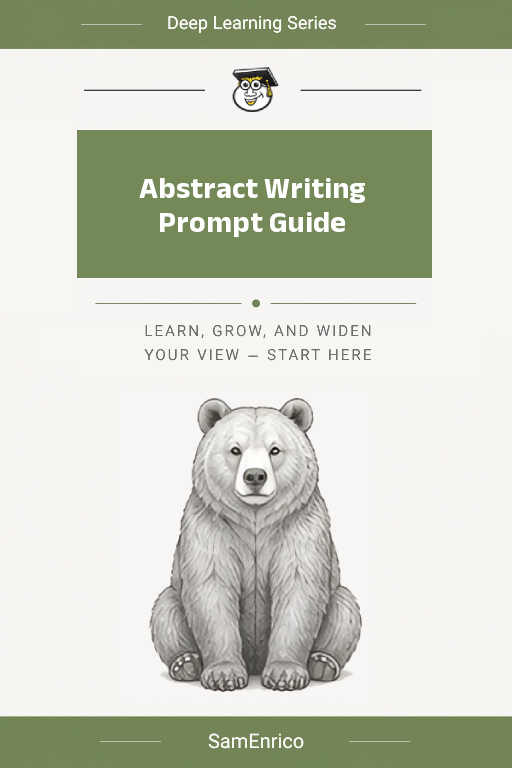
Abstract Writing Prompt Guide
Summarize your entire essay in 150-250 words using
Summarize your entire essay in 150-250 words using GPT prompts that extract key findings and implications for academic papers.
Formats
About this book
Free sample
Chapter 1: The Extraction Mandate...--–- Most researchers don’t have a writing problem. They have a selection problem.Open your most recently published paper. Highlight every sentence that would survive if you were forced to cut from 8,000 words to 200. Go ahead. Most people freeze at this moment.
They stare at their own work—work they spent months, sometimes years, perfecting—and cannot bring themselves to delete 97.5 percent of it. So they don’t. Instead, they write an abstract that reads like a miniature version of the full paper: same slow buildup, same background citations, same cautious hedging, same everything, just shorter. And then a journal editor rejects it within ninety seconds, not because the science is bad, but because the abstract failed to answer four questions that every editor silently asks.That silence is expensive. A 2022 study of 1,200 manuscript submissions across six journals found that editors spent an average of ninety-two seconds on the first read of an abstract before deciding to reject, send for review, or flag for discussion.
Papers with abstracts that clearly stated the research gap, method, key findings, and implications in the first 150 words were 3.2 times more likely to move to peer review than those that buried these elements. Three point two times. Not because the science was better. Because the abstract was extractable.This chapter solves the selection problem permanently. You will learn why the canonical four-part abstract structure exists, why 200 words (give or take 20) is the journal-standard sweet spot, and how to turn GPT into a structural auditor that forces your messy full paper to output only what matters.
By the end of this chapter, you will have a clean, labeled skeleton of your research that requires no creative writing—only honest extraction.Let me be explicit about what this chapter is not. It is not a creative writing workshop. It is not a lesson in rhetorical flourish. It is not a collection of “tips and tricks” for making your abstract sound impressive. This chapter is a surgical protocol.
You will learn to remove everything that does not belong. The prompt at the center of this chapter is deliberately…
This is the end of the free sample. Get the eBook to keep going. Buy now
Contents
- Chapter 1
- Chapter 2
- Chapter 3
- Chapter 4
- Chapter 5
- Chapter 6
- Chapter 7
- Chapter 8
- Chapter 9
- Chapter 10
- Chapter 11
- Chapter 12
Details
- Author
- Pennington Delois
- Publisher
- SamEnrico
- Language
- English
- Genre
- Non-Fiction, Student's Shortcut
- Released
- 2026-05-30
- Pages (approx.)
- 154
- Available as
- eBook, Audiobook

Read better in the ZLOADR app
Your eBooks on your phone or tablet. Sign in with your SamEnrico account and start reading.
More by Pennington Delois
 Automobile Purchase Intent GapPennington Delois$11.99
 Imposter Syndrome App CompanionPennington Delois$11.99
 Curtis Mayfield SuperflyPennington Delois$11.99
 The Interruption Recovery IndexPennington Delois$11.99
 Low Carb Fast Food GuidePennington Delois$11.99
 Long Distance AngerPennington Delois$11.99
 Gifting And Estate ImpactPennington Delois$11.99
 Effective Delegation GuidePennington Delois$11.99
 The Nairobi Gold Heist: The 1982 Bank Robbery That Shocked East AfricaPennington Delois$11.99
 The Lost Library of Nineveh: Secrets of Ashurbanipal's Forbidden ArchivesPennington Delois$11.99
 A Collector's Handbook to the Cadillac 90Pennington Delois$11.99
 How to Produce Ski and Snowboard Tuning ToolsPennington Delois$11.99
You may also like
 Hong Kong Handover 1997Dunn Johnnie$11.99
 Zumba For Postnatal Recovery CourseNeal Christian$11.99
 Zumba for BeginnersLadner Nikia$11.99
 YouTube Comment Mining GuideHumes Pandora$12.99
 Worry Box MeditationCarlin Rudy$11.99
 Workplace Stress MeditationNguyen Lynn$11.99
 Workplace Stress and Sleep RepairHawley Ivory$11.99
 Workplace Perfectionism CureDelaney Jeffry$11.99
 Workplace Injustice Anger GuideWallen Isabelle$11.99
 Work Addiction and Burnout LinkGreenwood Ester$11.99
 Women in Yoga and WellnessBeattie Galina$11.99
 Women in Stand Up ComedyChun Evangeline$11.99