

Non-FictionSelf-HelpTask Discipline
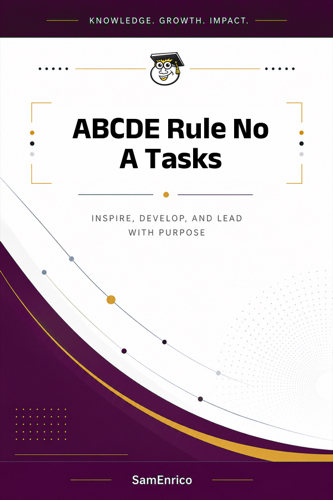
ABCDE Rule No A Tasks eBook
Never start a B task while an A task remains unfin
by Haas Giselle
Never start a B task while an A task remains unfinished.
Formats
Free sample
Chapter 1: The Completion Illusion--–- The email arrived at 9:47 AM on a Tuesday. Sarah, a senior marketing director, read it twice, felt a familiar knot in her stomach, and promptly archived it. The message was from her CEO: “Q3 strategy deck needed for Friday’s board meeting. Please finalize.” That was an A task—severe consequences if undone. But instead of opening Power Point, Sarah glanced at her to-do list.
Forty-three items stared back. She chose item number 37: “Organize desktop folders.” Twenty minutes later, her files were beautifully sorted. She felt a small, satisfying ping of accomplishment. Then she answered three non-urgent emails, updated a team calendar, and ordered office supplies. By 5:00 PM, Sarah had completed nineteen tasks.
She left work tired but vaguely proud. The strategy deck remained untouched.Three days later, Sarah stood in the boardroom as the CEO asked, “Where is the Q3 deck?” Her pride evaporated. She stammered about being “busy.” The CEO’s silence was louder than any reprimand. That night, Sarah realized the painful truth: she had traded what mattered for what felt good. She was not alone.
She was, in fact, the rule, not the exception.The Most Expensive Mistake Knowledge Workers Make Every day, millions of professionals commit the same error Sarah made. They mistake activity for achievement. They confuse a full to-do list with meaningful progress. And they pay for this mistake with missed promotions, strained relationships, chronic stress, and a quiet, creeping sense that they are capable of more but somehow never deliver.The problem is not laziness. The problem is not a lack of ambition.
The problem is a flawed system—one that most people do not even know they are using. The traditional to-do list, for all its ubiquity, is secretly sabotaging you. It treats every task as equal. It rewards completion regardless of consequence. It is a machine designed to produce the illusion of productivity while allowing your most important work to rot.This book offers a different way.
It is called the ABCDE Rule, and its core principle is deceptively simple, brutally difficult, and life-changing when mastered: Never start a B task while an A task remains unfinished.Before we can master that rule, however, we must first understand why the alternative—the default mode of most professionals—is so dangerously seductive. We must name the enemy. And the enemy has a name: the Completion Illusion.Why Your To-Do List Is Lying to You The to-do list is one of humanity’s oldest productivity tools. Seneca, the Roman Stoic philosopher, wrote about using lists to organize his days. Benjamin Franklin famously carried a small book of thirteen virtues, tracking his daily adherence.
In the 20th century, consultants turned the to-do list into an industry, complete with leather-bound planners, color-coded apps, and system upon system.But here is the secret that the productivity industry does not want you to know: the typical to-do list is not a tool for prioritization. It is a tool for capture. It is a bucket. You throw tasks in, and the only measure of success is how many you pull out. This creates a perverse incentive: do the easy things first.
Do the quick things first. Do the comfortable things first. Because each small checkmark feels like progress.Behavioral psychologists call this the completion bias. Humans have a deep neurological need to finish what they start. The Zeigarnik effect, discovered by Russian psychologist Bluma Zeigarnik in the 1920s, shows that our brains hold unfinished tasks in a heightened state of memory and tension.
Completion releases that tension. It feels good. Really good. Dopamine, the neurotransmitter associated with reward and pleasure, floods your brain when you check a box.The problem is that your brain does not distinguish between checking off “send email to client” and “complete annual budget.” It only cares about the act of completion. The smaller and easier the task, the faster the dopamine hit.
Your brain learns, very quickly, that small B tasks are a reliable drug. Large A tasks, by contrast, offer delayed and uncertain rewards. They require hours or days of effort before the satisfying click of completion. Your brain, like Sarah’s, will reliably choose the small, easy, comfortable task every single time—unless you build a system to override that instinct.B Task Creep: The Silent Killer of Careers Sarah did not set out to ignore the strategy deck. She did not wake up thinking, “Today I will disappoint my CEO.” She simply fell victim to a phenomenon we call B task creep.B tasks are the should-dos of your world.
They have mild consequences if undone. Returning a non-urgent phone call is a B task. Tidying your desk is a B task. Reading industry news, updating your calendar, filing receipts, taking an online training module that is not yet required—all B tasks. Individually, each one is harmless.
Collectively, they form an avalanche that buries your A tasks.B task creep happens gradually. You tell yourself, “I’ll just answer one quick email.” Then, “Let me organize these files for five minutes.” Then, “I should really clear out my inbox before I start the big project.” Each step feels reasonable. Each step provides a small reward. And each step pushes the A task further into the future.By the time you finally look at the clock, hours have passed. The A task now feels even heavier because you have less time to complete it.
So you seek more B tasks to escape the anxiety. This is the downward spiral of false productivity. You work hard all day. You feel exhausted. But you have moved no closer to what actually matters.The real-world costs of B task creep are staggering.
Consider the following patterns that appear again and again in research on workplace productivity:Missed deadlines. According to a study by the Project Management Institute, organizations lose an average of 11.4% of their investment due to poor project performance. A significant driver of that loss is what researchers call “priority diffusion”—teams working on low-impact tasks while high-impact deliverables slip.Chronic stress. The American Psychological Association reports that 65% of adults cite work as a top source of stress. However, follow-up studies show that the stress is not caused by workload volume.
It is caused by unfinished important work. A single undone A task sitting on your list for days creates a low-grade, persistent anxiety that colors every other activity. You cannot fully enjoy a B task because, somewhere in your mind, the A task is still there, waiting.Career stagnation. A longitudinal study of 500 professionals over ten years found that the single best predictor of promotion was not hours worked, not intelligence, not even technical skill. It was the ability to consistently identify and complete high-consequence tasks without being derailed by low-consequence work.
In other words, the people who rose fastest were those who instinctively followed the ABCDE rule—even if they had never heard that name for it.Erosion of trust. Every time you fail to deliver an A task, someone notices. Your boss notices. Your client notices. Your spouse notices.
Trust is built on reliability in high-stakes situations. When you repeatedly complete B tasks while A tasks decay, you signal…
This is the end of the free sample. Get the eBook to keep going. Buy now
About this book
Details
- Author
- Haas Giselle
- Publisher
- SamEnrico
- Language
- English
- Genre
- Non-Fiction, Self-Help, Task Discipline
- Released
- 2026-06-08
- Pages (approx.)
- 139
- Available as
- eBook, Audiobook

Read better in the ZLOADR app
Your eBooks on your phone or tablet. Sign in with your SamEnrico account and start reading.
More by Haas Giselle
 The Silent Walking PracticeHaas Giselle$11.99
 Fear Of Failure In MusicHaas Giselle$11.99
 Eisenhower Matrix For ADHDHaas Giselle$11.99
 The Black Dahlia James Ellroy ObsessionHaas Giselle$11.99
 Orpheus and the Underworld’s Last WaltzHaas Giselle$11.99
 Material Handling OperatorHaas Giselle$11.99
 Kigali Student Life GuideHaas Giselle$12.99
 VAT Filing Deadlines ComparisonHaas Giselle$12.99
 Understanding RhytiphobiaHaas Giselle$17.99
 How to Become a Dumper-bailer OperatorHaas Giselle$11.99
You may also like
 Hong Kong Handover 1997Dunn Johnnie$11.99
 Zumba For Postnatal Recovery CourseNeal Christian$11.99
 Zumba for BeginnersLadner Nikia$11.99
 YouTube Comment Mining GuideHumes Pandora$12.99
 Worry Box MeditationCarlin Rudy$11.99
 Workplace Stress MeditationNguyen Lynn$11.99
 Workplace Stress and Sleep RepairHawley Ivory$11.99
 Workplace Perfectionism CureDelaney Jeffry$11.99
 Workplace Injustice Anger GuideWallen Isabelle$11.99
 Work Addiction and Burnout LinkGreenwood Ester$11.99
 Women in Yoga and WellnessBeattie Galina$11.99
 Women in Stand Up ComedyChun Evangeline$11.99