

Non-FictionSelf-HelpPerfectionism
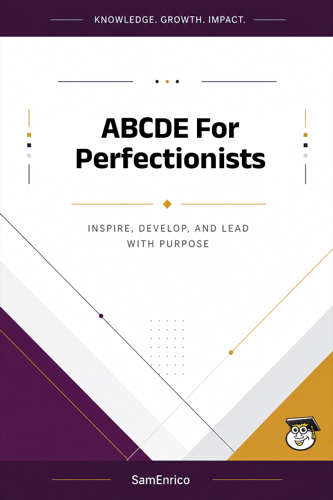
ABCDE For Perfectionists eBook
Lets perfectionists finish B tasks before perfecti
Lets perfectionists finish B tasks before perfecting A tasks.
Formats
Free sample
Chapter 1: The Blank Page Paradox--The cursor blinks on a white screen. You have been staring at it for forty-seven minutes. The coffee next to you has gone cold twice. You have opened and closed your email six times, rearranged the sticky notes on your desk, and read the same sentence in a book three paragraphs back without comprehending a single word. You are not lazy.
You are not unmotivated. You are not waiting for inspiration to strike like lightning from a clear sky.You are terrified.This is the quiet confession that productivity gurus never mention in their glossy morning routine videos and their five-step frameworks for world domination. They show you the after—the finished novel, the successful business, the perfectly curated life—but they never show you the before. The before looks like this: a person alone with their ambition, frozen by the realization that anything they create can be judged, found wanting, and held up as evidence of their inadequacy.Welcome to the paradox of the high-achieving perfectionist. You care more than almost anyone you know.
You have the capacity for excellence buried somewhere beneath the fear. And yet, you finish less than people who care half as much. You watch colleagues submit work that is fine—not great, not terrible, just fine—and they move on to the next thing while you are still rewriting the first paragraph for the ninth time. They are building careers. You are building walls.This book is not for people who need motivation.
You have plenty of that. It is not for people who lack discipline. You have discipline in spades, perhaps too much. It is not even for people who are lazy. You are the opposite of lazy.
You work harder than anyone, just on the wrong things, at the wrong time, in the wrong order.This book is for the person who has spent years mistaking perfectionism for excellence and is finally ready to see the difference.The Diagnosis That Changed Everything Let me tell you about a patient I will call James. He was a software engineer in his early thirties, brilliant by any objective measure, and he had not shipped a major feature in eighteen months. His code reviews were legendary for their thoroughness. His documentation was beautiful. His test coverage was immaculate.
And he was about to be put on a performance improvement plan because his productivity had cratered to nearly zero.When James came to see me—and yes, I am a therapist who specializes in high-performing professionals with perfectionist tendencies—he described his problem as "a lack of motivation." But within fifteen minutes, a different story emerged. James was not lacking motivation. He was drowning in it. Every morning he sat down to write code, and before he typed a single character, his brain presented him with the complete architectural diagram of what the feature could become if he did everything perfectly. He saw the finished product in his mind: elegant, efficient, praised by his peers, a model of engineering excellence.Then he looked at his blank screen and felt the weight of the gap between the vision and reality.
That gap was not a challenge to be overcome. It was a chasm to be feared. Every line of code he wrote would be judged against the perfect version in his head. Every character was a potential failure. So he wrote nothing.This is the blank page paradox: the more clearly you can imagine perfection, the harder it becomes to start anything at all.James's story is not unusual.
I have seen it in writers who cannot write the first sentence, in entrepreneurs who have twelve domain names and zero launched products, in students who rewrite the same paragraph for hours because they cannot bear to turn in anything less than an A, in designers who have fifteen versions of a logo and none of them feel right.The pattern is always the same. High standards plus high fear equals paralysis.Adaptive Versus Maladaptive Perfectionism Here is something that might surprise you: perfectionism is not a single thing. Psychologists have distinguished between two forms for decades, though the distinction rarely makes it into popular self-help books because it complicates the simple narrative that perfectionism is always bad.Adaptive perfectionism—sometimes called healthy perfectionism or excellence-striving—is the tendency to set high standards for yourself while maintaining flexibility about how and when those standards are met. The adaptive perfectionist wants to do excellent work, but they understand that excellent work emerges through iteration, revision, and sometimes failure. They can distinguish between a project that needs 100% precision (brain surgery, airplane maintenance, legal contracts) and a project that is fine at 80% (the first draft of a blog post, a quick mockup for a client, an email to a colleague).The adaptive perfectionist finishes things.
Not because they are willing to do bad work, but because they understand that a finished draft at 80% is infinitely more valuable than a perfect first page that never leads to a second.Maladaptive perfectionism—the kind that fills waiting rooms and therapy offices—is different. The maladaptive perfectionist also sets high standards, but those standards are rigid, all-or-nothing, and attached directly to self-worth. If the work is not perfect, the person is not worthy. There is no middle ground. There is no "good enough for now." There is only flawless or failure.The maladaptive perfectionist rarely finishes anything.
They start with enthusiasm, hit the first obstacle or the first imperfection, and then either abandon the project entirely or sink into a spiral of endless revision that never produces a final product.Here is the critical insight that most people miss: the maladaptive perfectionist is not aiming higher than the adaptive perfectionist. They are often aiming for exactly the same outcome. The difference is in the relationship to imperfection along the way. The adaptive perfectionist says, "This draft is rough, but that is what drafts are for." The maladaptive perfectionist says, "This draft is rough, and therefore I am rough, and therefore I should stop."Why Traditional Productivity Advice Fails You If you have ever tried to get your life together by reading productivity books—and I suspect you have, because perfectionists are voracious consumers of self-improvement literature—you have encountered Brian Tracy's famous "Eat That Frog" method. The idea is simple: identify your most important task (your A task), the one that will have the greatest impact on your goals, and do it first before anything else.
Eat the frog. Get the hard thing out of the way.This is excellent advice for someone whose problem is procrastination born of avoidance or discomfort. If you are avoiding your taxes because the paperwork is tedious, eating that frog makes perfect sense. Do the tedious thing, feel the relief, move on with your day.But if your problem is perfectionism, the frog is not the problem. The frog is not even real.
Here is what actually happens when a perfectionist tries to "eat the frog" by working on their most important A task first:They sit down to write the novel (A). The blank page stares back. They cannot write the first sentence because…
This is the end of the free sample. Get the eBook to keep going. Buy now
About this book
Details
- Author
- Holder Maxwell
- Publisher
- SamEnrico
- Language
- English
- Genre
- Non-Fiction, Self-Help, Perfectionism
- Released
- 2026-06-06
- Pages (approx.)
- 139
- Available as
- eBook, Audiobook

Read better in the ZLOADR app
Your eBooks on your phone or tablet. Sign in with your SamEnrico account and start reading.
More by Holder Maxwell
 Assertiveness In Public Spaces CourseHolder Maxwell$11.99
 The Workplace Walking BreakHolder Maxwell$11.99
 E Limitation MethodHolder Maxwell$11.99
 The Rheumatoid Arthritis Medication GuideHolder Maxwell$11.99
 The Silicon Pioneers: Black Engineers Who Built the Modern WorldHolder Maxwell$11.99
 How to Become a Plug SorterHolder Maxwell$11.99
 Understanding Richieri–Costa–guion–Almeida DwarfismHolder Maxwell$17.99
 Rwanda Student Safety GuideHolder Maxwell$12.99
 Nigeria Zero Rated VAT GuideHolder Maxwell$12.99
 Mechanical AssemblerHolder Maxwell$11.99
You may also like
 Hong Kong Handover 1997Dunn Johnnie$11.99
 Zumba For Postnatal Recovery CourseNeal Christian$11.99
 Zumba for BeginnersLadner Nikia$11.99
 YouTube Comment Mining GuideHumes Pandora$12.99
 Worry Box MeditationCarlin Rudy$11.99
 Workplace Stress MeditationNguyen Lynn$11.99
 Workplace Stress and Sleep RepairHawley Ivory$11.99
 Workplace Perfectionism CureDelaney Jeffry$11.99
 Workplace Injustice Anger GuideWallen Isabelle$11.99
 Work Addiction and Burnout LinkGreenwood Ester$11.99
 Women in Yoga and WellnessBeattie Galina$11.99
 Women in Stand Up ComedyChun Evangeline$11.99