
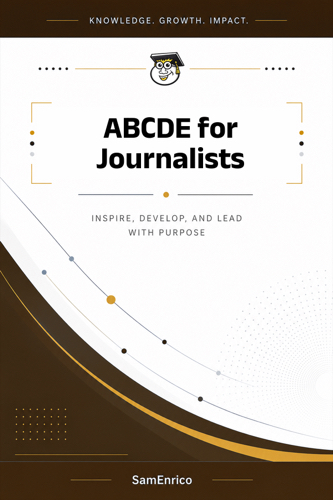
Non-FictionSelf-HelpJournalism
ABCDE for Journalists eBook
Ranks stories and publication deadlines.
by Rivera Guy
Ranks stories and publication deadlines.
Formats
Free sample
Chapter 1: The Drowning Reporter--–- Every journalist knows the feeling. It arrives not with a dramatic crash but with a quiet, terrible certainty that you have already lost.Your phone buzzes. Your computer chirps. Three different people are asking for three different things, and somewhere in the noise, the story you promised to deliver by 4 PM has vanished like smoke. You are not lazy.
You are not incompetent. You are drowning—and the worst part is, everyone else seems to be swimming just fine.This chapter is for the drowning reporter. Not the hero journalist who thrives on chaos. Not the martyred workaholic who wears burnout like a medal. The real reporter—the one who came into this profession to do meaningful work, to hold power accountable, to tell stories that matter—and who now spends their days frantically treading water, praying for a moment of calm that never comes.I wrote this book because I was that reporter.
For six years, I believed that my inability to keep up was a personal failure. I thought if I just worked harder, learned faster, cared more, the chaos would resolve itself. It did not. It got worse. Until I stopped trying to work faster and started learning to think clearer.The 2 PM Tuesday Meltdown Let me show you exactly how it happens.
Not in theory. In practice.Anna has been a reporter for six years. She is good at her job—solid, reliable, the kind of journalist any editor would be lucky to have. She meets most of her deadlines. She cultivates sources who trust her.
She has never been sued for libel. By any reasonable measure, she is exactly where she should be in her career.At 2:00 PM on a Tuesday, Anna is writing a feature profile about a retiring teacher. It is a good story—heartfelt, well-reported, scheduled for the weekend edition. It is not urgent. It is a C story, though Anna does not know that terminology yet.
All she knows is that she needs ninety minutes of uninterrupted writing time.She will not get it.At 2:03 PM, her phone buzzes. Chemical plant fire on the south side. The assignment desk is already in Slack: “Anyone near the south side? Need eyes on this. Fast.”Anna is not near the south side.
She is in the newsroom, four miles away. But she has covered industrial accidents before. She knows the relevant regulations. She has a source at the fire department. She volunteers to help.This is not a mistake.
The fire is important. The fire is, by any definition, an A story. The mistake is what happens next.At 2:07 PM, Anna is on the phone with her fire department source, gathering the basics. At 2:12 PM, her editor DMs her: “Where are we on the teacher profile?” She types back one-handed: “Working on fire. Will get to profile after.”At 2:14 PM, a competitor publishes a one-sentence alert.
The assignment desk posts: “Competitor has something. Can we beat them?”At 2:18 PM, her phone buzzes again. It is not the fire department. It is a source for an investigative piece she has been working on for three months—a contractor defrauding homeowners. The source has new documents and is only available for the next twenty minutes.Anna makes a choice.
She tells the source she will call back in an hour.At 2:22 PM, she ends the call with the fire department. She has the basics. She opens a blank document and starts writing. She is behind the competitor by eight minutes.At 2:25 PM, another notification: the city council just released a draft budget with a surprise property tax increase. Also an A story.
Also urgent.At 2:28 PM, she finishes the fire alert. Four paragraphs. Twelve sentences. One quote. She hits publish.
The competitor beat her by fourteen minutes, but at least she has something up.Now she has three active tasks: finish the teacher profile, download and analyze the budget document, and call back her investigative source. Plus, the fire story is still developing.It is 2:30 PM. She has been in crisis mode for twenty-seven minutes. She has published one short story. She has made progress on nothing else.What follows is predictable.
At 2:45 PM, she starts skimming the budget document—forty-seven pages, looking for the tax increase. She finds it on page thirty-two. She writes a three-paragraph story without comment from the mayor’s office. She publishes at 3:15 PM.At 3:20 PM, she calls back her source. The source is now in a meeting and cannot talk until tomorrow.
She has lost her window.At 3:30 PM, the fire department issues an update. She updates her fire story.At 3:45 PM, her editor asks about the teacher profile. Anna has not written another word. She asks for an extension until tomorrow. The editor grants it, reluctantly.At 4:00 PM, Anna realizes she never ate lunch.
She has forty-seven unread emails.At 5:00 PM, she goes home. She has published two stories. Both are fine. Neither is great. The teacher profile is delayed.
The investigative source is annoyed. And somewhere in the chaos, the story that could have been her best work was sacrificed on the altar of urgency.Why Anna Is Not the Problem If you recognize yourself in Anna, hear this clearly: You are not lazy. You are not incompetent. You are not failing.Anna’s afternoon is not unusual. It is not a failure of character or talent.
It is a predictable outcome of a system that rewards reactivity over intentionality. The modern newsroom is designed to produce exactly this kind of chaos—and then to blame the individuals who cannot keep up.Here is what the productivity experts do not tell you. Traditional time management assumes a world that does not exist for journalists. It assumes tasks are discrete, linear, and interruptible. It assumes you can check off Item A, then move to Item B, then Item C, in a neat, orderly progression.But journalism is not neat.
Journalism is not orderly. Journalism is the source who calls back at the exact wrong moment. The competitor who publishes while you are still verifying. The document dump that arrives at 4:55 PM on a Friday. The editor who appears in your doorway with a “quick question” that consumes forty-five minutes.As Christopher Cox writes in The Deadline Effect, “Perfectionists and procrastinators alike dread the ticking clock.” For journalists, the clock is not a gentle reminder.
It is a ruthless enforcer. It does not care about your source interviews, your document review, or your carefully planned outline. It only cares about one thing: what you publish before it runs out.The Tyranny of the Urgent Psychologists have a name for what happened to Anna. They call it urgency bias—the tendency to prioritize tasks with immediate deadlines over tasks with greater long-term importance, even when the urgent tasks are objectively less significant.Urgency bias is not a moral failing. It is a cognitive shortcut.
Your brain is wired to respond to immediate threats. When a notification buzzes, when an editor asks for something “right now,” when a competitor publishes, your nervous system interprets this as a survival threat. You react before you think.This shortcut served…
This is the end of the free sample. Get the eBook to keep going. Buy now
About this book
Details
- Author
- Rivera Guy
- Publisher
- SamEnrico
- Language
- English
- Genre
- Non-Fiction, Self-Help, Journalism
- Released
- 2026-06-06
- Pages (approx.)
- 129
- Available as
- eBook, Audiobook

Read better in the ZLOADR app
Your eBooks on your phone or tablet. Sign in with your SamEnrico account and start reading.
More by Rivera Guy
 Menopause Oral Health GuideRivera Guy$11.99
 Sunday Planning Ritual GuideRivera Guy$11.99
 Stress and TachycardiaRivera Guy$11.99
 Email Marketing Compliance GuideRivera Guy$11.99
 Age Gap Relationship StressRivera Guy$11.99
 Dorothy Hodgkin Chemistry PioneerRivera Guy$11.99
 Self Compassion HypnosisRivera Guy$11.99
 The Siege of Fort Jesus: The Prohibition-Era Prison Break That Shook East AfricaRivera Guy$11.99
 The Derby Duel: How Rivalry Forged Modern Football's Greatest ClubsRivera Guy$11.99
 Exploring Applied Art: Function & BeautyRivera Guy$11.99
 How to Produce Plastic TubingRivera Guy$11.99
 Transport Cooperative Model GuideRivera Guy$12.99
You may also like
 Hong Kong Handover 1997Dunn Johnnie$11.99
 Zumba For Postnatal Recovery CourseNeal Christian$11.99
 Zumba for BeginnersLadner Nikia$11.99
 YouTube Comment Mining GuideHumes Pandora$12.99
 Worry Box MeditationCarlin Rudy$11.99
 Workplace Stress MeditationNguyen Lynn$11.99
 Workplace Stress and Sleep RepairHawley Ivory$11.99
 Workplace Perfectionism CureDelaney Jeffry$11.99
 Workplace Injustice Anger GuideWallen Isabelle$11.99
 Work Addiction and Burnout LinkGreenwood Ester$11.99
 Women in Yoga and WellnessBeattie Galina$11.99
 Women in Stand Up ComedyChun Evangeline$11.99