
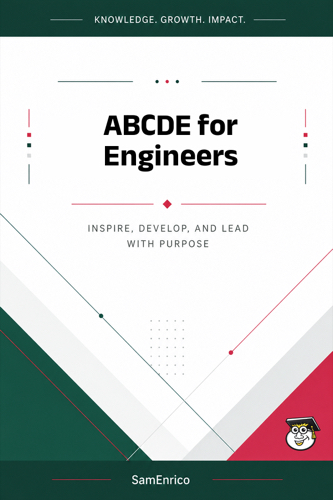
ABCDE for Engineers eBook
Ranks technical tasks and meetings.
by Arevalo Fran
Ranks technical tasks and meetings.
Formats
Free sample
Chapter 1: The One Big Thing--It was 2:47 PM on a Tuesday when the production alert went off. Sarah, a senior backend engineer at a growing fintech startup, had already switched contexts eleven times since 9 AM: two stand-ups, a sprint planning overrun, three Slack threads about a broken build, a "quick" code review that turned into a debugging session, and a product manager who kept appearing at her desk with "just one small question." When the pager went off, she stared at the screen for a full ten seconds. She could not remember what she had been working on before the interruption. The code editor was still open to a file she had opened four hours ago. The cursor was blinking on line 47, exactly where she had left it.
She had no idea what line 47 was supposed to do.This is not a story about burnout. It is a story about the slow, invisible erosion of engineering productivity that has become normalized across the industry. Sarah is not lazy. She is not disorganized. She is not bad at her job.
On the contrary, she is a skilled engineer who consistently receives "exceeds expectations" on her performance reviews. But like most engineers today, she has been trained—by the culture, by the tools, by the very rhythm of Agile ceremonies—to believe that being busy is the same as being productive. She answers every Slack message within three minutes. She never declines a meeting invitation. She says "yes" to every stakeholder request.
And at the end of each day, she looks at her partially completed ticket, feels a vague sense of failure, and promises herself that tomorrow will be different.Tomorrow is never different.The Engineering Productivity Paradox Let us name the problem precisely. Engineers in modern organizations report working an average of 50 to 60 hours per week, yet when asked to estimate how many hours of focused, uninterrupted technical work they actually performed, the average answer is between 10 and 15 hours. This gap—between time spent at work and time spent doing the work that only engineers can do—is what we will call the Engineering Productivity Paradox. The more connected the workplace becomes, the less deep work gets done. The more meetings we add, the slower the shipping velocity.
The more we optimize for "responsiveness," the less we actually respond to what matters.The root cause is not malice. It is physics. Specifically, it is the physics of human cognition. When an engineer is writing code, designing a system, or debugging a complex failure, they enter a state that psychologists call "flow"—a condition of deep concentration where time seems to disappear, self-consciousness fades, and the work feels almost effortless. Entering flow takes time.
Research from the University of California, Irvine, found that after an interruption, it takes an average of 23 minutes and 15 seconds to fully return to the original task. But for engineers engaged in complex problem-solving—the kind that involves holding a mental model of a distributed system with twelve microservices and three databases—the recovery time can exceed 40 minutes. A single ten-minute interruption can cost an engineer an hour of productive work. Not because the interruption itself takes an hour, but because the interruption destroys the mental context that took 40 minutes to build.Now consider the average engineer's day. According to data from Atlassian, the average knowledge worker switches between apps and tasks every 40 to 60 seconds.
For engineers, the interval is slightly longer—about every 12 minutes—because code editors hold attention longer than email clients. But twelve minutes is still catastrophically short. It takes 23 minutes to recover from an interruption. If you are interrupted every 12 minutes, you never recover. You never enter flow.
You spend your entire day in a state of shallow, reactive, context-switching hell.This is not your fault. It is the system.The False God of Urgency The modern workplace has confused urgency with importance. A Slack message feels urgent because there is a human on the other end, waiting. A meeting invitation feels urgent because it occupies a square on the calendar. A product manager appearing at your desk feels urgent because they are physically present.
But urgency is a feeling, not a fact. The question we must learn to ask—the question that separates productive engineers from busy engineers—is not "How quickly can I do this?" but "What happens if I do not do this at all?"Let us test this with a concrete example. A Slack direct message arrives: "Hey, quick question about the API endpoint for user profiles. Can you remind me which field has the timezone?" What happens if you do not answer this immediately? Almost nothing.
The other person might wait three minutes instead of thirty seconds. They might look it up themselves. They might ask someone else. The cost of delay is negligible. Now consider an alternative: a production bug that is causing a 5% error rate on the checkout endpoint.
What happens if you do not fix this immediately? Customers cannot complete purchases. Revenue drops. The on-call engineer gets paged. The incident escalates to the CTO.
The cost of delay is enormous.These two scenarios feel different in your body. The Slack message creates a subtle sense of social pressure—the feeling that you are being rude if you do not reply. The production bug creates a clear, objective consequence. The mistake most engineers make is treating the social pressure as if it were the same as the business consequence. It is not.
Learning to distinguish between them is the single most important skill for engineering productivity.This is where most productivity advice fails. Generic time management books—written for executives, salespeople, or general knowledge workers—will tell you to "prioritize your tasks" and "focus on what matters." They assume that you already know which tasks are important. For engineers, the problem is not knowing. You know that the production bug is more important than the Slack message. The problem is acting on that knowledge when the Slack message is screaming at you and the production bug is just a ticket in a backlog.
You need a system that overrides your brain's hardwired response to social urgency. You need a framework that makes the right decision automatic. You need ABCDE.Introducing the ABCDE Framework for Engineers ABCDE is a prioritization method originally developed by Brian Tracy in his book Eat That Frog!, adapted here for the specific realities of engineering work. The core idea is brutally simple: before you do anything, you assign every task on your list a letter from A to E. The letter determines the order in which you work.
You do all A tasks before any B task. All B tasks before any C task. And so on. You never, under any circumstances, do a C task while an A task remains unfinished.But the original ABCDE method has limitations. It was designed for general knowledge work, not for the unique pressures of sprints, on-call rotations, code reviews, and technical debt.
It does not account for firefighting—those moments when a new emergency arrives and demolishes your carefully planned list. It does not tell you what to do when you have two different tasks that both…
This is the end of the free sample. Get the eBook to keep going. Buy now
About this book
Details
- Author
- Arevalo Fran
- Publisher
- SamEnrico
- Language
- English
- Genre
- Non-Fiction, Self-Help, Engineering
- Released
- 2026-06-05
- Pages (approx.)
- 144
- Available as
- eBook, Audiobook

Read better in the ZLOADR app
Your eBooks on your phone or tablet. Sign in with your SamEnrico account and start reading.
More by Arevalo Fran
 Menopause And Thyroid GuideArevalo Fran$11.99
 Click Through Rate OptimizationArevalo Fran$11.99
 Political Disagreement CouplesArevalo Fran$11.99
 John Bardeen Two Time WinnerArevalo Fran$11.99
 Stress and Chest PainArevalo Fran$11.99
 GTD Weekly Review GuideArevalo Fran$11.99
 Boundary Setting HypnosisArevalo Fran$11.99
 The Silk Road Runner: Letters of a Forgotten Warrior-PoetessArevalo Fran$11.99
 Socrates in the Sky: The Birth of Western ThoughtArevalo Fran$11.99
 10 Ways to Use Apricot Jam (Recipe Book)Arevalo Fran$11.99
 SWIFT vs Alternative Payment HandbookArevalo Fran$12.99
 Ghana Delivery Times CourseArevalo Fran$12.99
You may also like
 Relationship Building for EngineersGetz Cordie$11.99
 Dreaming for Engineering DesignKline Sharee$11.99
 Constraints for EngineersSlaughter Birgit$11.99
 Emotional Intelligence For EngineersWorth Zina$11.99
 Personal Branding for EngineersKimmel Cletus$11.99
 Failure Fear in EngineeringSpalding Richard$11.99
 TRIZ Problem SolvingMcdade Refugio$11.99
 NVC for EngineersCrump Krysta$11.99
 Workaholism in EngineeringHughes Derrick$11.99
 Fear of Failure for EngineersSchott Charline$11.99
 Engineering Student StressBurris Trinh$11.99
 Engineer Imposter SyndromeMoreau Melodee$11.99