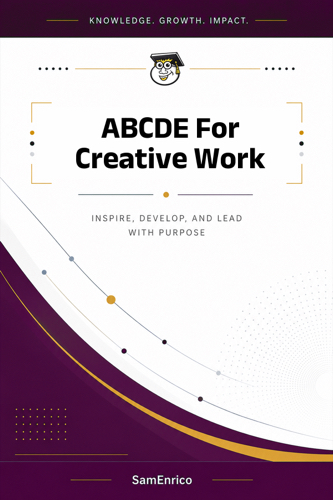
ABCDE For Creative Work eBook
Ranks artistic projects by deadline and impact usi
by Gale Emmie
Ranks artistic projects by deadline and impact using letter system.
Formats
Free sample
Chapter 1: The Frog That Ate Your Muse--–- Marcus was a talented songwriter who hadn't finished a song in eleven months. This was not for lack of effort. Every morning at 6:00 AM, his alarm screamed him awake. He would stumble to his home studio, pour a black coffee, open his digital audio workstation, and stare at the blinking cursor. He had read all the productivity books.
He knew the gospel: eat the frog first. Do the hardest thing when your willpower is fresh. So every morning, Marcus tried to write a melody – the hardest, most vulnerable part of songwriting – at six in the morning. And every morning, after ninety minutes of clicking and deleting and sighing, he would close his laptop and spend the rest of the day answering emails, organizing his sample library, and watching You Tube tutorials about music theory he already knew. He was busy.
He was exhausted. He had not written a single lyric worth keeping.The cruel joke was that Marcus was not lazy. He was a disciplined person by any reasonable measure. He woke early. He showed up.
He put in the hours. But the hours produced nothing because he had fallen into what this chapter calls the Flow Trap: the mistaken belief that "discipline" means ignoring your biology and forcing creative work into the hours when your brain is least capable of producing it.This chapter will deconstruct the most famous productivity advice in the world – "eat the frog first" – and explain why it works brilliantly for accountants, data entry specialists, and email processors, but catastrophically fails for painters, composers, writers, coders, designers, and anyone whose work requires original thought. More importantly, this chapter will teach you how to identify your personal Flow Window, the two to four hours each day when your creative brain is actually online, and how to protect that window from the frogs that want to eat it.The Frog That Ate Productivity Culture The phrase "eat a live frog first thing in the morning and nothing worse will happen to you the rest of the day" is attributed to Mark Twain, though like most good quotes, he probably never said it exactly that way. The sentiment, however, is unmistakable: do your hardest, most unpleasant task immediately, before your willpower erodes, before distractions multiply, before the day gets away from you.The idea was popularized by Brian Tracy's 2001 bestseller Eat That Frog!, which has sold over 1.5 million copies and been translated into dozens of languages. Tracy's system is elegant in its simplicity.
He argues that your "frog" is the most important and most challenging task on your to-do list – the one you are most likely to procrastinate on. By eating that frog first thing in the morning, you build momentum, prove your competence to yourself, and free up the rest of the day for smaller tasks.For certain kinds of work, this is excellent advice. If your job involves processing invoices, responding to routine emails, filing documents, or any task that requires following a procedure rather than generating original thought, eating the frog first is genuinely effective. The frog is unpleasant, but it is not cognitively demanding in the way creative work is demanding. You can process invoices at 6:00 AM because processing invoices does not require your brain to make novel connections, silence its inner critic, or access emotional states that are biologically timed to specific hours of the day.Creative work is different.
And the difference is not merely a matter of preference or personality. It is a matter of neurology.The Neuroscience of Why Morning Frogs Poison Creativity To understand why "eat the frog" fails for creatives, we need to understand what actually happens in your brain when you do creative work. This is not mystical or romantic. It is measurable.Creative cognition – the process of generating novel, useful ideas – relies on what neuroscientists call the default mode network (DMN). The DMN is a set of brain regions that become active when you are not focused on external tasks.
It is the network that makes connections between seemingly unrelated memories, concepts, and sensations. It is the source of the "aha" moment, the unexpected association, the lyric that arrives in the shower, the solution that appears while you are walking the dog.The DMN is most active when you are in a state of low inhibition and high associative thinking. This state is characterized by alpha wave activity in the frontal lobes, reduced activity in the dorsolateral prefrontal cortex (the part of your brain responsible for critical self-evaluation), and increased connectivity between the hippocampus (memory) and the default mode network.Here is the problem: the DMN does not operate on a twenty-four hour on-off switch. It follows a circadian rhythm. For the vast majority of humans, the DMN is least active in the early morning hours, typically between 4:00 AM and 8:00 AM, when the brain is still in a transition state between sleep and full wakefulness.
During these hours, the dorsolateral prefrontal cortex is still ramping up – which means your inner critic is actually more active, not less. You are more likely to judge your ideas harshly, less likely to make unexpected associations, and more likely to fall back on well-worn neural pathways (which is why morning writing tends to produce clichés).Conversely, for most people, the DMN reaches its peak activity between late morning and early afternoon, typically 10:00 AM to 2:00 PM, and again – for some people – in the late evening, 9:00 PM to midnight. These are the Flow Windows: the hours when your brain is biologically primed for creative work.The Flow Trap, then, is the act of scheduling your most creative, generative work during your least creative, least generative hours because a productivity book told you to "eat the frog." You are not being disciplined. You are being biologically illiterate. You are trying to sprint through quicksand and calling it character building.The Songwriter Who Switched His Clock Let us return to Marcus, the songwriter who spent eleven months failing to write at 6:00 AM.
After reading a draft of this chapter in a beta reader group, he decided to run an experiment. For one week, he would keep a simple energy log. Every hour, from waking to sleeping, he would rate his creative energy on a scale of 1 to 5, where 1 meant "I cannot imagine writing a single word" and 5 meant "ideas are flowing faster than I can capture them."His results were unambiguous. From 6:00 AM to 8:00 AM, his average creative energy was 1.7. He felt groggy, critical, and blocked.
From 10:00 AM to noon, his average creative energy was 4.3. He felt alert, curious, and generative. From 2:00 PM to 4:00 PM, his average dropped to 3.1 – still capable, but not peak. And from 9:00 PM to 11:00 PM, he recorded a second smaller peak of 3.8, which he attributed to the quiet of the house after his children went to bed.Marcus stopped eating frogs. He stopped forcing melodies at 6:00 AM.
Instead, he blocked 10:00 AM to noon on his calendar as his "Creation Window." During those two hours, he did not check email, did not open his social media, did not organize his sample library. He wrote. He used the five-minute reverse start technique…
This is the end of the free sample. Get the eBook to keep going. Buy now
About this book
Details
- Author
- Gale Emmie
- Publisher
- SamEnrico
- Language
- English
- Genre
- Non-Fiction, Self-Help, Creative Productivity
- Released
- 2026-06-06
- Pages (approx.)
- 144
- Available as
- eBook, Audiobook

Read better in the ZLOADR app
Your eBooks on your phone or tablet. Sign in with your SamEnrico account and start reading.
More by Gale Emmie
 Cross Border Franchise Software IntegrationGale Emmie$11.99
 C Priority Task GuideGale Emmie$11.99
 Walking Meditation For Autoimmune DiseaseGale Emmie$11.99
 The Arthritis Exercise PrescriptionGale Emmie$11.99
 The Divine Fire: Mozart and the Birth of Musical GeniusGale Emmie$11.99
 Maximizing Revenue Per Audience MemberGale Emmie$11.99
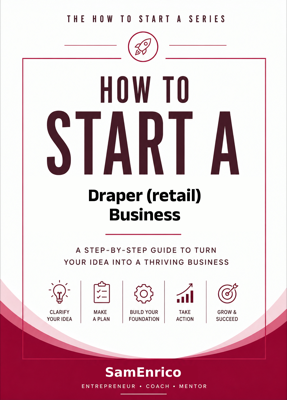 How to Start a Draper (retail) Business (Beginners Guide)Gale Emmie$11.99
 French for Rwanda StudentsGale Emmie$12.99
 Zero Rated VAT EU GuideGale Emmie$12.99
 Understanding Richieri–Costa–gorlin SyndromeGale Emmie$17.99