
Non-FictionSelf-HelpContent Strategy
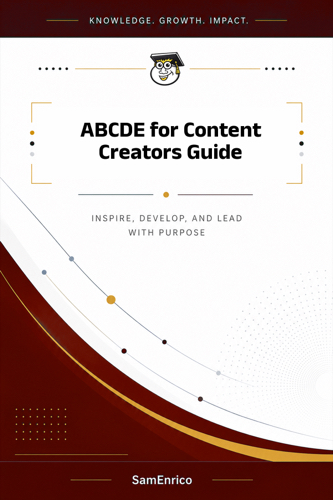
ABCDE for Content Creators Guide eBook
Prioritizes filming, editing, posting, and engagem
by Yoder Harley
Prioritizes filming, editing, posting, and engagement tasks.
Formats
Free sample
Chapter 1: The Pre-Production Trap--Most creators do not fail because they make bad videos. They fail because they film bad ideas.This distinction sounds subtle, but it is the difference between growing an audience and shouting into an empty room for two years before quitting. I have watched hundreds of creators—beginners with i Phones and veterans with $10,000 camera rigs—repeat the same devastating mistake. They get an idea. They feel excited.
They grab their camera. They start recording. And six hours later, they have a video that nobody watches.The problem is not their editing. The problem is not their thumbnails. The problem is not even their on-camera presence.
The problem is that they never asked three simple questions before they hit record: Does anyone actually want this? Will anyone click on it? Will anyone finish it?This chapter exists to make sure you never make that mistake again.The 80/20 Truth That Changes Everything Let me state something so important that it will appear exactly once in this book—because repeating it would dilute its power: 80% of a video's success is determined before you record a single frame.Read that again. Not during filming. Not during editing.
Not during posting. Before.Most creators spend 80% of their time on the wrong 20% of the work. They obsess over color grading, transition effects, and background music. They spend four hours editing a ten-minute video that should have taken ninety minutes. Then they upload it with a generic title and a blurry thumbnail, and they wonder why the algorithm ignored them.The top 1% of creators do the opposite.
They spend 80% of their time on pre-production: validating ideas, scripting structured talking points, and designing thumbnails before they even turn on the camera. Then filming takes one hour. Editing takes two hours. Posting takes thirty minutes. And the video performs.This chapter teaches you that pre-production system.The Three Questions Every Idea Must Survive Before any idea becomes a video, it must pass through three gates.
If it fails any single gate, you delete the idea immediately. No exceptions. Do not film it. Do not "save it for later." Delete it.Gate One: Is It Specific?Vague ideas kill videos. "How to grow on You Tube" is a dead idea.
It is too broad. Too generic. Too forgettable. "How I grew from 0 to 10,000 subscribers in 90 days without buying ads" is a specific idea. It has a number.
It has a timeframe. It has a constraint that creates curiosity.Specific ideas promise a clear outcome. Vague ideas promise nothing. Write down your idea. If you cannot add a specific number, timeframe, or result to the title, the idea is not ready.Gate Two: Is It Curious?Does your idea create an information gap?
Does the viewer need to watch the video to resolve a tension? A good title and thumbnail should make the brain ask a question. "This editing trick doubled my retention" creates the question: what trick? How did it double? Will it work for me?If your idea does not naturally create a question that demands an answer, it will not get clicked.
Curiosity is not optional. It is the engine of every successful video.Gate Three: Is It Beneficial?Will the viewer be better off after watching? Not entertained—better off. Will they learn a skill? Save time?
Save money? Avoid a mistake? Understand something they were confused about?Benefit is the reason someone watches to the end. Curiosity gets the click. Benefit earns the retention.
If your idea does not clearly benefit the viewer, it is entertainment—and unless you are already famous, entertainment alone does not grow an audience.The Magnetic Headlines Framework These three questions come from a framework I call Magnetic Headlines. Every video idea must be Specific, Curious, and Beneficial. If it is missing any one of these three elements, it is not magnetic. It is a weak signal that will be ignored by both algorithms and humans.Let me give you examples of weak ideas versus magnetic ideas.Weak: "My vlog from New York"Specific? No (which New York?
when? why?)Curious? No (why should anyone care?)Beneficial? No (what do I gain?)Magnetic: "How I filmed a viral travel video in NYC using only an i Phone"Specific: i Phone only, NYC location, viral result Curious: How did they do it? What was the technique?Beneficial: I learn a replicable skill for my own travel videos Weak: "Photoshop tutorial"Specific?
No (which feature? which outcome?)Curious? No (there are millions of Photoshop tutorials)Beneficial? No (what specific problem does this solve?)Magnetic: "Remove anything from any photo in 90 seconds (Photoshop 2025)"Specific: 90 seconds, 2025 version, "anything"Curious: How can it be that fast? Is it really any object?Beneficial: I save time and learn a powerful editing skill Before you film anything, write your idea in the Magnetic Headlines format.
If you cannot complete the sentence "This video will teach viewers how to [specific outcome] in [timeframe] using [specific method]," the idea is not ready.Structured Talking Points: Why Scripts Fail Now let me clarify something important. Many books on content creation will tell you to write scripts. Other books will tell you to never script anything. Both are wrong if you misunderstand what "script" means.Word-for-word scripts (every sentence written out, to be read verbatim) are terrible for most creators. They produce stiff, robotic, disconnected performances.
You sound like you are reading—because you are. Audiences can smell a scripted read from the first sentence. Unless you are a trained actor with years of teleprompter experience, do not write word-for-word scripts.Structured talking points (bullet-point outlines of what to say, in order) are essential. They keep you on track. They ensure you hit every key point.
They prevent rambling. And they leave room for natural, conversational delivery.Here is the difference:Word-for-word script (bad for most):"Hello and welcome back to my channel. Today I am going to show you how to edit a video using Cap Cut. First, you need to open the application. Second, you need to import your footage.
Third, you need to cut out the bad parts."Structured talking points (good):Hook: "Most people edit Cap Cut wrong and waste 2 hours per video"Line: "I'll show you the 3 cuts that save me 90 minutes"Sinker: "Stay to the end for the keyboard shortcut that changed everything"Point 1: Open Cap Cut, but skip the default settings Point 2: Import footage, but use batch import (demonstrate)Point 3: The three cuts: top/tail, middle removal, J-cut Close: The shortcut cheat sheet is linked below See the difference? The structured talking points give you a roadmap. They tell you what to say and in what order. But they do not tell you exactly how to say it. Your voice, your personality, your natural pauses and emphasis—those come through because you are not reading.Throughout the rest of this book, when I say "talking points" or "structured talking points," this is what I mean.
Not word-for-word scripts. Just clear, ordered bullet points that guide your delivery without suffocating it.The Hook-Line-Sinker Method Your structured talking points must follow a specific architecture. I call it the Hook-Line-Sinker method. It is borrowed from…
This is the end of the free sample. Get the eBook to keep going. Buy now
About this book
Details
- Author
- Yoder Harley
- Publisher
- SamEnrico
- Language
- English
- Genre
- Non-Fiction, Self-Help, Content Strategy
- Released
- 2026-06-05
- Pages (approx.)
- 153
- Available as
- eBook, Audiobook

Read better in the ZLOADR app
Your eBooks on your phone or tablet. Sign in with your SamEnrico account and start reading.
More by Yoder Harley
 Attempt Survivor Art Therapy Recovery GuideYoder Harley$11.99
 Somali Immigrant Success StoriesYoder Harley$11.99
 HGH and Cardiovascular HealthYoder Harley$11.99
 Robinhood Trading AddictionYoder Harley$11.99
 The Phantom of the Pacific: The Unsinkable Ghost Ship of 1944Yoder Harley$11.99
 How to Become a Clip-loading-machine AdjusterYoder Harley$11.99
 Executive Network Building BlocksYoder Harley$12.99
 India Raise Body Language GuideYoder Harley$12.99
 Understanding Meadows Syndrome[disambiguation Needed]Yoder Harley$17.99
 Presales EngineerYoder Harley$11.99
You may also like
 Hong Kong Handover 1997Dunn Johnnie$11.99
 Zumba For Postnatal Recovery CourseNeal Christian$11.99
 Zumba for BeginnersLadner Nikia$11.99
 YouTube Comment Mining GuideHumes Pandora$12.99
 Worry Box MeditationCarlin Rudy$11.99
 Workplace Stress MeditationNguyen Lynn$11.99
 Workplace Stress and Sleep RepairHawley Ivory$11.99
 Workplace Perfectionism CureDelaney Jeffry$11.99
 Workplace Injustice Anger GuideWallen Isabelle$11.99
 Work Addiction and Burnout LinkGreenwood Ester$11.99
 Women in Yoga and WellnessBeattie Galina$11.99
 Women in Stand Up ComedyChun Evangeline$11.99