
Non-FictionSelf-HelpDBTSelf Care
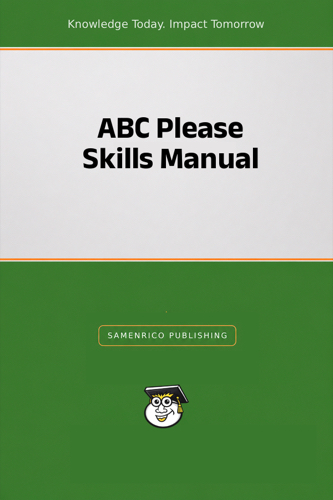
ABC Please Skills Manual eBook
Build physical resilience to emotional storms usin
Build physical resilience to emotional storms using Accumulate positives, Build mastery, and Please care for body.
Formats
Free sample
Chapter 1: The Body’s Rebellion...--–- You are not broken. Your nervous system is just doing its job—and no one gave you the manual.The first time your heart races for no reason, you think you are dying. The tenth time, you think you are going crazy. The fiftieth time, you learn to hide it. You smile through meetings.
You laugh at jokes while your chest feels like a trapped animal. You tell yourself to breathe, to calm down, to think positive thoughts. And when that doesn’t work—because it never does—you conclude something is fundamentally wrong with you.Let me stop you right there.Nothing is fundamentally wrong with you. Your nervous system is not broken, defective, or malfunctioning. It is doing exactly what it evolved to do over millions of years: protect you from threat.
The problem is not your body’s reaction. The problem is that your body is detecting threats that your rational mind knows are not dangerous—a crowded grocery store, a text message left on read, a performance review at work, a memory that flashes unbidden. And no amount of positive thinking will convince a survival system that it is safe when every physiological signal says otherwise.This chapter is about understanding that rebellion. Your body is not your enemy. It is a highly sophisticated early warning system that has been calibrated—through genetics, childhood experiences, trauma, chronic stress, and simply being human—to sound the alarm too often and too loudly.
Once you understand how that system works, you can stop fighting it and start working with it. That shift—from fighting to partnering—is the foundation of everything that follows in this book.The Three-Color Nervous System Let me simplify something that neuroscientists spend decades studying. Your autonomic nervous system has three primary states, and understanding them is like learning to read a dashboard. You cannot fix a problem if you cannot name it.The Green Zone: Ventral Vagal (Safe, Social, Regulated)This is your home base. In Green Zone, your nervous system signals safety.
Your heart rate is moderate and variable—speeding up slightly when you inhale, slowing when you exhale. Your facial muscles are relaxed enough that you can make eye contact, smile genuinely, and read other people’s expressions. Your voice has natural prosody—it rises and falls. You can think clearly, solve problems, and feel connected to others.In Green Zone, a frustrating email might annoy you, but you do not spiral. A disagreement with a partner might be uncomfortable, but you can talk it through.
Your emotional threshold is high—it takes a significant trigger to knock you offline.Most people spend far less time in Green Zone than they realize. If you grew up in a chaotic household, if you have experienced trauma, if you have chronic pain or illness, if your job demands hypervigilance—your nervous system may rarely experience true safety. You might not even know what Green Zone feels like.The Yellow Zone: Sympathetic (Fight or Flight)This is your activation state. In Yellow Zone, your nervous system detects a threat—real or perceived—and prepares you to survive it. Your adrenal glands release epinephrine and norepinephrine.
Your heart rate spikes. Your breathing becomes shallow and rapid, pulling oxygen into your large muscle groups. Blood shifts away from your digestive system and prefrontal cortex toward your limbs. Your pupils dilate. Your hearing becomes more acute.
Your body is preparing to fight the threat or flee from it.Here is what most people misunderstand: Yellow Zone is not bad. It is essential. If a car swerves toward you, you need Yellow Zone to jump out of the way. If someone threatens you, you need Yellow Zone to defend yourself. The problem is not activation itself.
The problem is chronic or inappropriate activation—being in Yellow Zone when you are sitting in traffic, lying in bed, or trying to have a calm conversation.The physical sensations of Yellow Zone feel like anxiety: racing heart, sweaty palms, tight chest, clenched jaw, tunnel vision, the urge to move or escape. Your thoughts become narrow and threat-focused. You might interpret a neutral comment as an attack. You might snap at someone who does not deserve it. You might feel an overwhelming urge to check your phone, eat something, drink alcohol, or do anything to make the feeling stop.Many people live in low-grade Yellow Zone constantly.
They do not feel the full roar of fight-or-flight—just a persistent hum of tension, irritability, and vigilance. They have forgotten what stillness feels like.The Red Zone: Dorsal Vagal (Freeze, Collapse, Shutdown)If Yellow Zone is too much activation, Red Zone is too little. When your nervous system detects a threat so overwhelming that fight or flight is impossible—or when fight-or-flight has failed repeatedly—it activates an ancient survival circuit. Your body shuts down. Heart rate and blood pressure drop.
You may feel numb, heavy, disconnected from your body or surroundings. Your face may go blank. Your voice may become flat or disappear entirely.Red Zone is dissociation. It is the feeling of watching yourself from outside your body. It is suddenly feeling very tired in the middle of an argument.
It is going numb during a difficult conversation. It is the inability to speak or move even though you want to.Like Yellow Zone, Red Zone is not a malfunction. A mouse frozen in the presence of a cat is using dorsal vagal shutdown—playing dead in hopes the predator loses interest. A human who experiences overwhelming trauma may dissociate to survive an experience that would otherwise be unbearable. The problem is when Red Zone activates in non-life-threatening situations: during a disagreement with a partner, while giving a presentation, when a memory surfaces unexpectedly.Many people swing between Yellow and Red without ever touching Green.
They are revved up (anxious, irritable, reactive) until they crash into shutdown (numb, exhausted, dissociated). They may mistake this cycle for bipolar disorder, borderline personality disorder, or simply being "too sensitive." Often, it is a nervous system that has lost access to the middle path.What Most Self-Help Books Get Wrong At this point, you might expect me to give you breathing exercises. You might expect me to tell you to "just notice your thoughts" or "practice mindfulness" or "reframe your cognitive distortions." I am not going to do that.Not because those techniques are useless. They are not. Mindfulness and cognitive reframing have genuine value—for people whose nervous systems are already in Green Zone.
For someone whose heart is racing, whose jaw is clenched, whose body is preparing to fight or flee, asking them to "take a deep breath" is like asking someone to solve a calculus problem while being chased by a bear. The prefrontal cortex—the part of your brain responsible for rational thought, impulse control, and emotional regulation—literally goes offline during Yellow and Red Zone activation.This is not metaphorical. Neuroimaging studies show that during high emotional arousal, blood flow decreases to the prefrontal cortex and increases to the amygdala (threat detection) and brainstem (automatic survival responses). You cannot think your way out of a state that…
This is the end of the free sample. Get the eBook to keep going. Buy now
About this book
Details
- Author
- Gatewood Hortense
- Publisher
- SamEnrico
- Language
- English
- Genre
- Non-Fiction, Self-Help, DBT, Self Care
- Released
- 2026-06-09
- Pages (approx.)
- 145
- Available as
- eBook, Audiobook

Read better in the ZLOADR app
Your eBooks on your phone or tablet. Sign in with your SamEnrico account and start reading.
More by Gatewood Hortense
 Power Posing for Presentation NervesGatewood Hortense$11.99
 News Corp Global TakeoverGatewood Hortense$11.99
 Prioritization for Project ManagersGatewood Hortense$11.99
 Service Positions in Twelve StepsGatewood Hortense$11.99
 The Serpent’s Crown: The Lost Dynasty of the AmazonGatewood Hortense$11.99
 Frozen Frontiers: The Unseen Expeditions of Antarctica's Indigenous GuardiansGatewood Hortense$11.99
 Sursassite MiningGatewood Hortense$11.99
 Ten Year Career OutcomesGatewood Hortense$12.99
 Alibaba Supplier Red Flags GuideGatewood Hortense$12.99
 Understanding Blepharophimosis Ptosis Esotropia Syndactyly ShortGatewood Hortense$17.99
 How to Start a Powder Compact Made of Plastic Business (Beginners Guide)Gatewood Hortense$11.99
You may also like
 Hong Kong Handover 1997Dunn Johnnie$11.99
 Zumba For Postnatal Recovery CourseNeal Christian$11.99
 Zumba for BeginnersLadner Nikia$11.99
 YouTube Comment Mining GuideHumes Pandora$12.99
 Worry Box MeditationCarlin Rudy$11.99
 Workplace Stress MeditationNguyen Lynn$11.99
 Workplace Stress and Sleep RepairHawley Ivory$11.99
 Workplace Perfectionism CureDelaney Jeffry$11.99
 Workplace Injustice Anger GuideWallen Isabelle$11.99
 Work Addiction and Burnout LinkGreenwood Ester$11.99
 Women in Yoga and WellnessBeattie Galina$11.99
 Women in Stand Up ComedyChun Evangeline$11.99