
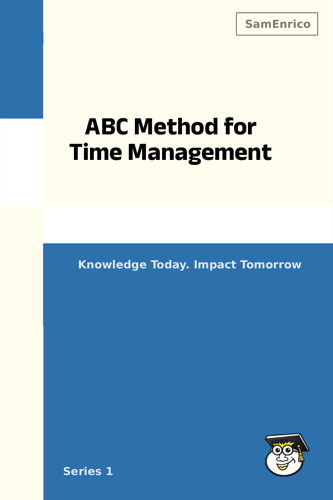
ABC Method for Time Management eBook
Implement the Brian Tracy system to tackle hardest
Implement the Brian Tracy system to tackle hardest tasks first each morning.
Formats
Free sample
Chapter 1: The Frog That Ate Your Life--–- You do not have a time management problem. You have an avoidance problem. And the proof is sitting on your to-do list right now, untouched, day after day, growing heavier not because it is becoming more difficult but because your failure to start it has turned a simple task into a monument of shame.Let us be honest about what happens every morning. You wake up. Maybe you check your phone immediately—email, messages, news, social media.
You tell yourself this is “staying informed” or “warming up.” Then you make coffee. You sit down. You look at your to-do list, which you wrote yesterday or last week or sometime in the vague past when you still believed that writing things down was the same as doing them. And there it is. That one task.
The one you have been avoiding for three days, or three weeks, or three months. You know which one I am talking about. Do not pretend you do not.Your eyes skip over it. You tell yourself you will do it later. You do something else instead—something easier, something that feels productive but is not actually important.
You answer emails. You reorganize your files. You read an article about productivity. You clean your desk. You make a second cup of coffee.
And at the end of the day, that task is still there. Unchanged. Unstarted. And you feel exhausted not because you worked hard but because you spent the entire day running from something you were afraid to face.This is not laziness. This is not a character flaw.
This is your brain doing exactly what it evolved to do.The Anatomy of Avoidance Your brain is not designed for modern productivity. It is designed for survival on the African savanna, where the most important skill was avoiding things that might kill you. A saber-toothed tiger? Avoid. A poisonous snake?
Avoid. A rival tribe? Avoid. Your brain became extraordinarily good at pattern recognition and threat assessment, and it learned one lesson above all others: uncertainty is dangerous.Here is what most productivity books get wrong. They tell you that you procrastinate because you are disorganized, or lazy, or lacking willpower.
They tell you to “just do it” or “try harder” or “wake up earlier.” But these are not solutions. They are accusations dressed as advice. The truth is more interesting and more useful: you procrastinate because you are smart. Your brain has correctly identified that the task you are avoiding carries a risk of discomfort, failure, or emotional pain. And your brain, still operating on savanna rules, has decided that the safest course of action is to do nothing.Consider what happens when you finally force yourself to start that dreaded task.
Notice the feeling. There is resistance at first—a physical sensation, almost like pushing against a heavy door. Your chest tightens. Your mind generates a hundred reasons why now is not the right time. But then, after a few minutes of actually working, something shifts.
The resistance dissolves. The task becomes manageable. Sometimes it even becomes enjoyable. And when you finish, you feel something remarkable: relief, satisfaction, even euphoria.That feeling is not an accident. It is chemistry.The Dopamine Lie (And Why It Matters)You have heard about dopamine.
It is the “reward chemical,” the thing that makes you feel good when you eat chocolate, have sex, or scroll through social media. But here is what most people do not understand: dopamine is not released when you receive a reward. It is released when you pursue a reward. The anticipation of completing a difficult task triggers more dopamine than the completion itself. This is why crossing something off your to-do list feels so good—not because the task is done, but because your brain has been anticipating that moment of completion.This creates a paradox.
Your brain is wired to seek dopamine, but it is also wired to avoid uncertainty. A difficult task offers a large potential dopamine reward—but only if you complete it. Your brain, calculating risk versus reward on a system designed 200,000 years ago, often decides that the certain discomfort of starting is not worth the uncertain reward of finishing. So it chooses the easier path: check email, reorganize files, make coffee. These small tasks offer small, immediate, guaranteed dopamine hits.
The difficult task offers a large, delayed, uncertain hit. Your brain, like a lazy accountant, chooses the certain small reward over the uncertain large one.This is the fundamental problem of productivity. And it is the problem this book exists to solve.The Frog Metaphor (And Why It Works)Mark Twain famously said: “Eat a live frog first thing in the morning, and nothing worse will happen to you the rest of the day.” This is one of those quotes that everyone has heard but almost no one has actually applied. A “frog” is not just any task. It is the task you are most likely to procrastinate on—the one that, if you did it, would have the greatest positive impact on your work, your goals, and your life.But here is the distinction that most people miss.
Your frog is not simply the hardest task on your list. It is the task that, once completed, makes every other task on your list easier or irrelevant. This is the difference between difficulty and leverage. A task can be difficult but low-leverage—for example, reorganizing your email folders by color. This takes time and effort but produces almost no meaningful result.
Another task can be moderately difficult but extremely high-leverage—for example, having a difficult conversation with a colleague about a recurring problem. This task might take fifteen minutes but could save you fifty hours of frustration over the next year.Your frog is the highest-leverage task. It is the one that, if you eat it first, changes the entire landscape of your day.The Avoidance Reflex: Your Primary Enemy Throughout this book, you will encounter many obstacles: technology, interruptions, unclear goals, skill gaps, fear, fatigue. But these are not your real enemy. They are weapons.
They are tools that your real enemy uses to keep you stuck. Your real enemy is something I call the avoidance reflex.The avoidance reflex is an automatic neurological response that activates whenever you approach a task that carries a risk of discomfort, failure, or emotional pain. It is not a conscious choice. You do not decide to procrastinate. Your avoidance reflex decides for you, below the level of your awareness, and then your conscious mind generates a perfectly reasonable explanation for why you should check email first, or make coffee, or “warm up” with something easier.Here is how the avoidance reflex works in real time.
You sit down to work. You think about your frog—the difficult, high-leverage task you have been avoiding. Immediately, your amygdala (the brain’s threat detection center) activates. It does not know the difference between a saber-toothed tiger and a quarterly report. All it knows is that this task is associated with past discomfort, potential failure, or emotional pain.
So it sends a signal to your prefrontal cortex—the rational part of your brain—that says, in effect, “Danger. Do something…
This is the end of the free sample. Get the eBook to keep going. Buy now
About this book
Details
- Author
- Newman Frankie
- Publisher
- SamEnrico
- Language
- English
- Genre
- Non-Fiction, Self-Help
- Released
- 2026-06-08
- Pages (approx.)
- 134
- Available as
- eBook, Audiobook

Read better in the ZLOADR app
Your eBooks on your phone or tablet. Sign in with your SamEnrico account and start reading.
More by Newman Frankie
 DBT For Grief ProcessingNewman Frankie$11.99
 Pomodoro For Meal PrepNewman Frankie$11.99
 Self Directed IRA Rental GuideNewman Frankie$11.99Self Directed IRA Rental GuideNewman Frankie$11.99
 Pelvic Floor During IVFNewman Frankie$11.99
 Breath Awareness In LineNewman Frankie$11.99
 Antwerp Heist CriminologyNewman Frankie$11.99
 Abandonment and Self WorthNewman Frankie$11.99
 The Silent Witness: The Union Boss Who VanishedNewman Frankie$11.99
 Leiden's Starvation: The Siege That Forged a NationNewman Frankie$11.99
 Ultimate Handbook Guide to Georgetown : (Guyana) Travel GuideNewman Frankie$11.99
 Automated Bank Reconciliation GuideNewman Frankie$12.99
You may also like
 Hong Kong Handover 1997Dunn Johnnie$11.99
 Zumba For Postnatal Recovery CourseNeal Christian$11.99
 Zumba for BeginnersLadner Nikia$11.99
 YouTube Comment Mining GuideHumes Pandora$12.99
 Worry Box MeditationCarlin Rudy$11.99
 Workplace Stress MeditationNguyen Lynn$11.99
 Workplace Stress and Sleep RepairHawley Ivory$11.99
 Workplace Perfectionism CureDelaney Jeffry$11.99
 Workplace Injustice Anger GuideWallen Isabelle$11.99
 Work Addiction and Burnout LinkGreenwood Ester$11.99
 Women in Yoga and WellnessBeattie Galina$11.99
 Women in Stand Up ComedyChun Evangeline$11.99