
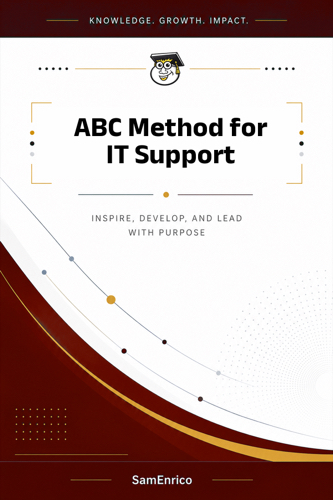
ABC Method for IT Support eBook
Rank tickets by system criticality and number of u
by Burke Matt
Rank tickets by system criticality and number of users affected.
Formats
Free sample
Chapter 1: The Chaos Audit--It was 9:03 AM on Cyber Monday when the payment gateway died.Not with a dramatic explosion of sparks or a blaring alarm. It died quietly. A single line of red text appeared on the monitoring dashboard: “Payment Gateway – HTTP 503 – Service Unavailable.” The on-call technician, Marcus, saw it immediately. His finger hovered over the ticket creation button. He knew, in his bones, that this was bad.
This was the kind of bad that got people fired.But Marcus had a problem. The queue in front of him held 47 tickets. Forty-seven. And his helpdesk, like most helpdesks, operated on an unspoken but ironclad rule: first in, first out. FIFO.
It felt fair, didn't it? No accusations of favoritism. No angry users screaming about line-jumping. Just a simple, orderly line.So Marcus did what he was trained to do. He opened ticket number 48—the payment gateway outage—and placed it at the end of the queue.
Behind the 43 password resets. Behind the 12 printer jams. Behind the request from accounting for a new wireless mouse.At 9:15 AM, the CEO’s phone rang. A customer had tried to check out and failed. Then another.
Then a hundred. By 9:45 AM, the company’s revenue dashboard looked like a heart monitor flatlining. By 11:45 AM, when Marcus finally reached ticket number 48, the company had lost $187,000 in sales. The damage was done. The gift cards they would have to issue as apologies would cost another $40,000.
The social media firestorm was already spreading.The root cause of the disaster was not a faulty server or a bad software update. The root cause was a well-intentioned but catastrophically flawed prioritization system: FIFO. Treating all tickets as equal had treated business value as worthless.This book exists because of what happened to Marcus. And because what happened to Marcus happens every single day in thousands of IT departments around the world. The names change.
The dollar amounts change. But the pattern is always the same: a helpdesk drowning in tickets, unable to distinguish between a papercut and a heart attack, lurches from crisis to crisis, burning out its staff and frustrating its users, all while believing that it is being “fair.”This book is the antidote to FIFO. It is called the ABC Method, and it will transform your helpdesk from a chaotic lottery into a business-aligned, data-driven service organization. But before we can build the solution, we must first fully understand the depth of the problem. And the problem, as we will see, is far worse than most IT managers realize.The Three Faces of Chaos The payment gateway story is dramatic, but it is only one flavor of the chaos that infects poorly prioritized helpdesks.
Through years of research, post-mortem analyses, and case studies from organizations ranging from small startups to Fortune 500 enterprises, three distinct failure patterns emerge again and again. Understanding these patterns is the first step toward escaping them.Case Study One: The FIFO Fallacy Let us return to Marcus and his helpdesk, because the FIFO Fallacy deserves a deeper autopsy. The belief that “first come, first served” is inherently fair is one of the most persistent and destructive myths in IT service management.Consider the math. Marcus’s queue of 47 tickets ahead of the payment gateway outage had an average resolution time of 12 minutes per ticket. Those 47 tickets represented approximately 9.4 hours of work.
But here is the cruel arithmetic: the 43 password resets and 12 printer jams could have been postponed for hours, even days, without causing any measurable business harm. The payment gateway outage, by contrast, was hemorrhaging money every second it remained unresolved. By placing the high-impact, high-urgency ticket at the back of the line, Marcus’s helpdesk had effectively chosen to lose $187,000 rather than inconvenience 55 users with minor issues.The FIFO Fallacy has a second, more insidious layer. It creates a hidden incentive for technicians to prioritize easy tickets over hard ones, regardless of order. A technician looking at a queue of 50 tickets will naturally gravitate toward the 5-minute password reset rather than the 4-hour database reconstruction.
This is not laziness; it is basic human psychology. We seek quick wins. We want to feel productive. Closing ten easy tickets in an hour feels like progress. Spending four hours on one difficult ticket feels like stagnation.But this behavior, when multiplied across a team of technicians, creates a vicious cycle.
The hard tickets sit at the bottom of the queue, aging like forgotten milk. They require more context to resolve because the original issue has degraded. They generate more angry follow-up emails from frustrated users. They eventually escalate to managers, consuming even more organizational attention. The total cost of a ticket handled late is often three to five times higher than the same ticket handled promptly.The Financial Formula: If your helpdesk processes 10,000 tickets per year, and just 5% of those tickets are misprioritized due to FIFO, the direct labor cost of rework, escalation, and customer dissatisfaction can easily exceed $200,000 annually.
That is not a rounding error. That is a full-time salary for two senior technicians.Case Study Two: The Squeaky Wheel The second failure pattern is even more corrosive to team morale and user trust. It is what we call the Squeaky Wheel problem.Maria was a senior database administrator at a financial services firm. She submitted a ticket at 8:15 AM: “Production database replication lag – 15 minutes behind – risk of data loss if primary fails.” She rated it as high priority. The helpdesk acknowledged it, placed it in the queue, and promised to update her within two hours.At 8:45 AM, David from sales submitted a ticket: “Laptop won’t connect to projector for 10 AM client demo.” His laptop was working fine; the projector simply needed its input source changed.
David did not know this, but he knew how to be loud. He called the helpdesk at 8:50 AM, 8:55 AM, 9:00 AM, and 9:05 AM. Each time, he raised his voice. Each time, he threatened to “escalate to the VP.” By 9:10 AM, a technician had been dispatched to David’s conference room to change the projector input. Maria’s database replication lag ticket remained untouched.At 10:30 AM, the primary database node failed.
The replication lag meant the secondary node was 45 minutes out of sync. The recovery took six hours. The firm lost an estimated $2.3 million in trading revenue during the outage. David’s client demo, by the way, went perfectly.The Squeaky Wheel problem is not a failure of process. It is a failure of psychology.
Helpdesk technicians are human beings who experience stress, who want to avoid conflict, and who have been conditioned by years of customer service training to “make the customer happy.” A loud, angry, persistent user triggers a fear response. The technician’s brain, operating on instinct, prioritizes threat reduction over business value. The silent, patient user—the one whose ticket actually represents a genuine business risk—is inadvertently penalized for their professionalism.This problem is amplified by modern helpdesk metrics. Many organizations track “first response time” as a key performance indicator. A technician who responds to David’s projector ticket in 2 minutes looks great on a dashboard.
A technician who spends 30 minutes investigating Maria’s database issue before responding looks terrible. The metric, which was designed to…
This is the end of the free sample. Get the eBook to keep going. Buy now
About this book
Details
- Author
- Burke Matt
- Publisher
- SamEnrico
- Language
- English
- Genre
- Non-Fiction, Self-Help
- Released
- 2026-06-11
- Pages (approx.)
- 146
- Available as
- eBook, Audiobook

Read better in the ZLOADR app
Your eBooks on your phone or tablet. Sign in with your SamEnrico account and start reading.
More by Burke Matt
 Only Child Self Worth GuideBurke Matt$11.99
 Mindfulness for Teens GuideBurke Matt$11.99
 Alcohol Relapse Distress ToleranceBurke Matt$11.99
 Design Thinking For FinanceBurke Matt$11.99
 The Priority ChallengeBurke Matt$11.99
 Startup Tax PreparationBurke Matt$11.99
 Apple Fitness ComparisonBurke Matt$11.99
 Anansi’s Web of Lies: The Spider’s Endless TrickeryBurke Matt$11.99
 The Phantom Developer: How a Real Estate Mogul Bought a Country’s SoulBurke Matt$11.99
 How to Produce Hands Paint RemoverBurke Matt$11.99
 Sandbox Testing for Bank APIsBurke Matt$12.99
 Chinese Supplier Payment Discount NegotiationBurke Matt$12.99
You may also like
 Workplace Stress MeditationNguyen Lynn$11.99
 Volcano Monitoring ScientistCox Alexis$11.99
 The Tech Professional NetAguiar Nevada$11.99
 The Morning Metta RitualCanales Anya$11.99
 The Chunking Memory TechniqueClanton Hyacinth$11.99
 The Beginner Mistake FixAmmons Cassondra$11.99
 Surrendering to What IsGrimm Reatha$11.99
 Self Hypnosis for Fear of FireBillups Eli$11.99
 Road Rage for Professional DriversBrackett Janise$11.99
 Psychiatric Ward Nurse StressDunning Wyatt$11.99
 Observation vs Evaluation NVCTimmons Alda$11.99
 Networking for Nonprofit ProfessionalsPoole Jesse$11.99