
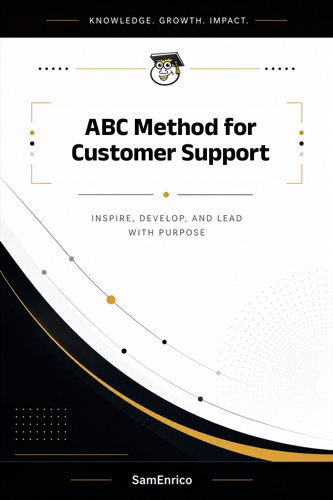
ABC Method for Customer Support eBook
Rank tickets by impact on customer retention and r
Rank tickets by impact on customer retention and revenue loss.
Formats
Free sample
Chapter 1: The $10,000 Password Reset--The email arrived at 9:47 AM on a Tuesday."Your support is a joke. I've been waiting four hours for someone to help me reset my password. I have a team of 47 people who cannot work. We are switching to your competitor effective immediately. Cancel our account."The support agent who finally saw this ticket at 10:15 AM had no idea who this customer was.
The ticket had been sitting in the general queue, behind 47 other requests. Among those 47 were password resets from free trial users, a question about changing a profile picture, someone asking if the company had a Slack community, and a complaint about a typo in the help documentation.The agent, following standard protocol, responded with the pre-written password reset instructions and apologized for the delay.The customer never replied.Because the customer had already signed a contract with a competitor during the four hours they waited.The annual value of that lost contract? Two hundred and forty thousand dollars.All over a password reset.The Fairness Trap This is not a story about bad customer service. This is a story about a system that was designed to fail.The company in question had what most leaders would call a "fair" support policy. First-in, first-out.
Every customer gets treated equally. No favorites. No jumping the line. It sounds reasonable. It sounds ethical.
It sounds like the kind of thing you would put in a company values document under "We treat everyone with respect."It is also mathematically guaranteed to destroy your business.Let me explain why.When you treat every customer equally, you are not treating them fairly. You are treating them identically. And identical treatment of unequal situations is the definition of unfairness.A customer paying $10,000 per month who cannot log in to run their business is not in the same situation as a free-tier user who forgot their password. A customer whose payment just failed and whose account is about to be frozen is not in the same situation as someone asking how to change their avatar. A customer who has explicitly said "I am leaving" is not in the same situation as someone who says "Thanks, this was helpful."Yet most support organizations treat these tickets identically.
They sit in the same queue. They wait the same amount of time. They receive the same templated responses.This is the Fairness Trap. And it is quietly, systematically, and predictably leaking revenue from your business every single day.The Mathematics of Revenue Leak Let me show you the math behind the Fairness Trap.Imagine you have two tickets arrive at the exact same moment.Ticket A comes from a customer with a lifetime value of $100,000. Their business is completely blocked.
They cannot process payments, cannot access customer data, cannot run their operations. Every hour they wait costs them money. Every hour they wait increases the probability that they will leave forever.Ticket B comes from a free-tier user who has never paid you a dollar. They want to know how to change their email address. They can wait.
The world will not end.Under a FIFO system, these two tickets are treated identically. They sit in the queue in the order they arrived. Whichever one came in first gets served first. The difference of thirty seconds in arrival time determines which customer gets attention first.Now let me ask you a question. If you had to choose which customer to help first, which would you choose?Every reasonable person chooses Ticket A.
Every reasonable person understands that the consequences of delaying Ticket A are catastrophic, while the consequences of delaying Ticket B are trivial.But here is the problem. Most support organizations do not give their agents the freedom to make this choice. The system itself prevents it. The queue is the queue. The rules are the rules.
First come, first served.This is not a technology problem. This is a philosophy problem. And it is costing you more money than you probably want to know.Let me quantify it.Calculating Your Hidden Revenue Leak Take out a piece of paper. Or open a spreadsheet. I want you to calculate something.First, identify your top 10% of customers by monthly spend.
Calculate their average lifetime value. For most B2B Saa S companies, this number is somewhere between $50,000 and $500,000. For e-commerce, it might be smaller but the volume is higher. For enterprise software, it can run into the millions.Now, look at your average response time for tickets. Not the average you report to the board.
The real average. The one that includes the tickets that sat for six hours because everyone was busy.Now, look at your churn data. Specifically, look at the churn rate among customers who experienced a response time longer than your average. Most companies see churn rates increase by 15-30% when response times double.Now multiply.If your average high-value customer has an LTV of $100,000, and your delayed response rate increases their churn probability by 20%, and you have 100 such customers who experience delays each year, you are looking at $2,000,000 in annual revenue leak.Two million dollars. From slow responses to a small group of customers.And here is the cruel irony.
You are probably spending money on customer acquisition to replace that lost revenue. You are paying sales commissions, marketing spend, advertising costs to bring in new customers to replace the ones your support system is driving away.You are literally paying to acquire customers that your support team is then losing.The Four-Hour Cliff There is something else the data shows. Something most support leaders have never seen because they are looking at the wrong numbers.Resolution time does not have a linear relationship with churn. It has an exponential one.Let me explain what that means.If you resolve a ticket in five minutes versus thirty minutes, the difference in churn probability is negligible. Customers barely notice.
They are still happy.If you resolve a ticket in thirty minutes versus two hours, the difference starts to appear. Some customers will notice. A few will be annoyed. A very small percentage will churn.But if you resolve a ticket in four hours versus eight hours, the difference is dramatic. The churn probability does not double.
It quadruples. It octuples.There is a cliff. And that cliff is somewhere between three and five hours for most industries.Before the cliff, customers are patient. They understand that things take time. They assume you are busy.
They give you the benefit of the doubt.After the cliff, something changes. The customer starts to feel abandoned. They start to wonder if you care about them. They start to look at alternatives. They start to tell their colleagues about their bad experience.And if you cross the eight-hour mark?
The data shows that customers who wait eight hours or more for a first response have a churn rate nearly ten times higher than customers who get a response within one hour.Ten times.Think about that for a moment. A customer who waits eight hours is ten times more likely to leave than a customer who waits one hour. Not twice as likely. Not five times as…
This is the end of the free sample. Get the eBook to keep going. Buy now
About this book
Details
- Author
- Haskins Keiko
- Publisher
- SamEnrico
- Language
- English
- Genre
- Non-Fiction, Self-Help
- Released
- 2026-06-08
- Pages (approx.)
- 126
- Available as
- eBook, Audiobook

Read better in the ZLOADR app
Your eBooks on your phone or tablet. Sign in with your SamEnrico account and start reading.
More by Haskins Keiko
 Mindfulness for Veterans GuideHaskins Keiko$11.99
 Postpartum Self Care Recovery PlanHaskins Keiko$11.99
 Profit and Loss for FoundersHaskins Keiko$11.99
 Uber Eats Lifestyle CompareHaskins Keiko$11.99
 The Priority and Time BlockingHaskins Keiko$11.99
 Design Thinking For LibrariesHaskins Keiko$11.99
 Depression NeurobiologyHaskins Keiko$11.99
 The Enlightenment Unchained: Voltaire’s Lost RepublicHaskins Keiko$11.99
 The Art of War and the Art of the Game: Sun Tzu’s Influence on Ancient Chinese SportsHaskins Keiko$11.99
 How to Produce Hard Drive DuplicatorsHaskins Keiko$11.99
 Mastering The Art of Musti-yuddhaHaskins Keiko$11.99
 Multiple Choice Online Exam TricksHaskins Keiko$12.99
You may also like
 Workplace Stress MeditationNguyen Lynn$11.99
 Volcano Monitoring ScientistCox Alexis$11.99
 The Tech Professional NetAguiar Nevada$11.99
 The Morning Metta RitualCanales Anya$11.99
 The Chunking Memory TechniqueClanton Hyacinth$11.99
 The Beginner Mistake FixAmmons Cassondra$11.99
 Surrendering to What IsGrimm Reatha$11.99
 Self Hypnosis for Fear of FireBillups Eli$11.99
 Road Rage for Professional DriversBrackett Janise$11.99
 Psychiatric Ward Nurse StressDunning Wyatt$11.99
 Observation vs Evaluation NVCTimmons Alda$11.99
 Networking for Nonprofit ProfessionalsPoole Jesse$11.99