
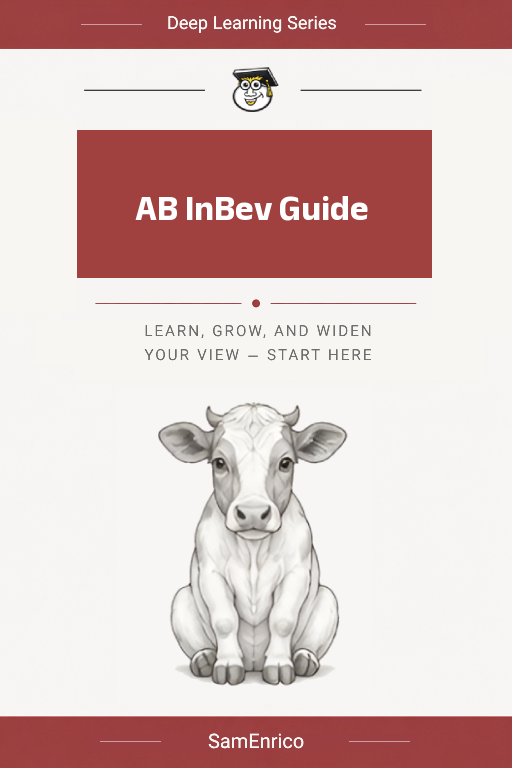
Non-FictionStrategic AtlasBeverage Logistics
AB InBev Guide eBook
Trace brewing consolidation, distribution network
Trace brewing consolidation, distribution network optimization, and keg logistics for global beer giant.
Formats
Free sample
Chapter 1: The Zero-Based Mindset...--–- On a humid July morning in 2008, a small team of Brazilian financiers walked into the headquarters of Anheuser-Busch in St. Louis. They carried no spreadsheets. They made no Power Point presentation. They simply announced that they were taking over one of America's most beloved companies—and that the era of comfortable, incremental management was over.
The men from 3G Capital, led by Jorge Paulo Lemann, had not built their fortune on innovation or marketing genius. They had built it on a single, ruthless idea: every dollar spent must be justified from zero, every single year.This is the story of Zero-Based Budgeting (ZBB)—the financial engine that powered AB In Bev's transformation from a struggling Brazilian brewer into the world's largest beer company. But more than that, it is the story of how a seemingly simple accounting discipline became a weapon of mass acquisition, a tool for cultural revolution, and the most misunderstood competitive advantage in modern business.The question that haunts every large company is simple: Where does the money go? Most organizations answer this question by looking backward. They take last year's budget, add a percentage for inflation, adjust for expected growth, and call it a plan.
This approach, known as incremental budgeting, is comfortable. It is predictable. And it is deadly. Over time, small inefficiencies compound into massive waste. A line item that made sense five years ago persists because "that's what we've always spent." No one questions it.
No one kills it. The organization slowly calcifies.AB In Bev's founders rejected this logic entirely. They asked a different question: If we were starting this company from scratch today, with no history, no legacy, and no sacred cows, what would we spend? Every expense—from the salary of a senior vice president to the cost of cleaning supplies on a factory floor—must be justified anew each budget cycle. Nothing is carried forward.
Nothing is assumed. Zero is the only starting point.This chapter will dissect the Zero-Based Budgeting machine that powered the 52billion In Bev–Anheuser−Buschmergerandthe52 billion In Bev–Anheuser-Busch merger and the 52billion In Bev–Anheuser−Buschmergerandthe100+ billion SABMiller acquisition. It will explain how cost-cutting became an engine for growth, not a defensive retreat. It will resolve the apparent contradiction between ZBB's short-term discipline and AB In Bev's long-term investments in innovation. And it will provide the financial foundation for every logistics decision in the chapters that follow.
Because before you can move beer efficiently, you must understand how the company that moves it thinks about money.The Brazilian Trio and the Birth of a Philosophy To understand ZBB at AB In Bev, you must first understand the men who imported it from the world of private equity into the sleepy world of beer. Jorge Paulo Lemann, Marcel Telles, and Beto Sicupira were not brewers. They were bankers, investors, and relentless efficiency seekers. In the 1970s, they built Banco Garantia into Brazil's premier investment bank by applying a simple principle: hire the best people, pay them exceptionally well, and demand that every expense be justified as if the bank were on the verge of bankruptcy.When they acquired Brahma (later Companhia Cervejaria Brahma) in 1989, the Brazilian beer market was fragmented, inefficient, and family-run. Breweries operated as fiefdoms.
Costs were opaque. No one knew—truly knew—whether a given plant was profitable or simply surviving on inertia. The trio imported their banking discipline: every plant manager had to justify every expense from zero. If a brewery had spent $10,000 on forklift maintenance last year, that meant nothing. What did forklift maintenance need to cost this year, given expected production volumes, equipment age, and industry benchmarks?The results were staggering.
Within a few years, Brahma's margins surpassed those of every other Brazilian brewer. The company merged with rival Antarctica in 1999 to form Am Bev, then crossed the Atlantic to merge with Interbrew (Belgium) in 2004, then seized Anheuser-Busch in 2008, and finally swallowed SABMiller in 2016. At each step, the ZBB machine came along for the ride, digesting the acquired company's cost structure and spitting out savings that helped pay for the next deal.This is the critical insight that most observers miss: ZBB is not a cost-cutting program. It is an acquisition financing mechanism. When AB In Bev buys a company, it does not pay from accumulated cash.
It borrows billions. The interest on that debt must be covered by new efficiencies. ZBB identifies those efficiencies—often 15–25% of the target's operating costs—within the first 12–18 months. The cost savings become the debt service. The acquisition pays for itself.How Zero-Based Budgeting Actually Works (The Mechanics)Let us move from philosophy to practice.
How does ZBB function inside a company that operates 150+ breweries across 50+ countries, manages 500+ brands, and employs 150,000+ people?The Annual Ritual Every September, AB In Bev's budget cycle begins. Each department head receives a blank slate. Not "last year's budget plus 3%." Not "your allocation reduced by 5% across the board." A literal zero. The manager must propose every expense for the coming year, with documented justification for each line item.The budget is divided into two distinct categories, and this distinction is crucial for understanding how AB In Bev avoids the trap of short-termism.Operating Expenses (Op Ex): These are the day-to-day costs of running the business—salaries, utilities, raw materials, marketing campaigns, travel, office supplies, maintenance. Op Ex is subject to full ZBB scrutiny every single year.
A marketing manager cannot say, "We spent 10millionon Super Bowladslastyear,soweneed10 million on Super Bowl ads last year, so we need 10millionon Super Bowladslastyear,soweneed10.5 million this year." They must start at zero and answer: What is the expected ROI of a Super Bowl ad? Is there a cheaper way to reach the same audience? Could we achieve similar results with digital advertising at half the cost?Capital Expenditures (Cap Ex): These are long-term investments—new breweries, warehouse automation, electric delivery fleets, the Perfect Draft system, multi-year technology implementations. Cap Ex is treated differently. These projects are proposed, approved, and funded on multi-year horizons, often with payback periods of five to ten years.
Once approved, Cap Ex is ring-fenced from annual budget cuts. A warehouse automation project approved for three years and $50 million will not be re-litigated each September.This distinction resolves the apparent contradiction between ZBB's annual scrutiny and AB In Bev's long-term innovation. The company is not myopic. It simply separates maintenance spending (Op Ex, heavily scrutinized) from transformation spending (Cap Ex, protected). A factory manager cannot hide inefficiency in her Op Ex budget, but she can propose a Cap Ex project to install solar panels that will pay back in seven years.
The two budgets operate under different rules.The Zero-Based Justification For any Op Ex line item, the manager must answer three questions:Is this expense legally or contractually required? (e.g., insurance, union agreements, tax compliance)Does this expense directly enable more revenue? (e.g., sales commissions, trade marketing)If neither, what is the consequence of eliminating it?Most expenses fail the third test. The consequence is often "nothing noticeable." Those expenses are cut. This is not cruelty.
It is discipline. AB In Bev's argument is simple: if you cannot articulate the consequence of a dollar spent, that…
This is the end of the free sample. Get the eBook to keep going. Buy now
About this book
Details
- Author
- Trudeau Freddy
- Publisher
- SamEnrico
- Language
- English
- Genre
- Non-Fiction, Strategic Atlas, Beverage Logistics
- Released
- 2026-06-01
- Pages (approx.)
- 141
- Available as
- eBook, Audiobook

Read better in the ZLOADR app
Your eBooks on your phone or tablet. Sign in with your SamEnrico account and start reading.
More by Trudeau Freddy
 Deep Rest Through TM GuideTrudeau Freddy$11.99
 Vaccine Myths Debunked GuideTrudeau Freddy$11.99
 The Equifax CEO DepartureTrudeau Freddy$11.99
 Disappointment Coping SkillsTrudeau Freddy$11.99
 The Gacy House Current StateTrudeau Freddy$11.99
 The Iron Titan: Carnegie’s Rise from Rags to RailsTrudeau Freddy$11.99
 Strategic ConsultantTrudeau Freddy$11.99
 AI Tax Provision CalculationTrudeau Freddy$12.99
 Understanding Multiple Fibrofolliculoma FamilialTrudeau Freddy$17.99
 How to Become a Cloth InspectorTrudeau Freddy$11.99
You may also like
 Hong Kong Handover 1997Dunn Johnnie$11.99
 Zumba For Postnatal Recovery CourseNeal Christian$11.99
 Zumba for BeginnersLadner Nikia$11.99
 YouTube Comment Mining GuideHumes Pandora$12.99
 Worry Box MeditationCarlin Rudy$11.99
 Workplace Stress MeditationNguyen Lynn$11.99
 Workplace Stress and Sleep RepairHawley Ivory$11.99
 Workplace Perfectionism CureDelaney Jeffry$11.99
 Workplace Injustice Anger GuideWallen Isabelle$11.99
 Work Addiction and Burnout LinkGreenwood Ester$11.99
 Women in Yoga and WellnessBeattie Galina$11.99
 Women in Stand Up ComedyChun Evangeline$11.99