
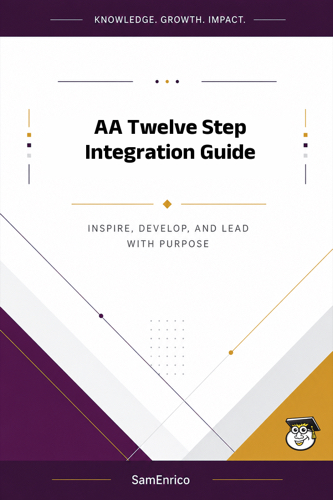
Non-FictionSelf-HelpTwelve Step
AA Twelve Step Integration Guide eBook
Works 12-step programs without spiritual barriers
by Gainey Louis
Works 12-step programs without spiritual barriers or resistance.
Formats
Free sample
Chapter 1: The Literalist Trap--–- The first time Sarah prayed at an AA meeting, she felt nothing. The second time, she felt dirty. The third time, she stood up, walked out mid-sentence, and drove directly to a bar. She was three weeks sober. Within 48 hours, she had lost her job, her apartment, and nearly her life.
When she returned to the rooms six months later, a well-meaning sponsor told her, “You just didn’t want it badly enough. You need to surrender.” Sarah, a trauma nurse with a degree in human physiology, thought: I am not the problem. The instruction manual is.She was right.You are holding this book for one of three reasons. Either you have tried Alcoholics Anonymous or Narcotics Anonymous and found yourself blocked by the God language, or you are currently in the rooms but secretly rolling your eyes during the Lord’s Prayer, or you have never walked through those church-basement doors because you assumed—correctly—that you would be asked to believe in something you cannot stomach. Whatever brought you here, the question is the same: Can I work the Twelve Steps without believing in a supernatural Higher Power?The answer is not just yes.
It is hell yes—but only if you stop making the one error that has driven millions of intelligent, skeptical, science-minded addicts back to their drug of choice. That error is what I call the Literalist Trap.The Literalist Trap Defined The Literalist Trap is the mistaken belief that the words of the Twelve Steps must be taken exactly as written, with their original 1930s Christian undertones fully intact, for the program to work. It is the insistence that “God” means a bearded man in the sky, that “prayer” means talking to an invisible entity, and that “spiritual awakening” means a visitation from the Holy Ghost. This trap is set by both sides of the religious divide: devout believers who insist on orthodox interpretation, and hard atheists who throw out the entire program because they reject the packaging.Here is what both groups miss. The Twelve Steps were never a divine revelation carved into stone tablets.
They were a pragmatic, cobbled-together protocol borrowed from a Christian revivalist movement called the Oxford Group, stripped of some of its more florid theology, and then accidentally canonized by two desperate alcoholics in Akron, Ohio, in the 1930s. Bill Wilson was a stockbroker who saw visions of white light while detoxing in a hospital. Dr. Bob Smith was a proctologist who prayed before surgery. They were not theologians.
They were men who stumbled backward into a behavioral technology that worked—not because God was in it, but because the structure worked.The trap is this: when you take the Steps literally, you focus on the nouns (God, prayer, awakening). When you take the Steps operationally, you focus on the verbs (admitted, came to believe, made, asked, took). The verbs are the medicine. The nouns are the sugar coating. And for millions of secular readers, that sugar coating is poison.This book is the antidote.The Problem of Success Rates (And Why It Doesn't Matter)Before we go any further, let us address the elephant in the room.
You have probably heard that AA has a success rate somewhere between 5 and 40 percent, depending on which study you read. You have heard that “AA works for those who work it” is a tautology. You have heard that the only people who stay in AA are the ones who were going to get sober anyway. And you may be thinking: Why bother adapting a program that barely works for believers, let alone for skeptics like me?Fair question. Here is the honest answer.The research on AA’s efficacy is a methodological swamp.
Early studies that claimed 5 percent success rates counted everyone who ever walked through the door, including people who attended one meeting and never returned—which is like measuring the success of a gym by counting everyone who ever bought a membership but never worked out. Later studies, including a large 2020 Cochrane review, found that AA and 12-step facilitation interventions perform as well or better than other treatments for alcohol use disorder, particularly for continuous abstinence. The truth is somewhere in the messy middle: AA helps a significant minority of people, fails many others, and—critically for our purposes—has a documented retention problem with atheists, agnostics, and anyone who feels alienated by religious language.But here is the point that changes everything. Regardless of the exact success rate, secular adaptations of the Twelve Steps consistently show higher retention and better outcomes for non-believers than traditional, theistic AA. The problem is not the Steps.
The problem is the literalism. When you translate “Higher Power” into “Reality” or “The Group” or “Future Self,” when you translate “prayer” into “affirmation” or “mindfulness,” when you translate “spiritual awakening” into “identity shift,” the dropout rate for secular participants plummets.This book is not a defense of AA as an institution. AA has plenty of problems: its insistence on lifetime attendance, its anti-medication stance in some groups, its patriarchal history, its resistance to formal outcome studies. But the structure of the Twelve Steps—the sequence of observation, deconstruction, confession, repair, and maintenance—is one of the most sophisticated psychological technologies ever developed for behavior change. And it has been hiding in plain sight, wrapped in language that makes it inaccessible to the very people who need it most.You do not need to believe in God to need a system that helps you admit you have a problem, examine your patterns, share your secrets with a trusted witness, make things right with people you have hurt, and build a daily practice of self-awareness.
That is just cognitive behavioral therapy with a group component. The only thing supernatural about it is how well it works when you strip away the superstition.What the Top Ten Secular Recovery Books Teach Us Over the past thirty years, a quiet literature has emerged—books written by atheists, agnostics, and “spiritual but not religious” addicts who reverse-engineered the Twelve Steps into a secular framework. This book synthesizes the ten most influential of them, including The Sober Truth by Dr. Lance Dodes, Staying Sober Without God by Jeffrey Munn, Unhooked by James Christopher, The Secular Big Book by the AA Agnostica group, and Beyond Belief by Joe C. Here is what they collectively teach us.First, the Steps are a cognitive-behavioral protocol in disguise.
Step One is functional analysis (identifying the relationship between trigger, behavior, and consequence). Step Four is behavioral logging. Step Five is exposure therapy for shame. Step Nine is behavioral economics (reparation). Step Ten is self-monitoring.
Step Eleven is mindfulness. Step Twelve is social modeling and reinforcement. Every single Step has a direct correlate in evidence-based psychotherapy. The language of “sin” and “redemption” is just the 1930s vernacular for “maladaptive patterns” and “behavioral change.”Second, the group functions as a legitimate Higher Power for secular purposes. Social support is one of the most robust predictors of recovery outcomes in the entire addiction literature.
The group—whether you call it the “Group Of Drunks” (G.O.D.) or simply “the fellowship”—provides accountability, modeling, feedback, and a sense…
This is the end of the free sample. Get the eBook to keep going. Buy now
About this book
Details
- Author
- Gainey Louis
- Publisher
- SamEnrico
- Language
- English
- Genre
- Non-Fiction, Self-Help, Twelve Step
- Released
- 2026-06-06
- Pages (approx.)
- 140
- Available as
- eBook, Audiobook

Read better in the ZLOADR app
Your eBooks on your phone or tablet. Sign in with your SamEnrico account and start reading.
More by Gainey Louis
 Attempt Survivor Teacher StoryGainey Louis$11.99
 Mindful Meditation For Gout FlaresGainey Louis$11.99
 Project Scope Creep ControlGainey Louis$11.99
 The Parent Carpool Network GuideGainey Louis$11.99
 Changping: The Bloodiest Battle of the Warring StatesGainey Louis$11.99
 How to Become a Compression-molding-machine OperatorGainey Louis$11.99
 Why This College Essay GuideGainey Louis$12.99
 Tesla Manufacturing SWOTGainey Louis$12.99
 Understanding Night BlindnessGainey Louis$17.99
 Procurement AdministratorGainey Louis$11.99
You may also like
 Hong Kong Handover 1997Dunn Johnnie$11.99
 Zumba For Postnatal Recovery CourseNeal Christian$11.99
 Zumba for BeginnersLadner Nikia$11.99
 YouTube Comment Mining GuideHumes Pandora$12.99
 Worry Box MeditationCarlin Rudy$11.99
 Workplace Stress MeditationNguyen Lynn$11.99
 Workplace Stress and Sleep RepairHawley Ivory$11.99
 Workplace Perfectionism CureDelaney Jeffry$11.99
 Workplace Injustice Anger GuideWallen Isabelle$11.99
 Work Addiction and Burnout LinkGreenwood Ester$11.99
 Women in Yoga and WellnessBeattie Galina$11.99
 Women in Stand Up ComedyChun Evangeline$11.99