
Non-FictionSelf-HelpSobriety Chips
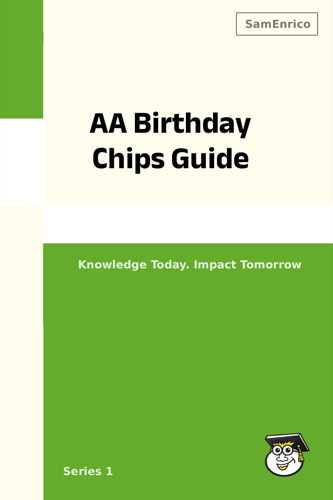
AA Birthday Chips Guide eBook
Explains sobriety milestone chips and medallions.
Explains sobriety milestone chips and medallions.
Formats
Free sample
Chapter 1: The Hidden Contract...--The first chip is never asked for. It is offered. A white, unassuming circle of metal or plastic, often no larger than a quarter, pressed into a trembling palm by someone who has been exactly where the newcomer now sits. There are no words adequate to that moment. The giver may say something routine—"This is just for today"—or nothing at all.
But the exchange itself speaks a language deeper than English. It says: You are not alone. You have made a promise. And we will hold you to it.This book is about that chip and every chip that follows. But before we can understand the colors, the ceremonies, the medallions polished to a mirror shine, we must answer a more fundamental question: Where did the idea of a sobriety token come from?
And why does a simple piece of metal have the power to keep a person sober when willpower alone has failed?The answer begins not in the church basements and church halls of twentieth-century Alcoholics Anonymous, but in the temperance societies of the 1840s, the quiet ingenuity of a Catholic nun named Sister Ignatia, and a psychological principle so ancient that the Romans understood it: a promise given to an object is harder to break than a promise whispered only to oneself.The Washingtonian Experiment: Brass Medals and Public Accountability Long before AA codified the Twelve Steps, the Washingtonian Temperance Society was doing something revolutionary. Founded in Baltimore in 1840 by six men who had struggled with alcohol, the Washingtonians rejected the moralizing tone of earlier temperance movements. They were not clergymen preaching from pulpits. They were tailors, blacksmiths, and carpenters who met in taverns—a deliberate inversion of expectations—and spoke to each other as equals. Their founding insight was simple: shame does not sober a man, but brotherhood might.The Washingtonians developed a system of mutual support that would look familiar to any AA member today.
They held meetings where members shared their "experience, strength, and hope" (though they did not yet use that phrase). They encouraged newcomers to find a "confidant" among the older members. And they distributed tokens: small brass medals stamped with the Society's name and the wearer's pledge of abstinence.These medals were not hidden. They were worn on lapels or watch chains, visible to everyone. This was the critical innovation.
A Washingtonian who drank while wearing his medal had not merely broken a private resolution. He had broken a public contract. His shame was visible to every member of the Society, and the ritual for returning the medal was almost ceremonially brutal: he would hand it back to the group secretary, often in silence, and start again.The Washingtonian movement grew with astonishing speed. At its peak in the mid-1840s, it claimed over 600,000 members—a staggering number given that the total population of the United States was barely 17 million. But the Washingtonians also contained the seeds of their own destruction.
They became involved in political temperance campaigns, fractured over the issue of abolition, and eventually collapsed under the weight of their own ambition. By the 1850s, the movement was all but dead.But the medal lived on. The idea that a physical token could externalize a private commitment survived the collapse of the Washingtonians. And seventy years later, when AA co-founder Bill Wilson sat in a hotel room in Akron, Ohio, desperate for a drink, he was unknowingly walking into a world where that idea had been preserved, adapted, and perfected by an unlikely figure: a Catholic nun named Sister Ignatia.The Quiet Revolution of Sister Ignatia The year is 1939. Alcoholics Anonymous is barely four years old.
The Big Book has just been published, but only 400 copies have been printed, and the fellowship is still a fragile experiment. In Akron, Ohio—AA's birthplace—Dr. Bob Smith is treating alcoholic patients at St. Thomas Hospital, a Catholic institution run by the Sisters of Charity of St. Augustine.The Sisters are skeptical of alcoholics.
In the 1930s, alcoholism is widely regarded as a moral failure, not a medical condition. Most hospitals will not admit alcoholics at all. Those that do often place them in locked wards and treat them with little more than cold baths and sedatives. But one nun sees something different. Her name is Sister Mary Ignatia Gavin, and she will become the unsung hero of the early AA movement.Sister Ignatia is a formidable woman.
Born in 1889, she entered the convent at 21 and spent her early career as a music teacher and hospital administrator. She is described by those who knew her as small in stature but immense in will. She does not ask permission. She simply acts, and lets God sort out the paperwork.When Dr. Bob approaches her about admitting alcoholic patients to St.
Thomas, the hospital's official policy forbids it. Sister Ignatia finds a loophole. She categorizes alcoholic patients as having "acute gastritis" or "nervous disorders," circumventing the ban. She creates a dedicated ward—Ward D, later known as "The Ghost Ward" because of its unusual silence—where alcoholics can detox under medical supervision while attending AA meetings.But the innovation that directly concerns this chapter is what Sister Ignatia did next. She gave each patient a small religious medal—a Sacred Heart medal, to be precise—and made them promise to return it if they drank before their next visit.This was not a gift.
It was a contract. The medal was not decorative. It was functional. It was a promise made visible, tangible, and returnable. A patient who kept the medal through the week had succeeded.
A patient who returned it had relapsed, but crucially, had shown up to admit it—a precondition for trying again.Sister Ignatia understood something that neuroscience would only confirm decades later. The brain processes physical commitments differently than verbal ones. When you make a promise to another person, your brain activates regions associated with social bonding and reputation maintenance. When you make a promise that is attached to a physical object—a medal you must carry, return, or display—your brain engages additional systems related to ownership and loss aversion. The medal becomes an extension of the self.
Returning it feels like giving away a piece of your own identity.This is why the Sacred Heart medal worked when lectures, threats, and moral appeals had failed. It was not magic. It was psychology.The Psychological Architecture of the Promise Let us pause here and examine this mechanism more closely, because it is the foundation upon which every AA chip is built. The psychological literature calls this phenomenon externalization of commitment—the process by which an internal intention is translated into an external, observable artifact.Why does externalization matter? Because internal intentions are fragile.
They live in the same brain that is craving alcohol. They are subject to revision, rationalization, and outright abandonment the moment a trigger appears. "I will not drink today" is a sentence that can be rewritten by a single argument from the addicted self: "Just one. It's been a hard day. You deserve it."But a physical chip in your pocket is not a sentence.
It is an object. It does not argue. It does not rationalize. It simply sits there, milled edges pressing into…
This is the end of the free sample. Get the eBook to keep going. Buy now
About this book
Details
- Author
- Valenzuela Livia
- Publisher
- SamEnrico
- Language
- English
- Genre
- Non-Fiction, Self-Help, Sobriety Chips
- Released
- 2026-06-09
- Pages (approx.)
- 137
- Available as
- eBook, Audiobook

Read better in the ZLOADR app
Your eBooks on your phone or tablet. Sign in with your SamEnrico account and start reading.
More by Valenzuela Livia
 The Nun Who Built a UniversityValenzuela Livia$11.99
 Sephora Beauty Insider TrapValenzuela Livia$11.99
 The Uncomfortable Beginner GuideValenzuela Livia$11.99
 Gut Health for HistamineValenzuela Livia$11.99
 The Thrift Store WardrobeValenzuela Livia$11.99
 Assertiveness Flash CardsValenzuela Livia$11.99
 Strength Training Volume GuideValenzuela Livia$11.99
 The Siege of Constantinople: Byzantine Walls That Defied the AgesValenzuela Livia$11.99
 Shadows of the Midnight Ride: The Forgotten Black Patriots of LexingtonValenzuela Livia$11.99
 The Ballad of the Singing Cowboy: Gene Autry’s Golden ReignValenzuela Livia$11.99
 Ultimate Handbook Guide to Miami : (United States) Travel GuideValenzuela Livia$11.99
 Web3 Social Networks and Creator EconomiesValenzuela Livia$11.99
You may also like
 Hong Kong Handover 1997Dunn Johnnie$11.99
 Zumba For Postnatal Recovery CourseNeal Christian$11.99
 Zumba for BeginnersLadner Nikia$11.99
 YouTube Comment Mining GuideHumes Pandora$12.99
 Worry Box MeditationCarlin Rudy$11.99
 Workplace Stress MeditationNguyen Lynn$11.99
 Workplace Stress and Sleep RepairHawley Ivory$11.99
 Workplace Perfectionism CureDelaney Jeffry$11.99
 Workplace Injustice Anger GuideWallen Isabelle$11.99
 Work Addiction and Burnout LinkGreenwood Ester$11.99
 Women in Yoga and WellnessBeattie Galina$11.99
 Women in Stand Up ComedyChun Evangeline$11.99