
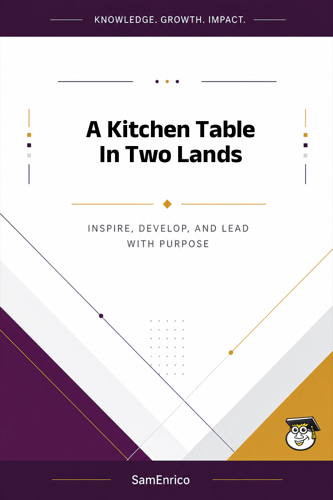
Non-FictionBiographyCulinary Memoir
A Kitchen Table In Two Lands eBook
Sisters raised apart on different continents recre
by Sang Cristie
Sisters raised apart on different continents recreate their mother's recipes together.
Formats
Free sample
Chapter 1: The Last Good Meal...--–- The envelope had no stamp, no return address, and no name. Just three words scrawled across the front in a handwriting Maya had not seen in twenty-five years: For my daughters.Maya Sochinska pressed her thumb against the faded blue ink as if it might still be wet. It was not. The letter had arrived in Lviv three days ago, tucked inside a larger manila envelope sent by a Chicago probate lawyer. The outer envelope had been stamped ESTATE OF IRINA SOCHINSKA — PERSONAL EFFECTS.
Maya had left it unopened on her grandmother’s kitchen table for seventy-two hours, walking past it each morning on her way to the hearth, each evening on her way to bed. She told herself she was not afraid. She told herself she had made peace with her mother’s death fifteen years ago. She told herself many things that were not true.Now, on a freezing February morning, with snow melting off the tin roof of the cottage and dripping into a rusted bucket by the door, she slid her finger under the flap and pulled out the contents. A single recipe card.
The paper was soft as old linen, stained at the corners with what looked like butter, and smelled faintly of cinnamon and yeast—a ghost of a smell that hit Maya in the sternum like a fist. She did not need to read the handwriting to know what it was. She had watched her mother write it. She had been seven years old, standing on a wooden stool in this same kitchen, watching Irina’s left hand—the one with the half-moon burn scar—curl around the edge of the card while her right hand guided the pen.Babka na Nedilyu, the card read. Sunday Babka.Below the title, in smaller letters: For Lena.
Because she asked.Maya set the card down on the table. Her hands were not shaking, but they felt wrong—detached, as if they belonged to someone else. She looked out the window at the garden where she and her grandmother had planted dill every spring, where her mother had once buried a jar of pickles during a power outage in the early nineties. The snow had erased everything. The garden was a white field.
The bucket dripped. The clock on the wall, a Soviet-era relic that had not kept accurate time since the fall of the USSR, ticked exactly four minutes slow.She picked up the card again and read it three more times. The recipe was incomplete. Irina had written the ingredients in her usual maddening shorthand—flour, eggs, butter, yeast, patience—but the instructions were sparse, almost hostile. Knead until it feels like forgiveness.
Rise until it remembers. Bake until the kitchen smells like home. Maya almost laughed. Her mother had never been able to say I love you, but she could write a recipe that broke your heart in five lines.The Geography of Absence Three thousand miles away, in a brightly lit supermarket in Chicago’s Ukrainian Village neighborhood, Lena Sochinska was having a different kind of crisis. She stood in the international aisle, clutching a torn piece of paper that looked like it had been through a war.
In a way, it had. The paper was the back of a 2003 utility bill, smudged with what might have been coffee or tears or both, and on it was the same recipe Maya had just pulled from an envelope in Lviv.Lena had found it in a shoebox last week. The shoebox had been sitting in the back of her hall closet for fifteen years, since the week after her mother’s funeral. She had told herself she would open it when she was ready. Then she had told herself she would never open it.
Then her son Elijah, fourteen years old and relentlessly curious, had asked what was in the box, and Lena had said nothing, and Elijah had said then why is it still here, and Lena had realized she had no answer that made sense.So she opened it. Inside: a faded photograph of her mother on a beach in Odesa, 1987; a gold earring missing its mate; a rosary from the Greek Catholic church her mother had stopped attending after the divorce; and the utility bill, folded into eighths, with the recipe scrawled on the back.Babka na Nedilyu, the recipe read. For Lena. Because she asked.Lena had not remembered asking. She had been nine years old, maybe ten, and she had wanted her mother to bake something—anything—because the kitchen had been silent for a year by then.
The kitchen fire of 1996 had taken more than a few cabinets and a smoke-stained ceiling. It had taken Irina’s will to cook. After the fire, the pots and pans sat untouched. The stand mixer gathered dust. The timer, which had once been the heartbeat of the apartment, stopped being set.
Lena had asked for babka the way a child asks for a lullaby: not because she expected one, but because the asking itself was a kind of hope.And her mother had written the recipe down. She had never made it. But she had written it down.Now Lena stood in the international aisle of the supermarket, staring at shelves full of ingredients she did not fully understand. Farina di grano duro. Lievito madre.
She was reasonably sure these were Italian, not Ukrainian, but the Ukrainian section had been picked over by the time she got here. She grabbed a bag of rye flour that claimed to be “heirloom” but was probably just repackaged commodity grain. She found a jar of honey that said clover and had a picture of a cartoon bee on it. She put it in her cart, took it out, put it back in.A woman with a heavy Eastern European accent passed by and glanced at Lena’s cart. “Ty robytysh babka?” she asked.Lena understood maybe every third word.
Her Ukrainian was functional at best—enough to order in a restaurant, not enough to follow a recipe. “Tak,” she said anyway. “Sprobuyu.”The woman nodded, unimpressed, and walked away.Two Kitchens, One Memory The first attempt happened that night, in two different time zones. In Lviv, Maya cleared her grandmother’s table and laid out her ingredients: heritage rye flour from the village mill, butter from a farmer she had known since childhood, eggs from the chickens in the backyard, wild yeast she had been maintaining for twelve years—a starter her grandmother had passed to her mother, and her mother had never had the chance to pass to her. Maya had rescued it from the refrigerator the week after Irina died.
She had fed it every week for fifteen years. She thought of it as the closest thing she had to a conversation with the dead.In Chicago, Lena laid out her ingredients: supermarket rye flour, supermarket butter, supermarket eggs, a packet of active dry yeast from Amazon. She had a stand mixer that cost more than Maya’s monthly rent. She had a digital scale that measured to the tenth of a gram. She had an…
This is the end of the free sample. Get the eBook to keep going. Buy now
About this book
Details
- Author
- Sang Cristie
- Publisher
- SamEnrico
- Language
- English
- Genre
- Non-Fiction, Biography, Culinary Memoir
- Released
- 2026-06-11
- Pages (approx.)
- 137
- Available as
- eBook, Audiobook

Read better in the ZLOADR app
Your eBooks on your phone or tablet. Sign in with your SamEnrico account and start reading.
More by Sang Cristie
 Arm Levitation TechniqueSang Cristie$11.99
 China Burma India TheaterSang Cristie$11.99
 Embassy Cat RescueSang Cristie$11.99
 The Rajput Gambit: What If Rana Sanga Had Defeated Babur at Khanwa?Sang Cristie$11.99
 Technical Solution ArchitectSang Cristie$11.99
 How to Produce Bicycle Wheel PartsSang Cristie$11.99
 Parking Lot Attack ProtocolSang Cristie$12.99
 Ultimate Handbook Guide to Chongjin : (North Korea) Travel GuideSang Cristie$11.99
You may also like
 Hong Kong Handover 1997Dunn Johnnie$11.99
 Zumba For Postnatal Recovery CourseNeal Christian$11.99
 Zumba for BeginnersLadner Nikia$11.99
 YouTube Comment Mining GuideHumes Pandora$12.99
 Worry Box MeditationCarlin Rudy$11.99
 Workplace Stress MeditationNguyen Lynn$11.99
 Workplace Stress and Sleep RepairHawley Ivory$11.99
 Workplace Perfectionism CureDelaney Jeffry$11.99
 Workplace Injustice Anger GuideWallen Isabelle$11.99
 Work Addiction and Burnout LinkGreenwood Ester$11.99
 Women in Yoga and WellnessBeattie Galina$11.99
 Women in Stand Up ComedyChun Evangeline$11.99