
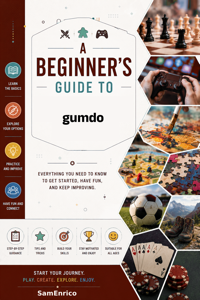
A Beginners Guide to gumdo (Volume 1) eBook
A Beginners Guide to gumdo (Volume 1)
A Beginners Guide to gumdo (Volume 1)
Formats
Free sample
Chapter 1: The Forked Road–- The wooden sword felt heavier than you expected. Not in your hand—you have not even picked it up yet—but in your chest. You have watched the You Tube videos, the K-drama sword fights, the tournament highlights where blades blur into invisibility. You have felt that strange pull, the whisper that says: I want to move like that. But standing at the edge of a martial art you cannot pronounce correctly (is it GOOM-doh or GUM-doh?), with a name that sounds like fifty other martial arts you have vaguely heard of, you have one question that no online forum has answered clearly: Which Gumdo is actually for me?This chapter exists to answer that question before you spend a single dollar on a uniform, a single evening in an unfamiliar training hall, or a single moment of frustration practicing techniques that do not align with your deepest reasons for picking up the sword in the first place.The term "Gumdo" (검도) is deceptively simple.
In Korean, it means "Way of the Sword"—two syllables that conceal a fractious, beautiful, and often confusing family of martial arts. If you walk into a dojang (training hall) in Seoul, Busan, or Los Angeles and announce you want to learn "Gumdo," you will be asked a follow-up question: Which one? Because the umbrella covers at least two major traditions that are as different as basketball and ballet. Both use a ball. Both require athleticism.
But the soul of each is entirely distinct.You are about to encounter the fork in the road. On one side stands Haidong Gumdo (해동검도), the Way of the Sea Dragon Sword—dynamic, explosive, rooted in battlefield reconstruction and athletic power. On the other side sits Shim Gum Do (심검도), the Mind Sword Path—meditative, internal, born in Buddhist temples and aimed at enlightenment rather than victory.One is not better than the other. But one is almost certainly better for you—right now, at this moment in your life. This chapter will help you choose.
And if you cannot choose? The chapter ends with a third option: walking both roads, at least for a while.The Problem With a Single Name Before we examine the two paths, you need to understand why confusion exists at all. In Japan, the art of swordsmanship has relatively clear distinctions: Kendo (sport fencing with bamboo swords), Iaido (sword-drawing and forms), and Kenjutsu (classical combat techniques). Korea's modern martial arts history followed a different trajectory.During the Japanese occupation of Korea (1910–1945), many native martial arts were suppressed or erased. After liberation, Korean masters faced a peculiar challenge: they wanted to reclaim their sword heritage, but much of the continuous lineage had been broken.
What emerged were two philosophically opposite solutions to the same problem.Haidong Gumdo took the path of reconstruction. Its founders studied historical texts, battlefield accounts, and surviving folk traditions, then built a new, systematic martial art that feels ancient but is organized like a modern sport. Think of it as a museum that was rebuilt using original blueprints—authentic in spirit, practical in execution.Shim Gum Do took the path of preservation-through-religion. It survived unbroken within the walls of Golgulsa Temple, a Buddhist monastery in Gyeongju, where monks had maintained sword practice as a form of moving meditation for centuries. When Grandmaster Chang Il Sik began teaching it to laypeople in the 1960s, he was not inventing; he was revealing what had never disappeared.Both are legitimate.
Both are "Gumdo." But they serve radically different human needs.Path One: Haidong Gumdo – The Way of the Sea Dragon What the Name Means Hae (해) means sea or ocean. Dong (동) means east or rising. Gumdo (검도) means way of the sword. The full name evokes an image: the dragon rising from the eastern sea, powerful, fluid, and unstoppable. This is not accidental.
Haidong Gumdo emphasizes explosive forward energy, continuous motion, and cuts that seem to accelerate rather than slow down upon impact.The Historical Claim (And the Honest Truth)Here is where many books lie to you, and I will not. Haidong Gumdo's official history traces its lineage to the Three Kingdoms period (57 BCE – 668 CE) and the legendary Hwarang warriors of Silla. This is partially true in spirit but misleading in fact.The Hwarang were real. They were young aristocrats trained in martial arts, poetry, Buddhist ethics, and military strategy. They carried swords.
They fought in battles. But they did not practice "Haidong Gumdo" any more than a Roman centurion practiced "modern Olympic fencing." What exists today under the Haidong Gumdo name is a reconstruction—a masterful, faithful, and powerful reconstruction, but a reconstruction nonetheless.The modern founder of Haidong Gumdo is widely recognized as Grandmaster Kim Jeong-ho (also known as Kwanjangnim Kim). In the 1960s and 1970s, he synthesized surviving techniques, battlefield manuscripts, and his own deep understanding of Korean martial arts to create a systematized curriculum. His genius was not in inventing something new but in organizing something scattered into something teachable.Why does this matter to you, a beginner? Because it frees you from the burden of "ancient authenticity." Haidong Gumdo works because it is well-designed, not because it is 2,000 years old.
You are learning a modern martial art with ancient DNA—and that is perfectly fine.What Training Actually Looks Like If you join a Haidong Gumdo school, here is what your typical class will contain:Warm-ups (15 minutes): Intense cardiovascular conditioning, stretching, and specific drills to loosen the shoulders, wrists, and hips. You will sweat.Basic cuts (20 minutes): Repetition of the four directional cuts (which you will master in Chapter 6) against the air, against a training post, and eventually against rolled bamboo mats. Speed and power are emphasized.Forms (Gumbub, 20 minutes): Pre-arranged sequences against imaginary opponents. Haidong Gumdo has approximately 20 to 30 core forms, depending on the federation. Each form tells a story: you are surrounded by three enemies, you are defending a narrow mountain pass, you are cutting down an opponent who has already wounded your left arm.Sparring (Gyorugi, 20 minutes): Controlled, armored sparring with bamboo swords (Jukdo) and protective gear.
Strikes are pulled, targets are limited, and the emphasis is on timing and distance rather than brute force.Cool-down and meditation (5 minutes): Brief breathing exercises and a closing bow.Notice what is missing: long sitting meditations, philosophical lectures, or slow, internal practices. Haidong Gumdo is an external martial art. It builds visible power, audible cuts (the kihap or spirit yell is essential), and athletic conditioning. You will get stronger, faster, and more explosive.Who Haidong Gumdo Is For This path fits you if:You want to learn how to fight with a sword. Not philosophically—actually.
Haidong Gumdo sparring is the closest you will get to safe, repeatable sword combat.You enjoy athletic challenge. The stances are low, the cuts are fast, and your legs will burn.You are motivated by visible progress. Belt ranks come at predictable intervals. Forms have clear right-and-wrong. Sparring has points.You like the idea of "Korean Kendo" but want something more dynamic.
Kendo is linear and restrained; Haidong Gumdo is circular and explosive.This path is not for you if you are seeking deep spiritual transformation, silent meditation, or a practice you…
This is the end of the free sample. Get the eBook to keep going. Buy now
About this book
Details
- Author
- Montero Racheal
- Publisher
- SamEnrico
- Language
- English
- ISBN
- 9781505761924
- Genre
- Non-Fiction, Informative, Educational
- Released
- 2026-04-25
- Pages (approx.)
- 117
- Available as
- eBook, Paperback, Audiobook

Read better in the ZLOADR app
Your eBooks on your phone or tablet. Sign in with your SamEnrico account and start reading.
More by Montero Racheal
 Distress Tolerance EQ SkillsMontero Racheal$11.99
 Quadrant Two Deep Work FocusMontero Racheal$11.99
 Stress Skin Condition ConnectionMontero Racheal$11.99
 Step Five Priest Pastor ConfessorMontero Racheal$11.99
 The Phantom Frequency: How a Soviet Spy Device Outsmarted the WestMontero Racheal$11.99
 Learn to Play the CimbalomMontero Racheal$11.99
 AI for Legal Document ClassificationMontero Racheal$12.99