
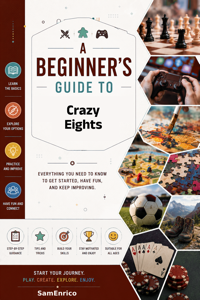
A Beginners Guide to Crazy Eights (Volume 1) eBook
A Beginners Guide to Crazy Eights (Volume 1)
A Beginners Guide to Crazy Eights (Volume 1)
Formats
Free sample
Chapter 1: The Fifty-Country Secret– Every card game has its moment. For Poker, it’s the final table of the World Series. For Bridge, it’s a quiet Sunday afternoon in a club filled with retirees who remember every bid from 1973. For Crazy Eights? Your moment is right now.
You’re holding this book because somewhere—at a family gathering, a dorm room, a camping trip, or a vacation rental with a drawer full of mismatched decks—someone is about to say, “Anyone know any card games?” And you want to be the person who says, “Yes. Deal.”But here’s the secret that no one tells you about Crazy Eights: it is not one game. It is fifty games disguised as one. It has been played in at least fifty countries under at least twenty different names. In Germany, they call it Mau-Mau.
In the Netherlands, it’s Pesten. In the United Kingdom, it’s Switch. In some British pubs, it’s called Black Jack (not to be confused with the casino game). In Sweden, it’s Plump. In Finland, it’s Williams.
In Brazil, it’s Buraco’s simpler cousin. And everywhere it is played, someone at the table believes their version is the only correct version.This book exists because of that beautiful, frustrating, wonderful truth.The Universal Game You’ve Never Been Taught Properly You probably already know a version of Crazy Eights. You learned it when you were seven from a cousin who learned it from a babysitter. The rule was simple: match the suit or the number, and eights are wild. That’s it.
That’s the whole game, right?Wrong.What you learned was the skeleton. What this book will teach you is how to put muscles on those bones. The standard rules of Crazy Eights—the official, tournament-ready, internationally recognized rules—contain layers of strategy that your seven-year-old self never imagined. When to play an eight versus when to hold it. How to track which suits your opponent has played.
When to draw cards intentionally even though you have a playable card. How to use the “lock” to force the player after you into an unwinnable position.But before we get to any of that, we need to talk about why this game has outsold every other “kids’ classic” on the planet. Because understanding why people play is the first step to understanding how to win.Why Go Fish Is Not Enough Let’s be honest about the card games most people learn as children. Go Fish teaches you how to ask for things and how to hold cards. Old Maid teaches you how to avoid getting stuck with a loser.
War teaches you that life is unfair and sometimes the person with the highest number just wins. These are fine games for a rainy afternoon when you’re six years old. But they have a fundamental problem: they require almost no decisions.In Go Fish, you ask for a rank you already hold. There’s no strategy—just memory and luck. In War, you flip a card and pray.
In Old Maid, you hope the person to your left doesn’t pass you the queen. These games are passive. They happen to you rather than being something you do.Crazy Eights is different.From your very first turn, you face a decision. Look at the discard pile. Look at your hand.
Do you have a match? If yes, which card do you play? Do you play the seven of hearts or the seven of spades? Do you play the king of diamonds or the three of diamonds? Each choice changes the game for every other player at the table.
Play a heart, and the next player must play a heart or a seven. Play a spade, and you shift the entire direction of the game. Play an eight, and you completely rewrite the rules of the table until your next turn.That is why Crazy Eights has survived for generations while other children’s card games have faded. It offers the perfect balance of luck and skill—but as you will learn throughout this book, that balance shifts dramatically based on how many people are playing.The Luck-Skill Balance (And Why It Matters to You)Let me be direct with you about something that most card game books dance around: luck matters. It matters a lot.
If you play a single round of Crazy Eights, an absolute beginner can beat an experienced player if the cards fall right. A string of bad draws can sink the best strategist. A perfectly timed eight can rescue the worst player at the table.But here is the truth that separates casual players from consistent winners: luck evens out over time. The more rounds you play, the more skill determines the outcome. And here is the critical insight that most players miss entirely—the balance shifts with player count.With two players, skill dominates.
You will see every card your opponent plays. You can track exactly what they have in their hand based on what they have not played. You can build a mental model of their remaining cards with surprising accuracy. The player who thinks two moves ahead will win roughly seventy percent of the time against a player who simply reacts.With three or four players, skill and luck reach their famous balance. You cannot track everyone’s cards perfectly because too much is hidden.
But you can track tendencies. You can notice that the player to your right never plays hearts when they have a choice, which probably means they are holding few hearts. You can observe that the player across from you hesitates before playing eights, which suggests they are considering whether to save them. You can use this information to make better decisions even though you lack complete information.With five or more players, luck dominates. The game becomes chaotic.
You will spend most of your time waiting for your turn, and by the time it arrives, the discard pile has changed four or five times. In high-player-count games, your best strategy is to focus on your own hand, play your cards efficiently, and accept that the winner will probably be whoever gets lucky with eights. (This is also why tournament Crazy Eights is almost always played with two or three players.)This book will teach you how to win at every table size. Chapters Eight and Nine will give you specific strategies for two-player, three-player, and four-player games. Chapter Eleven will introduce house rules that work better for larger groups.
But the most important lesson starts now: know your table. Know how many people are playing before you decide how aggressively to play.The Many Names of a Single Game Before we go any further, let’s address something that has probably already confused you. Maybe you searched online for “Crazy Eights rules” and found five different versions. Maybe a friend from another country told you they play “Mau-Mau” and it sounded completely different. Maybe your British colleague insisted that “Switch” is the real name and Crazy Eights is an American corruption.They are all right.
And they are all wrong.Crazy Eights belongs to a family of games called “shedding games” or “running games.” The goal…
This is the end of the free sample. Get the eBook to keep going. Buy now
About this book
Details
- Author
- Chavarria Kendall
- Publisher
- SamEnrico
- Language
- English
- ISBN
- 9781505800395
- Genre
- Non-Fiction, Informative, Educational
- Released
- 2026-05-02
- Pages (approx.)
- 125
- Available as
- eBook, Paperback, Audiobook

Read better in the ZLOADR app
Your eBooks on your phone or tablet. Sign in with your SamEnrico account and start reading.
More by Chavarria Kendall
 Laggard Fitness ConsumersChavarria Kendall$11.99
 Bandung Conference African RoleChavarria Kendall$11.99
 Hammock Rest VisualizationChavarria Kendall$11.99
 The Gacy Defense Attorney StrategyChavarria Kendall$11.99
 Emotional Triggers IdentificationChavarria Kendall$11.99
 The Wisdom of the Nile: African Philosophers Who Shaped the Persian EmpireChavarria Kendall$11.99
 Sephora Supply GuideChavarria Kendall$12.99
 AI Product Video GuideChavarria Kendall$12.99
 Understanding Mucopolysaccharidosis Type VChavarria Kendall$17.99
 Product MarketerChavarria Kendall$11.99