
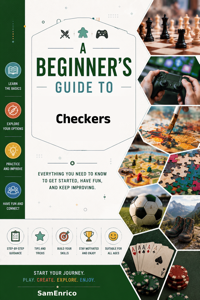
A Beginners Guide to Checkers (Volume 1) Paperback
A Beginners Guide to Checkers (Volume 1)
A Beginners Guide to Checkers (Volume 1)
Formats
Free sample
Chapter 1: More Than Child's Play...--The first time most people see a checkers board, they see a simple game. A child’s game. A way to pass time on a rainy afternoon or a quiet corner of a retirement home. The red and black pieces are cheap. The board is a simple grid.
The rules fit on a single index card. Surely, nothing of substance could hide beneath such a modest surface.That assumption is wrong. Deeply, historically, strategically wrong.What you are about to discover is that checkers—or draughts, as it is known in most of the world—is one of the oldest, most subtle, and most unforgiving strategy games ever invented. It has been played by pharaohs in Egypt, philosophers in Greece, generals in World War II, and computer scientists who used it as a proving ground for artificial intelligence. The game you thought was simple has more possible board configurations than there are atoms in the observable universe.
No, that is not an exaggeration. It is a mathematical fact.This chapter is not about rules or moves. It is about changing your mind. Before you learn how to play well, you must first unlearn what you think you know about checkers. You must understand why this game has endured for over five thousand years.
You must see it not as a diversion but as a sport of the mind—a duel of foresight, pattern recognition, and psychological nerve.By the end of this chapter, you will never look at a checkers board the same way again. And that transformation is the first and most important step toward becoming a player who wins.The Ancient Board: A History You Never Expected Long before chess, before backgammon, before playing cards arrived in Europe, there was checkers. Not exactly the checkers you know, but its ancestors—games that followed the same fundamental principle: pieces moving diagonally, capturing by hopping, and a board that was not quite square.The Mesopotamian Origins The oldest archaeological evidence of a checkers-like game comes from the ancient city of Ur, in what is now southern Iraq. Around 2600 BCE, the Sumerians played a game called the Royal Game of Ur. While its exact rules remain debated, it featured a race-like movement and a distinctive board.
But the more direct ancestor of checkers comes from ancient Egypt, where archaeologists have unearthed boards for a game called Alquerque dating to around 1400 BCE. Alquerque was played on a 5x5 grid of intersecting lines. Two players moved pieces diagonally. Captures were made by jumping over an opponent’s piece. Sound familiar?Alquerque spread throughout the Mediterranean world.
The Romans played a version called Ludus Latrunculorum—the Game of Brigands. The Greeks had Petteia. These games were not pastimes for children. They were training tools for strategy, played by soldiers and statesmen who understood that foresight on the board translated to foresight in life.The Medieval Transformation The critical evolution happened in southern Europe around the 12th century. Someone—we do not know who—had the simple but revolutionary idea to play Alquerque on a chessboard.
An 8x8 grid. Sixty-four squares. But here is the detail that matters: in the new game, pieces only moved on the dark squares. That meant only 32 squares were used. The board was the same, but the battlefield was reduced and regularized.This new game had a name in French: jeu de dames—the Ladies' Game.
In English, it became "draughts" (pronounced drafts), from the Old English word for moving or pulling a piece. The American name "checkers" comes from the checkered pattern of the…
This is the end of the free sample. Get the Paperback to keep going. Buy now
About this book
Details
- Author
- Smalls Elizebeth
- Publisher
- SamEnrico
- Language
- English
- ISBN
- 9781505799156
- Genre
- Non-Fiction, Informative, Educational
- Released
- 2026-05-02
- Pages (approx.)
- 125
- Available as
- eBook, Paperback, Audiobook

Read better in the ZLOADR app
Your eBooks on your phone or tablet. Sign in with your SamEnrico account and start reading.
More by Smalls Elizebeth
 The Nobel And Pain PathwaysSmalls Elizebeth$11.99
 Social Battery Conservation WorkbookSmalls Elizebeth$11.99Social Battery Conservation WorkbookSmalls Elizebeth$11.99
 Retirement Habit FormationSmalls Elizebeth$11.99
 Walking Meditation for High Blood PressureSmalls Elizebeth$11.99
 Social Media Positioning MapSmalls Elizebeth$11.99
 The Queen and the Rebel: A Love That Shook an EmpireSmalls Elizebeth$11.99
 The Last Empress of the Silk Road: Wu Zetian's Shadow EmpireSmalls Elizebeth$11.99
 Operating Agreement Drafting WorkbookSmalls Elizebeth$12.99
 BPO Technology Stack GuideSmalls Elizebeth$12.99
 Understanding Grix–blankenship–Peterson SyndromeSmalls Elizebeth$17.99
 Sports Betting TipsterSmalls Elizebeth$11.99