
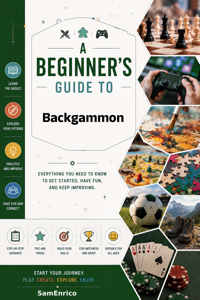
A Beginners Guide to Backgammon (Volume 1) eBook
A Beginners Guide to Backgammon (Volume 1)
A Beginners Guide to Backgammon (Volume 1)
Formats
Free sample
Chapter 1: The Oldest Game--–- Long before chess, before poker, before the invention of writing itself, a game was born on the sun-baked streets of ancient Mesopotamia. It was a game of moving stones across a board, of throwing bones to determine fate, and of outsmarting an opponent who sat directly across from you. That game evolved, traveled through Persia, was adopted by Roman centurions, and eventually found its way into the pubs and clubs of modern London and New York. Today, we call it backgammon.Backgammon is perhaps the oldest board game still played in its original form. Unlike chess, which has undergone radical rule changes over the centuries, or Go, which remained geographically isolated for millennia, backgammon’s rules have been remarkably stable for over two thousand years.
The ancient Romans played a version called Ludus Duodecim Scriptorum – the Game of Twelve Lines – on boards nearly identical to the ones you can buy today. In Persia, it was known as Takhteh Nard, meaning “Battle on Wood.” And in Byzantium, emperors reportedly played for entire provinces.But why has backgammon survived? Walk into any library, and you will find shelves of books on chess strategy. Poker dominates television schedules. Go has its passionate devotees.
Yet backgammon quietly endures, played by millions online and in back rooms across the world. The answer lies in a single, beautiful fact: backgammon is the only classic board game that perfectly balances luck and skill.Chess has no luck. If you lose, it is entirely your fault – your calculation failed, your strategy was flawed, your opponent outplayed you. That purity is admirable, but it is also exhausting. Poker has immense luck – a bad beat can ruin a perfect evening – but over time, skill dominates.
Backgammon sits in the middle. A beginner can sit down with a world champion and, with a few lucky dice rolls, actually win a game. That same beginner, however, will lose a 25‑point match virtually every time. The dice provide hope; the skill provides depth.This duality is why millions of people have learned backgammon and why you are reading this book. You do not need to memorize opening theory for five years before you can enjoy a game.
You can learn the rules in twenty minutes and play within the hour. But once you begin to understand the strategies – the running game, the prime, the blitz, the back game – you realize that backgammon is a lifetime study. No two games are ever the same.What This Chapter Will Teach You In this first chapter, we are going to ignore strategy entirely. You will learn nothing about doubling cubes or pip counts or optimal opening rolls. Instead, you are going to learn the physical landscape of the game.
By the time you finish this chapter, you will be able to set up a backgammon board correctly, name every part of that board, and understand the single goal that drives every decision you will ever make. Consider this your boot camp: no tactics, no tricks, just the terrain.The Board: Your Battlefield Backgammon is played on a board divided into four distinct sections called quadrants. Before you move a single checker, you must understand these quadrants because every rule, every strategy, and every mistake you will ever make relates back to where your checkers are relative to these four zones.The board is a rectangle, typically made of wood or synthetic material, with a raised ridge running down the center. That ridge is called the bar – you will learn about its punishing role in Chapter 2. The board is divided into two halves: the left half and the right half.
Each half is further divided into two quadrants. From your perspective as the player sitting on one side, the quadrants are:Your Home Board – This is the quadrant on your right-hand side (assuming you are sitting at the board with the bar running vertically away from you). Your home board contains points numbered 1 through 6. This is where your checkers must eventually gather before you can bear them off. Think of your home board as your castle.
It is safe, it is defensive, and it is where you will end the game.Your Outer Board – This is the quadrant directly to your left, adjacent to your home board. Your outer board contains points numbered 7 through 12. This is no‑man’s‑land – a dangerous transitional zone where blots are common and hits are frequent.Opponent’s Home Board – This is the quadrant on the far right from your perspective (the opponent’s right side). It contains points numbered 19 through 24. This is the most dangerous territory for you.
Walking into your opponent’s home board with a single checker is like walking into a lion’s den. You will learn to fear this place.Opponent’s Outer Board – This is the quadrant on the far left, adjacent to the opponent’s home board. It contains points numbered 13 through 18. Like your outer board, this is transitional space.Here is a simple mnemonic to remember the quadrants: Home is where you end, Outer is where you wander, Opponent’s Home is where you fear to tread, and Opponent’s Outer is where you pass through.The Points: Numbering and Direction Every backgammon board has 24 narrow, triangular wedges called points. These points alternate in color – typically tan and brown, or red and white – to make movement easier to visualize.
The points are arranged in a horseshoe shape, not as a straight line. Starting from your opponent’s home board (the far right), the points are numbered 24 down to 1, moving counter‑clockwise around the board.Let me make this concrete. Imagine you are sitting at the board. Your opponent sits across from you. On your right is your home board (points 1 through 6).
On your left is your outer board (points 7 through 12). Directly across the board, on the opponent’s side, their home board is on their right (which is your left if you turn the board around), but from your perspective, that quadrant contains points 19 through 24.The numbering system is standardized across all backgammon literature. If a book tells you to “move a checker from the 13‑point,” you must know instantly where that is. The 13‑point is the middle point of your outer board – specifically, the point closest to the bar on your left side. The 24‑point is the farthest point from you, deep in the opponent’s home board, against the edge of the board.Do not worry if this sounds confusing.
In a moment, you will set up the board physically, and all of this will click into place. Humans are visual learners. The words are just scaffolding.Critical note: Some backgammon boards have numbered points printed directly on the surface. If you are using such a board, the numbers will be oriented for both players (upside‑down for one player, right‑side‑up for the other). Trust your own perspective: your home board is always the quadrant immediately to your right.The Checkers: Your Army You have 15 checkers.
They are typically round, flat discs made of wood, plastic, or stone. Your opponent has 15 checkers of a different color. In standard sets, one player uses light‑colored…
This is the end of the free sample. Get the eBook to keep going. Buy now
About this book
Details
- Author
- Barlow Margareta
- Publisher
- SamEnrico
- Language
- English
- ISBN
- 9781505794670
- Genre
- Non-Fiction, Informative, Educational
- Released
- 2026-05-02
- Pages (approx.)
- 154
- Available as
- eBook, Paperback, Audiobook

Read better in the ZLOADR app
Your eBooks on your phone or tablet. Sign in with your SamEnrico account and start reading.
More by Barlow Margareta
 The Self-Compassion PrescriptionBarlow Margareta$11.99
 Spin Class Breathing Techniques CourseBarlow Margareta$11.99
 Credit Insurance BrokersBarlow Margareta$11.99
 Beginner Fitness YouTube GuideBarlow Margareta$11.99
 Condominium Purchase PitfallsBarlow Margareta$11.99
 Frozen Odyssey: The Lost Expedition of the KarlukBarlow Margareta$11.99
 The Last Speakers of the Arctic: Unlocking the Secrets of Inuit Linguistic TreasuresBarlow Margareta$11.99
 Understanding Developmental Delay Epilepsy Neonatal Diabetes (Dend Syndrome)Barlow Margareta$17.99
 Six Sigma Certificate GuideBarlow Margareta$12.99
 Canadian Beneficial OwnershipBarlow Margareta$12.99
 Tile SetterBarlow Margareta$11.99