
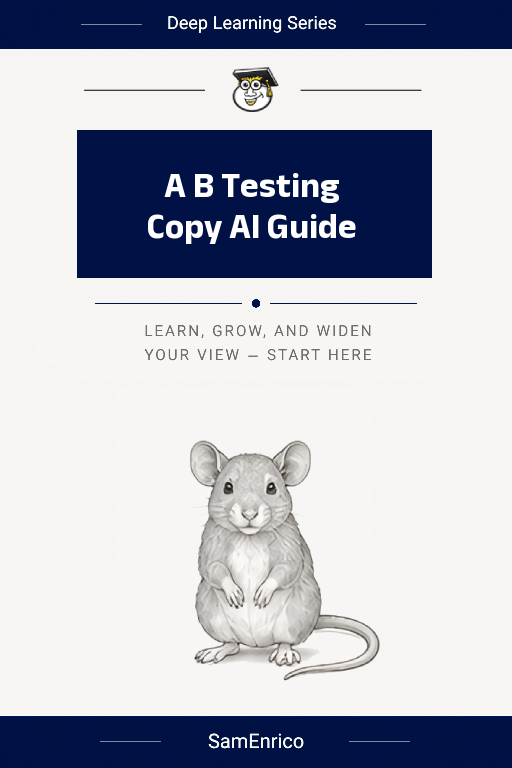
Non-FictionAI OperatorExperimentation
A B Testing Copy AI Guide eBook
Generate A/B test variants for headlines CTAs and
Generate A/B test variants for headlines CTAs and landing pages using prompt engineering.
Formats
Free sample
Chapter 1: The Hi PPO in the Room--–- Maria stared at her screen. Three weeks of work, fifteen email exchanges with legal, and a heated debate with her boss—all for a single A/B test that returned a flat zero. No lift. No loss. Just a giant, expensive “nothing.” Her Variant B had been a modest tweak: changing “Start Free Trial” to “Start My Free Trial.” First person instead of second person. A six-character difference.Her boss, the Chief Marketing Officer (and a proud Hi PPO—Highest Paid Person’s Opinion), had overruled her original hypothesis. “No one says ‘My’ before a trial,” he’d said. “It sounds entitled.” Maria knew the behavioral economics research. She’d cited the study showing first-person pronouns increase psychological ownership. She’d even shown him the data from three similar Saa S companies. He’d waved it away. “Trust me. I’ve been doing this for twenty years.”The test ran for two weeks. Six thousand visitors. Zero statistically significant difference. Maria had just spent her team’s monthly experimentation budget to prove that her boss was neither right nor wrong—just expensive.That night, scrolling through Twitter, she saw a post from a former colleague: “Chat GPT wrote 50 headline variants in 30 seconds. A/B tested the top 4. Beat control by 22%. I’m never brainstorming alone again.”Maria sat up. She’d been using AI for email drafts and meeting summaries. But for A/B testing copy? That had never occurred to her. She opened Chat GPT and typed: “Write 10 headlines for a project management tool aimed at remote teams.” Ten seconds later, she had ten headlines. Five were terrible. Three were decent. Two were genuinely better than anything she’d written in the past month. One of them—“Your remote team is losing 2 hours a day. Fix that.”—made her laugh out loud. It was aggressive. Specific. And completely outside her usual polite, corporate tone.She ran a quick hypothesis test (more on that later) and realized: the AI had done in ten seconds what her team took three days to do. Not because the AI was smarter. But because it had no ego, no confirmation bias, and no twenty-year veteran telling it what “sounds right.”This book is for Maria. And for you, if you have ever sat in a meeting where a well-paid executive killed a promising test because “it doesn’t feel right.” Or if you have ever stared at a blank Google Doc trying to think of a “Variant B” that is meaningfully different from Variant A. Or if you are simply tired of guessing when you could be testing.Welcome to the era of the Prompt Architect.The Real Reason Most A/B Tests Fail Let’s start with an uncomfortable truth: most A/B tests fail not because of bad data, but because of bad hypotheses. And bad hypotheses come from bad ideation processes.When humans brainstorm copy variants alone or in small teams, we suffer from what psychologists call confirmation bias—the unconscious tendency to favor information that confirms our existing beliefs. If you believe that “urgency” works, you will brainstorm urgent headlines. If you believe your brand voice is “friendly,” you will reject anything that sounds aggressive, even if the data suggests otherwise.But confirmation bias is only half the problem. The other half is the Hi PPO effect: the Highest Paid Person’s Opinion overrides data, research, and sometimes basic logic. The Hi PPO doesn’t mean to be wrong. Hi PPOs are usually smart, experienced, and well-intentioned. But experience creates mental models, and mental models create blind spots. The Hi PPO who succeeded with direct mail in 1995 has a very different intuition about what works than the data from 2025.Consider this: A/B testing platform VWO analyzed over 10,000 tests across its customer base. Tests where the hypothesis came from a Hi PPO (without data) succeeded only 1 out of 8 times. Tests where the hypothesis came from a structured ideation process (using frameworks like PIE or LIFT) succeeded 1 out of 3 times. That’s a 300% improvement simply by changing how you generate ideas, not how you run the test.But even structured human ideation has a ceiling. Humans, even smart ones, can usually generate only 3–5 distinct angles for a single headline or CTA before they start repeating themselves. We are pattern-matching creatures. We reach for what has worked before. That is why your “Variant B” is often just Variant A with synonyms.Enter generative AI. Not as a replacement for strategy, but as a creativity co-pilot that can generate 50 psychologically distinct angles in 30 seconds. The AI doesn’t have confirmation bias (though it has other biases we will discuss). It doesn’t care if you’ve been in marketing for twenty years or twenty days. It will happily generate a headline that calls your product “mediocre” if you ask it to. That discomfort—that friction—is precisely where breakthrough tests come from.The Bias Trade-Off: What AI Removes and What It Adds Before we go further, a critical clarification that most books get wrong: AI does not remove all cognitive load or all bias. It trades one set of problems for another.What AI removes:Personal confirmation bias – The AI doesn’t know your favorite headline from last year. It has no ego invested in “Start My Free Trial” vs. “Start Free Trial.”Groupthink – The AI wasn’t in your last team meeting where everyone nodded along to the Hi PPO.Creative exhaustion – The AI doesn’t get tired after writing ten headlines. It can write ten thousand.What AI adds (your new job):Hallucination risk – The AI might invent a statistic, a case study, or a customer quote. You must verify facts.Off-brand tone – The AI might generate copy that sounds like a used car salesman if you don’t ground it in your brand voice.Ethical blind spots – The AI doesn’t know your industry regulations or cultural sensitivities.Here is the deal you are making: you trade the cognitive load of generation (which is exhausting and biased) for the cognitive load of curation (which is strategic and objective). You stop being a writer and start being an editor, a director, and a quality-control officer. That is a much better job.In the previous example, Maria’s AI generated “Your remote team is losing 2 hours a day. Fix that.” She didn’t have to think of that angle. But she did have to decide: is this on-brand? Is the claim verifiable? Does it fit the character limit? Those are strategic decisions. And they take far less time than staring at a blank page.The PIE Framework: Prioritizing Before You Prompt Now that you understand why your current process fails, let’s talk about how to fix it. And counterintuitively, we are going to start before you open Chat GPT.The biggest mistake new Prompt Architects make is generating hundreds of variants immediately, then realizing they don’t know which ones to test, or worse, testing all of them and drowning in data dilution (more on that in Chapter 7). The correct sequence is: Prioritize first. Generate second. Test third.Enter the PIE framework, developed by the team at Wider Funnel and referenced in Chris Goward’s You Should Test That! PIE stands for Potential, Importance, Ease. Before you write a single prompt, you score every potential test element on these three criteria.Potential (P) – How much could this…
This is the end of the free sample. Get the eBook to keep going. Buy now
About this book
Details
- Author
- Griggs Blondell
- Publisher
- SamEnrico
- Language
- English
- Genre
- Non-Fiction, AI Operator, Experimentation
- Released
- 2026-05-29
- Pages (approx.)
- 130
- Available as
- eBook, Audiobook

Read better in the ZLOADR app
Your eBooks on your phone or tablet. Sign in with your SamEnrico account and start reading.
More by Griggs Blondell
 Sleep Sack Safety GuideGriggs Blondell$11.99
 MBSR for Medical Students GuideGriggs Blondell$11.99
 Self Harm and Teen EsteemGriggs Blondell$11.99
 Job Loss Self Esteem RepairGriggs Blondell$11.99
 Global Finance Talent Rotation ReportGriggs Blondell$11.99
 The Dragon’s Hoard: A Medieval Obsession with Gold and GreedGriggs Blondell$11.99
 How to Start a Building Boards Made of Asbestos Business (Beginners Guide)Griggs Blondell$11.99
 Build Your Sales MachineGriggs Blondell$11.99
 Impact Measurement ROI GuideGriggs Blondell$12.99
 Understanding Microcephaly Microphthalmos BlindnessGriggs Blondell$17.99
You may also like
 Hong Kong Handover 1997Dunn Johnnie$11.99
 Zumba For Postnatal Recovery CourseNeal Christian$11.99
 Zumba for BeginnersLadner Nikia$11.99
 YouTube Comment Mining GuideHumes Pandora$12.99
 Worry Box MeditationCarlin Rudy$11.99
 Workplace Stress MeditationNguyen Lynn$11.99
 Workplace Stress and Sleep RepairHawley Ivory$11.99
 Workplace Perfectionism CureDelaney Jeffry$11.99
 Workplace Injustice Anger GuideWallen Isabelle$11.99
 Work Addiction and Burnout LinkGreenwood Ester$11.99
 Women in Yoga and WellnessBeattie Galina$11.99
 Women in Stand Up ComedyChun Evangeline$11.99