
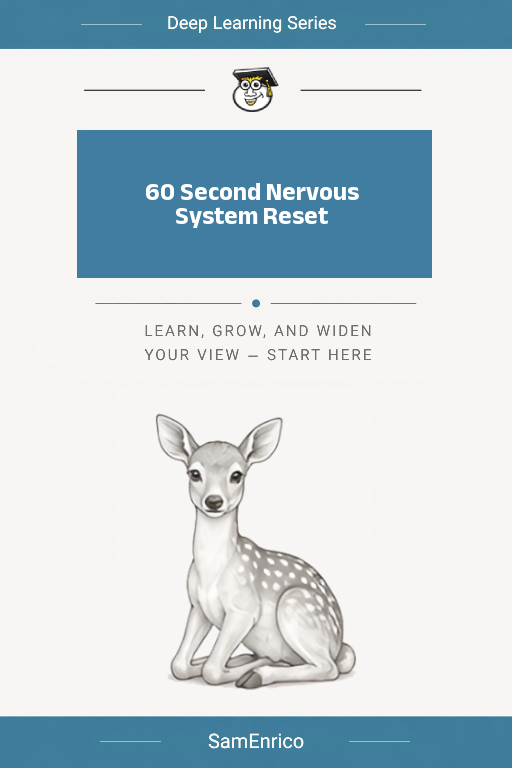
60 Second Nervous System Reset eBook
Use five rapid techniques to shift from fight-or-f
by Sommer Mica
Use five rapid techniques to shift from fight-or-flight to rest-and-digest in under one minute.
Formats
Free sample
Chapter 1: The 20-Millisecond Problem--–- Sarah had prepared for this moment for three months. She knew the case cold. Every deposition, every exhibit, every possible objection from opposing counsel—she had run through it all in her mind a hundred times. Now, standing before the jury in her charcoal-gray suit, she opened her mouth to deliver the closing argument that would make or break her career.Nothing came out.Her throat constricted. Her palms, suddenly slick, gripped the wooden lectern.
The jury stared. The judge raised an eyebrow. Opposing counsel smirked. And Sarah’s inner voice—the one that usually helped her think on her feet—had been replaced by a single, screaming thought: You are going to fail. Everyone can see it.
Sit down before you embarrass yourself further.She did not sit down. She froze. For five full seconds—which felt like five years—Sarah stood in perfect, terrified silence, her heart pounding so loudly she was certain the jury could hear it.What happened to Sarah happens to millions of people every day. Not just in courtrooms, but in boardrooms, on stages, in conversations with spouses, during exams, and in the quiet moments before sleep when the brain refuses to turn off. It happens to parents trying to calm a screaming toddler, to athletes standing on the free-throw line, to musicians before a performance, and to executives walking into a room full of hostile shareholders.
It is the moment when the body betrays the mind, when preparation meets panic, when the machinery of human biology overrides every good intention.And here is the most infuriating part: Sarah had been told, countless times, to “just relax.”The Worst Advice in the History of Advice If you have ever been told to “calm down” while actively panicking, you know the unique fury that follows. The person saying it—often a well-meaning partner, friend, or therapist—seems to believe that you have a relaxation switch somewhere inside your body and that you are simply refusing to flip it. As if your panic is a choice. As if you want to feel like your heart is about to explode.The truth is the opposite. You cannot “just relax” because the part of your brain that processes threat is ten times faster than the part of your brain that processes logic.
By the time your conscious mind catches up to what is happening, your body has already decided that you are in mortal danger and has launched a full-scale physiological counterattack.Let me say that again, because it is the single most important sentence in this book: Your body decides you are under threat before your brain knows what is happening.This is not a flaw. It is not a weakness. It is not a sign that you are broken, anxious, or weak-willed. It is an evolutionary masterpiece—a system that kept your ancestors alive through famines, predators, and plagues. The problem is that the same system cannot tell the difference between a saber-toothed tiger and a passive-aggressive email from your boss.
It cannot distinguish between a literal threat to your life and a metaphorical threat to your ego. When The Red Button—as we will call your amygdala from now on—sees a frowning face in a Zoom meeting, it reacts exactly as it would to a charging lion.The only difference is that you can outrun a lion.Meet The Red Button: Your Ancient, Overprotective Roommate Deep inside your brain, tucked behind your ears and roughly the size and shape of an almond, sits a structure called the amygdala. For the purposes of this book—and for the sake of giving you a villain you can actually name and fight—we are going to call it The Red Button.The Red Button has one job: detect threat. It does this job incredibly well. In fact, it does this job too well.
The Red Button does not wait for evidence, context, or a second opinion. It processes sensory information in approximately 20 milliseconds. That is twenty thousandths of a second. To put that in perspective, a hummingbird flaps its wings about 80 times per second. The Red Button processes threat faster than a hummingbird can flap its wings twice.Now meet the other guy: your prefrontal cortex (PFC).
This is the “thinking brain”—the part that reasons, plans, writes poetry, solves algebra, and decides whether a frown actually means danger or just indigestion. The PFC is wonderful. It is what makes you human. It is also slow. The PFC takes approximately 200 to 300 milliseconds to process the same information that The Red Button processed in 20.That gap—180 milliseconds—is the difference between life and death in the savanna.
It is also the difference between staying calm and losing your mind in a meeting.Here is what happens in that gap. The Red Button sees something ambiguous: a juror frowns, a boss sighs, a partner looks away. The Red Button does not know what a “juror” is. It does not understand “closing arguments.” It sees a face making a displeased expression, and it has exactly one database entry for that input: PREDATOR. DANGER.
FIGHT. FLIGHT. FREEZE. NOW.Before your prefrontal cortex can say, “Actually, that juror probably just has gas,” your body is already in full emergency mode. Your adrenal glands dump epinephrine (adrenaline) into your bloodstream.
Your heart rate doubles. Your breathing becomes shallow and rapid. Blood rushes away from your digestive system (not needed for running) and toward your large muscles (very needed for running). Your pupils dilate. Your hearing sharpens.
Your non-essential systems—including the part of your brain responsible for complex speech—shut down.That is why Sarah could not speak. The Red Button had decided she was being hunted, and hunted animals do not deliver closing arguments. They run, they fight, or they play dead. Sarah froze—a third option, and one we will explore later—because her body chose the strategy that worked best for small prey animals hiding from owls.Sarah is not a small prey animal. She is a trial lawyer in a well-lit courtroom.
But The Red Button does not know that.Your Inner Critic Is Not a Character Flaw Let us talk about that voice in your head. The one that says, “You are going to fail.” The one that replays every mistake you have ever made at 3 AM. The one that compares your worst moments to everyone else’s highlight reel.We have been taught to treat that voice as a psychological problem. We call it the inner critic. We go to therapy to silence it.
We read books about self-compassion to override it. We chant affirmations in the mirror, hoping to drown it out with positivity.Here is a radical reframe: Your inner critic is not a flaw. It is a smoke alarm.Imagine you have a smoke alarm in your kitchen. One day, you burn a piece of toast. The smoke alarm goes off—loud, obnoxious, impossible to ignore.
Do you smash the smoke alarm with a hammer and declare it broken? Do you go to therapy to work through your complicated feelings about the smoke alarm? Do you stand in front…
This is the end of the free sample. Get the eBook to keep going. Buy now
About this book
Details
- Author
- Sommer Mica
- Publisher
- SamEnrico
- Language
- English
- Genre
- Non-Fiction, Mental Wealth
- Released
- 2026-05-30
- Pages (approx.)
- 131
- Available as
- eBook, Audiobook

Read better in the ZLOADR app
Your eBooks on your phone or tablet. Sign in with your SamEnrico account and start reading.
More by Sommer Mica
 SAD Mindfulness PracticeSommer Mica$11.99
 Networking for StudentsSommer Mica$11.99
 Vegan Bodybuilding GuideSommer Mica$11.99
 Sky VisualizationSommer Mica$11.99
 Fear of Failure in EntrepreneursSommer Mica$11.99
 Workplace Achievement BalanceSommer Mica$11.99
 Collaborative StorytellingSommer Mica$11.99
 Anger De escalation at HomeSommer Mica$11.99
 The First Light of Aotearoa: How Māori Photography Transformed a NationSommer Mica$11.99
 The Roar of the Bamboo: How 18th-Century Fans Transformed Chinese Martial ArtsSommer Mica$11.99
 How to Produce Voip ProductsSommer Mica$11.99
 A Collector's Handbook to the Mazda Cosmo 110sSommer Mica$11.99
You may also like
 Hong Kong Handover 1997Dunn Johnnie$11.99
 Zumba For Postnatal Recovery CourseNeal Christian$11.99
 Zumba for BeginnersLadner Nikia$11.99
 YouTube Comment Mining GuideHumes Pandora$12.99
 Worry Box MeditationCarlin Rudy$11.99
 Workplace Stress MeditationNguyen Lynn$11.99
 Workplace Stress and Sleep RepairHawley Ivory$11.99
 Workplace Perfectionism CureDelaney Jeffry$11.99
 Workplace Injustice Anger GuideWallen Isabelle$11.99
 Work Addiction and Burnout LinkGreenwood Ester$11.99
 Women in Yoga and WellnessBeattie Galina$11.99
 Women in Stand Up ComedyChun Evangeline$11.99