
Non-FictionInformativeEducational
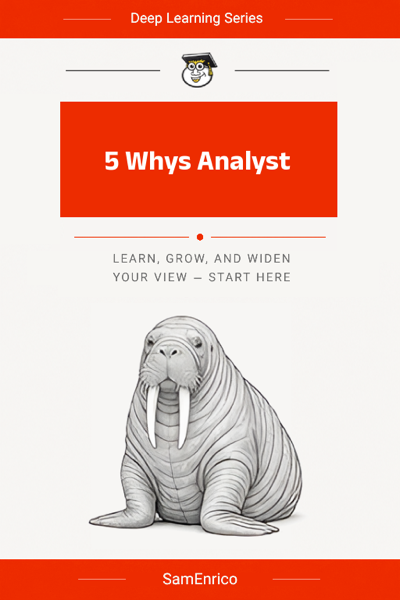
5 Whys Analyst eBook
A Coursebook on 5 Whys Analyst
A Coursebook on 5 Whys Analyst
Formats
Free sample
Chapter 1: The Chalk Circle--–- The fire started at 3:47 on a Tuesday afternoon. By 3:52, the sprinklers had activated. By 4:15, the fire was out. By 6:00 PM, the plant manager had already decided what caused it.“Faulty wiring,” he announced to the night shift. “We’ll replace the panel and be back online by morning.”He was wrong.Not because the wiring wasn’t faulty—it was.
But because he stopped asking questions at the first answer that let him return to normal. The wiring was the immediate cause. It was not the root cause. And because he never learned the difference, the same fire would burn down a different section of the same factory eighteen months later. The second fire killed two firefighters.This is not a story about faulty wiring.
It is a story about how otherwise intelligent, well-meaning, hardworking people repeatedly solve the same problems because they have never been taught how to analyze properly. They are experts at putting out fires. They are novices at understanding why fires start in the first place.This book exists to change that. You are about to learn a way of thinking that separates firefighting from fireproofing, symptom-treating from system-fixing, and blame-casting from genuine understanding. It is called the 5 Whys, and it is deceptively simple—so simple that most people think they already know it.
They do not. What they know is a caricature of the technique, stripped of its rigor, its discipline, and its power.What This Chapter Will Teach You By the end of this chapter, you will understand why most organizations remain trapped in cycles of recurring failure, what a 5 Whys Analyst actually does (and why it is not what you think), the critical distinction between symptoms, immediate causes, and root causes, the surprising history of the technique inside the Toyota Production System, and how this book will build your competency from beginner to certification-ready.Let us begin with the problem that makes this book necessary.The Cycle of Firefighting Every organization has problems. That is not the issue. The issue is that most organizations solve the same problems over and over again. A customer complaint about late delivery is resolved with an apology and a discount.
Two weeks later, the same customer complains again. A software bug is patched on a Friday night. By Wednesday, a similar bug appears in a different module. A safety incident is addressed with a retraining session. Three months later, the same incident happens on a different shift.This is the cycle of firefighting.
Teams bounce from crisis to crisis, extinguishing flames without ever finding the source of the fire. They are rewarded for speed—the faster you respond, the more heroic you appear. They are penalized for depth—taking time to investigate is seen as slow, academic, or blame-seeking. The result is an organization that is brilliantly effective at treating symptoms and tragically ineffective at finding causes.The numbers bear this out. A study of 1,500 companies conducted by the Root Cause Analysis Institute found that 73% of recurring problems had been “solved” at least twice before.
The average problem was solved 2.7 times before a permanent fix was implemented. In other words, organizations waste nearly three cycles of effort on every major problem, simply because they stop too soon.Why does this happen? The answer lies in how most people think about causality.The Ladder of Assumption Consider a simple scenario. You are a manager in a warehouse. A shipment goes out with the wrong product.
You ask your team what happened. Someone says, “Maria picked the wrong item.” You now have a story. The story is simple, memorable, and blames a specific person. Your brain rewards you with a small hit of closure. You have an answer.
You can act: talk to Maria, retrain Maria, or replace Maria.But you have not actually solved anything. Because you never asked why Maria picked the wrong item. Was the shelf mislabeled? Were the two products visually identical? Was Maria interrupted?
Was she working a double shift? Was the picking system designed to show similar products next to each other? Was there a barcode verification step that failed? Was there no verification step at all?Each of these questions leads in a different direction. Each direction points to a different kind of solution.
And none of them are “blame Maria.”This is the ladder of assumption—the cognitive shortcut that leaps from an observed event to a simple cause without testing the steps in between. Every human brain does this. It is efficient for survival. If you hear a rustle in the bushes, you do not need to conduct a 5 Whys analysis before running from the lion. But efficiency is not accuracy.
In organizational problem-solving, the ladder of assumption is the single greatest source of recurring failure.Defining the 5 Whys Analyst This book introduces a new role, or rather, a new way of inhabiting your existing role: the 5 Whys Analyst. This is not a job title that appears on any org chart (though it should). It is a mindset and a skillset that anyone can adopt, regardless of their position.A 5 Whys Analyst is not a technician who mechanically asks “Why?” five times. Anyone can do that, including a bored five-year-old on a long car ride. A 5 Whys Analyst is a systems thinker who understands that outcomes emerge from the interaction of processes, policies, incentives, and human behavior.
They know that the person closest to the problem is rarely the cause of the problem—they are usually the victim of a broken system.The 5 Whys Analyst asks different questions than the typical problem-solver. Where others ask “Who is responsible?” the Analyst asks “What process allowed this to happen?” Where others ask “How do we stop the bleeding?” the Analyst asks “How do we redesign the body so it doesn’t bleed again?” Where others ask “What did this person do wrong?” the Analyst asks “What about this situation made it rational for a reasonable person to do what they did?”This last question is the most important sentence in this book. Read it again: What about this situation made it rational for a reasonable person to do what they did? If you internalize only one idea from this chapter, let it be that question. It contains the entire philosophy of root cause analysis: assume good faith, assume reasonableness, and look for the system that shaped the behavior.Symptoms, Immediate Causes, and Root Causes To think like a 5 Whys Analyst, you must master a three-level hierarchy of causality.
Most people never move beyond level one. Many professionals stop at level two. Only analysts reach level three.Level One: Symptoms Symptoms are what you notice first. They are the smoke, the pain, the delay, the complaint, the error message. Symptoms are real, measurable, and urgent.
They demand attention. But they are not causes. They are the output of causes.A headache is a symptom. Taking aspirin treats the symptom. It does not cure the brain tumor, the dehydration, or the caffeine withdrawal.
In organizations, late deliveries are a symptom. Low morale is a symptom. Customer complaints are a symptom. Treating symptoms is necessary—you cannot ignore the headache—but it…
This is the end of the free sample. Get the eBook to keep going. Buy now
About this book
Details
- Author
- Still Giovanna
- Publisher
- SamEnrico
- Language
- English
- Genre
- Non-Fiction, Informative, Educational
- Released
- 2026-06-02
- Pages (approx.)
- 144
- Available as
- eBook, Audiobook

Read better in the ZLOADR app
Your eBooks on your phone or tablet. Sign in with your SamEnrico account and start reading.
More by Still Giovanna
 Gesture Avoidance ProtocolStill Giovanna$11.99
 Somatic Triggers Body MemoryStill Giovanna$11.99
 Chronic Stress Heart Disease LinkStill Giovanna$11.99
 France Consumer OutlookStill Giovanna$11.99
 Persuasion for Product ManagersStill Giovanna$11.99
 The Opium King of Shanghai: How One Man Built an Empire on the Black MarketStill Giovanna$11.99
 Understanding Ovarian CancerStill Giovanna$17.99
 Online Gaming Terms HandbookStill Giovanna$12.99
 Tutoring Chinese Students Shadowing MethodStill Giovanna$12.99
 How to Start a Hobby in World Wide WebStill Giovanna$11.99
You may also like
 Hong Kong Handover 1997Dunn Johnnie$11.99
 Zumba For Postnatal Recovery CourseNeal Christian$11.99
 Zumba for BeginnersLadner Nikia$11.99
 YouTube Comment Mining GuideHumes Pandora$12.99
 Worry Box MeditationCarlin Rudy$11.99
 Workplace Stress MeditationNguyen Lynn$11.99
 Workplace Stress and Sleep RepairHawley Ivory$11.99
 Workplace Perfectionism CureDelaney Jeffry$11.99
 Workplace Injustice Anger GuideWallen Isabelle$11.99
 Work Addiction and Burnout LinkGreenwood Ester$11.99
 Women in Yoga and WellnessBeattie Galina$11.99
 Women in Stand Up ComedyChun Evangeline$11.99