
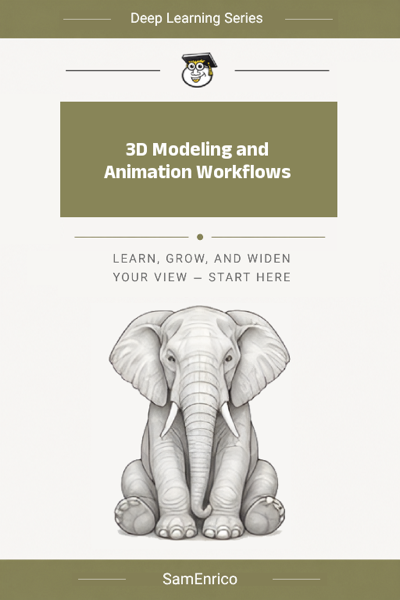
Non-FictionInformativeEducational
3D Modeling and Animation Workflows eBook
A Coursebook on 3D Modeling and Animation Workflow
A Coursebook on 3D Modeling and Animation Workflows
Formats
Free sample
Chapter 1: The Map Before the Territory...--Every broken 3D project you will ever encounter shares the same origin story: someone opened software, clicked a button that looked promising, and spent three weeks building something beautiful that could not be animated, could not be rendered in time, and could not be delivered to the client without starting over from scratch. You have probably felt this failure yourself. Perhaps you modeled a character with gorgeous detail, only to discover that its elbow collapsed into a twisted mess the moment you tried to bend the arm. Perhaps you spent days texturing a environment, only to realize that your lighting setup made every surface look like wet plastic. Perhaps you rendered a sequence for thirty hours, only to find that the client needed a different camera angle—an angle your scene was never built to support.None of these failures happened because you lacked talent.
They happened because you were drawing the map while already lost in the territory.This entire book exists to reverse that order. Before you extrude a single face, before you place a single light, before you even decide which software to launch, you must understand the production pipeline that separates professional 3D work from endless frustrating revisions. This chapter gives you that map. It will not teach you how to model or animate. It will teach you something far more valuable: how to think about modeling and animation so that every hour you spend produces usable, flexible, high-quality results that survive the journey from your imagination to the final render.The Production Pipeline: Why Order Matters More Than Talent The production pipeline is simply the sequence of stages that a 3D project moves through from concept to delivery.
In a professional studio—whether for film, games, or visual effects—this pipeline is not a suggestion. It is a rigid contract between departments. The concept artists deliver designs to the modelers. The modelers deliver clean geometry to the riggers. The riggers deliver controllable skeletons to the animators.
The animators deliver motion to the lighting and rendering team. Each stage has entry requirements and exit criteria. Nothing moves forward until the current stage is complete.You might think this sounds rigid or even counterproductive to creativity. The opposite is true. The pipeline exists to protect creativity.
When you know exactly what the next stage requires, you can be wildly creative within those constraints. When you have no constraints, you are not creative—you are just making random marks and hoping something sticks.The Two Pipeline Shapes: Linear and Non-Linear Most beginners assume there is one universal 3D pipeline. There are actually two, and understanding which one applies to your project determines everything from your polygon budget to your file naming conventions.The linear pipeline dominates film and cinematic production. In a linear pipeline, each phase completes fully before the next phase begins. Pre-production (concept art, storyboards, color scripts, asset lists) finishes entirely.
Then modeling begins and finishes entirely. Then texturing begins and finishes entirely. Then rigging, then animation, then lighting, then rendering, then compositing. This sounds inefficient—and for some projects, it is. But for film, where hundreds of artists must coordinate on thousands of assets, linearity prevents chaos.
You cannot have an animator waiting for a model that is still being sculpted. You cannot have a lighter adjusting a scene where the camera angles are still changing. The linear pipeline trades flexibility for predictability.The non-linear or iterative pipeline dominates game development and real-time projects. In a non-linear pipeline, assets move through the stages multiple times. A character might be modeled, textured, rigged, and animated at a low level of detail, then sent back to modeling for high-detail polish once the animation proves out.
This approach works because game development is interactive. You cannot know exactly how a character will feel to control until you play it. The non-linear pipeline trades predictability for flexibility.Here is the critical insight that most books never tell you: nearly every beginner project should follow the linear pipeline. Why? Because beginners lack the judgment to know when iteration is improving the work versus just churning in place.
The linear pipeline forces you to commit and move forward. It prevents the endless tweaking loop that kills more projects than any technical failure ever could.How Pre-Production Determines Everything Pre-production is the phase before any 3D work begins. It includes concept art (drawings of characters, environments, and props from multiple angles), storyboards (sequential drawings showing camera angles and action beats), color scripts (paintings establishing the mood and color palette of each scene), and asset lists (spreadsheets cataloging every single object that must be built).Most beginners skip pre-production entirely. They open their 3D software and start modeling whatever feels interesting. This is like building a house by hammering the first nail you see into the first board you find.
The house might stand. It will almost certainly be ugly, inefficient, and expensive to maintain.Professional pre-production answers five questions before any geometry exists:First, what is the visual style? Realistic, stylized, low-poly, high-fidelity, hand-painted, photoreal? This decision alone determines polygon budgets, texture resolution, shading complexity, and render times. A stylized character might use 5,000 polygons and 2K textures.
A photoreal film asset might use 50 million polygons and 8K textures. Switching styles mid-project is catastrophic.Second, what is the technical target? Film, broadcast, web, game engine (Unreal, Unity, custom), virtual reality, augmented reality? A model destined for a game engine must be triangulated, have level-of-detail versions, and use PBR materials (more on this in Chapter 6). A model destined for film can use quads, single high-resolution meshes, and complex shaders.
The technical target is not negotiable after modeling begins.Third, what is the animation requirement? Does the asset need to deform (a character with a face and joints)? Does it need to be rigid (a chair or table)? Does it need to fracture (a destructible wall)? Does it need to simulate cloth or fluids?
Each answer changes how you model. A character requires edge loops around joints. A rigid prop requires none. Modeling a character without deformation in mind guarantees rigging failure later.Fourth, what is the camera proximity? Will the asset be seen in extreme close-up, medium shot, or far background?
An asset seen in close-up requires high geometry density, detailed textures, and perfect UVs. A background asset can be simplified by ninety percent or more. Professional studios build multiple versions of the same asset at different detail levels. Beginners build one version and wonder why their render times are astronomical.Fifth, what is the delivery format? Print resolution stills?
4K video? 1080p web streaming? Mobile? Each format changes acceptable texture resolution, polygon count, and render settings. A still render for print might take hours per frame.
A 1080p animation for web might need to render in minutes per frame.The 3D Generalist Versus the Specialist: Knowing Your Role The term "3D generalist" means different things to different people. For the purpose of this book, a generalist is someone who understands enough of each discipline to build complete projects independently and to collaborate effectively with specialists. A generalist can model a prop, unwrap its UVs, texture it, rig it…
This is the end of the free sample. Get the eBook to keep going. Buy now
About this book
Details
- Author
- Morrill Rickie
- Publisher
- SamEnrico
- Language
- English
- Genre
- Non-Fiction, Informative, Educational
- Released
- 2026-06-03
- Pages (approx.)
- 145
- Available as
- eBook, Audiobook

Read better in the ZLOADR app
Your eBooks on your phone or tablet. Sign in with your SamEnrico account and start reading.
More by Morrill Rickie
 Keto for Children GuideMorrill Rickie$11.99
 Customer Service Coaching FrameworkMorrill Rickie$11.99
 Biteprint Database GuideMorrill Rickie$11.99
 The QuickBooks Freelancer GuideMorrill Rickie$11.99
 Francis of Assisi San DamianoMorrill Rickie$11.99
 The Silent Storm: Haig's Gamble at PasschendaeleMorrill Rickie$11.99
 Nokia Pivot StoryMorrill Rickie$12.99
 Faceless YouTube Self ImprovementMorrill Rickie$12.99
 Learn to Play the Lambeg DrumMorrill Rickie$11.99
 How to Start a Dental Laboratory Instruments and Equipment Business (Beginners Guide)Morrill Rickie$11.99
You may also like
 Hong Kong Handover 1997Dunn Johnnie$11.99
 Zumba For Postnatal Recovery CourseNeal Christian$11.99
 Zumba for BeginnersLadner Nikia$11.99
 YouTube Comment Mining GuideHumes Pandora$12.99
 Worry Box MeditationCarlin Rudy$11.99
 Workplace Stress MeditationNguyen Lynn$11.99
 Workplace Stress and Sleep RepairHawley Ivory$11.99
 Workplace Perfectionism CureDelaney Jeffry$11.99
 Workplace Injustice Anger GuideWallen Isabelle$11.99
 Work Addiction and Burnout LinkGreenwood Ester$11.99
 Women in Yoga and WellnessBeattie Galina$11.99
 Women in Stand Up ComedyChun Evangeline$11.99