
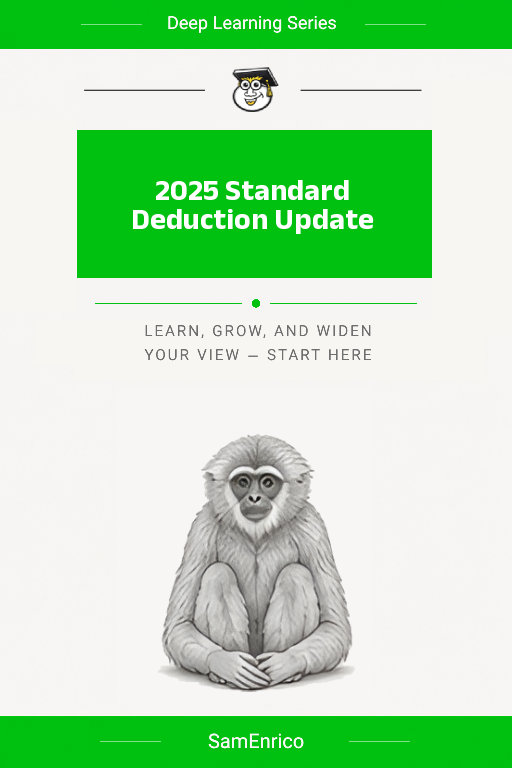
Non-FictionAnnual CheckupTax ComplianceSole Proprietor
2025 Standard Deduction Update eBook
Learn new IRS deduction limits for sole proprietor
Learn new IRS deduction limits for sole proprietors and single-member LLCs.
Formats
Free sample
Chapter 1: The Hidden Reality--–- Think about the last time you checked your bank account after paying your quarterly estimated taxes. That feeling in your gut—the one that says you worked too hard for too many hours only to send a massive chunk of your profit to the IRS—is not just frustration. It is a signal. A signal that your tax strategy, or lack thereof, is failing you. And here is the truth that most tax professionals will never tell you: the 2025 standard deduction increase to 15,000forsinglefilersand15,000 for single filers and 15,000forsinglefilersand30,000 for married couples filing jointly is not a gift from the government.
It is a trap disguised as a raise. A trap that, if you do not understand it, will cost you far more in missed opportunities than you will ever save from the higher deduction itself.Most sole proprietors and single-member LLC owners will read about the new 2025 standard deduction limits, nod approvingly, and assume their taxes will automatically go down. They will update their accounting software, plug in the new numbers, and move on with their lives. And in doing so, they will leave thousands of dollars on the table—not because they are bad at business, but because they are playing last year's game with this year's rules. The rules have changed.
The standard deduction is no longer a simple calculation. It is a strategic weapon. And in this chapter, you will learn how to wield it.The Great Disconnect: What the IRS Isn't Telling You Let us start with a fundamental question that almost no tax guide answers honestly. Why does the IRS raise the standard deduction every year? The official answer is inflation adjustment.
The real answer is more complicated. The standard deduction is a political tool. When Congress raises the standard deduction, it can claim it is cutting taxes for the middle class. And on paper, that is true. A higher standard deduction does reduce taxable income for the vast majority of Americans who do not itemize their deductions.
But for business owners, the math is entirely different.Here is the dirty secret. The standard deduction only applies to your personal income after your business income has already been taxed for self-employment purposes. That means the 15,000or15,000 or 15,000or30,000 deduction does absolutely nothing to reduce your 15.3 percent self-employment tax. You could have a standard deduction of $1 million, and you would still pay self-employment tax on every dollar of net business profit up to the Social Security wage base. This is the first and most important reality check of this entire book.
The standard deduction is not a business deduction. It is a personal deduction. And confusing the two is the fastest way to overpay your taxes.Consider this example. Maria runs a single-member LLC as a consultant. In 2025, she earns 120,000innetbusinessprofit.Sheissingle,soshetakesthe120,000 in net business profit.
She is single, so she takes the 120,000innetbusinessprofit.Sheissingle,soshetakesthe15,000 standard deduction. Her taxable income for income tax purposes is 105,000.Shewillpayapproximately105,000. She will pay approximately 105,000.Shewillpayapproximately20,000 in federal income tax. But she will also pay self-employment tax of 15.3 percent on the full 120,000,whichis120,000, which is 120,000,whichis18,360. Her total tax bill is nearly 40,000.Nowimagine Mariahadinsteadstructuredsomeofherpersonalexpensesasbusinessexpenses.Ahomeofficedeductionof40,000.
Now imagine Maria had instead structured some of her personal expenses as business expenses. A home office deduction of 40,000.Nowimagine Mariahadinsteadstructuredsomeofherpersonalexpensesasbusinessexpenses.Ahomeofficedeductionof5,000. A vehicle deduction of 8,000.Aretirementplancontributionof8,000. A retirement plan contribution of 8,000.Aretirementplancontributionof10,000. Suddenly her net business profit drops to 97,000.Herself−employmenttaxdropsto97,000.
Her self-employment tax drops to 97,000.Herself−employmenttaxdropsto14,841—a savings of over $3,500. Her income tax also drops. And none of those new deductions required her to spend an extra dollar. She simply reclassified expenses she was already paying.This is the hidden reality of the 2025 standard deduction. The number itself is almost irrelevant.
What matters is what you do around it. The standard deduction is not a strategy. It is a baseline. And your job as a business owner is to build on that baseline with business deductions that the standard deduction cannot touch.The Myth of the "Set It and Forget It" Tax Return One of the most dangerous mindsets in small business taxation is what I call the "Set It and Forget It" approach. You hire an accountant once, they set up your tax preferences, and then you assume everything is optimized forever.
This mindset is dangerous because tax laws change. Your business changes. The economy changes. And what worked last year may be actively harmful this year.The 2025 tax year is a perfect example of why you cannot set and forget. Multiple provisions of the tax code have changed in ways that directly impact sole proprietors and single-member LLCs.
The standard deduction increased. The SALT cap increased temporarily to 40,000.Anew40,000. A new 40,000.Anew25,000 deduction for tip income was added. A new $10,000 deduction for car loan interest on U.S.-assembled vehicles was added. The QBI deduction became permanent but with new phase-in ranges.
Each of these changes individually might seem small. But together, they represent a fundamental shift in the tax landscape.Let me give you a concrete example of how dangerous the Set It and Forget It mindset can be. Suppose you have been itemizing your deductions for the past five years because your mortgage interest plus state and local taxes exceeded the standard deduction. In 2024, the standard deduction was 14,600,andyouritemizeddeductionswere14,600, and your itemized deductions were 14,600,andyouritemizeddeductionswere18,000. You itemized and saved money.
Now in 2025, the standard deduction is 15,000.Youritemizeddeductionsarestill15,000. Your itemized deductions are still 15,000.Youritemizeddeductionsarestill18,000, so you still itemize. No problem, right? Wrong. The issue is not you.
The issue is the thousands of sole proprietors whose itemized deductions fall between 15,000and15,000 and 15,000and18,000. For them, the standard deduction is now larger than their itemized deductions, so they take the standard deduction and lose the value of every personal expense they thought was saving them taxes.But even if you are still itemizing, the 2025 changes affect you. The SALT cap increased to $40,000, which is great if you live in a high-tax state. But that increase is temporary. It expires on December 31, 2025.
If you are not paying attention, you might make multi-year decisions based on a cap that disappears in twelve months. Similarly, the car loan interest deduction for U.S.-assembled vehicles is also temporary. If you are planning to buy a new vehicle for your business in 2026, you might want to accelerate that purchase to 2025 to capture the deduction before it expires.The Set It and Forget It approach would miss all of this. A tax strategy that is updated annually—or better yet, quarterly—can capture these opportunities while they exist.Why Sole Proprietors Are Different Before we go any further, I need to address a fundamental misunderstanding that permeates most tax advice. When people talk about taxes, they usually assume that everyone's situation is roughly the same.
A wage earner, a sole proprietor, an LLC owner, and a corporation all face the same tax rules. This is false. Deeply, dangerously false.Wage earners receive a W-2. Their employer withholds taxes from every paycheck. They have very few deductions.
Their tax return can often be completed on a single page. Their entire tax planning strategy consists of deciding whether to take…
This is the end of the free sample. Get the eBook to keep going. Buy now
About this book
Details
- Author
- Dasilva Kasie
- Publisher
- SamEnrico
- Language
- English
- Genre
- Non-Fiction, Annual Checkup, Tax Compliance, Sole Proprietor
- Released
- 2026-06-01
- Pages (approx.)
- 150
- Available as
- eBook, Audiobook

Read better in the ZLOADR app
Your eBooks on your phone or tablet. Sign in with your SamEnrico account and start reading.
More by Dasilva Kasie
 Nursing Home LTC Insurance GuideDasilva Kasie$11.99
 Peer Support Networks In Low Resource AreasDasilva Kasie$11.99
 Imposter Retirement IdentityDasilva Kasie$11.99
 Breath Awareness for Headache ReliefDasilva Kasie$11.99
 Indigenous Cosmology LeadershipDasilva Kasie$11.99
 Morning Recall Boost GuideDasilva Kasie$11.99
 Accountant Tax Season SurvivalDasilva Kasie$11.99
 Transcendental Meditation OriginsDasilva Kasie$11.99
 Parent Time Cheat SheetDasilva Kasie$11.99
 The Last Broadcast: How a 1938 Radio Play Fooled a NationDasilva Kasie$11.99
 The Invisible Line: How a 19th-Century Survey Mistake Reshaped Two NationsDasilva Kasie$11.99
 The Fire Makers of Karakoram: Ancient Explorers of Central Asia’s Volcanic WondersDasilva Kasie$11.99
You may also like
 Hong Kong Handover 1997Dunn Johnnie$11.99
 Zumba For Postnatal Recovery CourseNeal Christian$11.99
 Zumba for BeginnersLadner Nikia$11.99
 YouTube Comment Mining GuideHumes Pandora$12.99
 Worry Box MeditationCarlin Rudy$11.99
 Workplace Stress MeditationNguyen Lynn$11.99
 Workplace Stress and Sleep RepairHawley Ivory$11.99
 Workplace Perfectionism CureDelaney Jeffry$11.99
 Workplace Injustice Anger GuideWallen Isabelle$11.99
 Work Addiction and Burnout LinkGreenwood Ester$11.99
 Women in Yoga and WellnessBeattie Galina$11.99
 Women in Stand Up ComedyChun Evangeline$11.99