
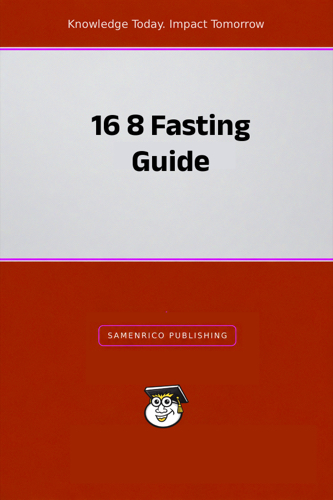
Non-FictionHealth & WellnessTime Restricted
16 8 Fasting Guide eBook
Teaches daily 16 hour fast with 8 hour eating wind
Teaches daily 16 hour fast with 8 hour eating window for weight loss.
Formats
Free sample
Chapter 1: The Breakfast Lie--–- I used to believe I was broken. Every morning, I would eat a "healthy" breakfast of oatmeal with berries and a banana at 7:00 AM. By 9:30 AM, I was hungry again. By 11:00 AM, I was raiding the office snack drawer for anything with sugar. By lunch, I was irritable and unfocused.
By 3:00 PM, I needed caffeine and chocolate just to stay awake until dinner. I thought I had no willpower. I thought my metabolism was permanently damaged. I thought I was simply one of those people who would always struggle with weight.None of that was true.The problem wasn't my willpower. The problem wasn't my metabolism.
The problem was that I was eating at the wrong time.Everything you have been taught about when to eat is probably wrong. This chapter will dismantle the most destructive myth in modern nutrition—the idea that breakfast is the "most important meal of the day"—and replace it with a radically simple truth: your body was designed to spend significant time without food. The 16:8 method isn't a diet. It's a return to how humans ate for 99% of our evolutionary history.The Myth That Made Us Fat Let us begin with a simple question: Who told you that breakfast is essential?The answer might surprise you. The modern breakfast industry as we know it was largely created by two men: John Harvey Kellogg and James Caleb Jackson, both Seventh-day Adventists who believed that bland, grain-based breakfast cereals would reduce sinful urges.
In the late 1800s, they invented corn flakes and granula. But breakfast did not become "the most important meal of the day" until 1944, when General Foods launched a marketing campaign to sell more Grape-Nuts. The slogan was simple, catchy, and entirely unscientific: "Breakfast is the most important meal of the day."A cereal company invented the idea that you must eat immediately upon waking.This is not conspiracy theory. It is documented marketing history. Edward Bernays, the father of public relations, famously used doctors to promote bacon and eggs for a client.
The meat industry followed. By the 1960s, three meals per day plus snacks was so deeply embedded in Western culture that questioning it seemed absurd. But here is what the science actually shows: there is no metabolic requirement to eat breakfast. None. Zero.
Your body does not need food within the first hour of waking. In fact, for many people, eating breakfast causes more harm than good.Let me be clear about what I am not saying. I am not saying breakfast is evil. I am not saying you can never eat in the morning. I am saying that the belief that you must eat breakfast—that skipping it is "dangerous" or "unhealthy"—is a marketing lie dressed up as nutritional advice.The Fed State vs.
The Fasted State To understand why 16:8 works, you must first understand two biological states that your body cycles through: the Fed State and the Fasted State. These are not abstract concepts. They are measurable hormonal conditions that determine whether you are storing fat or burning fat.The Fed State begins the moment you take your first bite of food. When you eat, your body releases insulin—a hormone with one primary job: to move glucose (sugar) out of your bloodstream and into your cells. Insulin is a storage hormone.
It tells your body to store energy as glycogen in your liver and muscles, and when those storage tanks are full, to store the excess as body fat. While insulin is elevated, your body cannot access stored fat for energy. It is biologically impossible. Your fat cells are locked. You are running exclusively on the food you just ate.The Fed State typically lasts between three to five hours after a meal, depending on the size and composition of that meal.
A large, carbohydrate-heavy meal keeps insulin elevated longer. A small, protein-rich meal allows insulin to drop faster.The Fasted State begins approximately eight to twelve hours after your last meal, once insulin has returned to its baseline level. In the Fasted State, the opposite happens. Insulin is low. Your body releases glucagon, a hormone that signals your liver to break down stored glycogen and release glucose.
When glycogen runs low, your body begins breaking down stored fat into free fatty acids and ketones, which become your primary fuel source. Your fat cells unlock. You are now running on the energy you stored weeks, months, or even years ago.Here is the critical insight that changes everything: Most people never enter the Fasted State. They eat dinner at 7:00 PM, have a late-night snack at 10:00 PM, wake up at 6:00 AM, and eat breakfast at 7:00 AM. Their insulin never drops.
Their body never gets the signal to burn fat. They are stuck in the Fed State twenty-four hours per day, seven days per week, storing fat continuously and never burning it.The 16:8 method solves this by creating a guaranteed Fasted State every single day. By compressing your eating into an 8-hour window and fasting for 16 hours, you give your body the time it needs to deplete glycogen, drop insulin, and begin burning stored fat. The first 8-12 hours after your last meal are spent in the Fed State or transitioning out of it. The final 4-8 hours of the 16-hour fast are pure fat-burning territory.Three Concepts, One Critical Distinction Before going further, we must distinguish between three related but different practices that are often confused:Intermittent Fasting (IF): This refers to longer, multi-day fasts lasting 24 hours or more.
Examples include alternate-day fasting (eating every other day) or 5:2 fasting (eating normally for five days, restricting calories for two non-consecutive days). These protocols are powerful but aggressive. They are not the subject of this book.Time-Restricted Eating (TRE): This is what 16:8 actually is. TRE involves limiting your daily eating to a specific window of time, typically between 8 and 12 hours, while consuming no calories outside that window. The key difference from intermittent fasting is that TRE happens every day.
It is a rhythm, not an event. This book is exclusively about TRE.Simple Starvation: This is caloric restriction without hormonal optimization. Starvation is eating too little throughout the day—for example, three tiny meals and two small snacks totaling 1,200 calories. This approach backfires because it keeps insulin elevated (since you are eating frequently) while simultaneously lowering your metabolic rate (since you are eating too little). Starvation is not fasting.
Fasting is about when you eat. Starvation is about how much you eat. They are opposites.The 16:8 method is time-restricted eating. You will not starve. You will eat satisfying meals during your 8-hour window.
You will not count calories obsessively. You will simply change when you eat, and let your hormones do the rest.Your Body Is a Hybrid Car Here is a metaphor that will stick with you. Your body has two fuel tanks and two engines.The first engine runs on sugar (glucose). This is your quick-burning, short-duration fuel. You get sugar from the food you eat—carbohydrates, primarily.
When you eat constantly, your body runs exclusively on this engine. The problem is that your sugar tank is small. It holds only about 1,500…
This is the end of the free sample. Get the eBook to keep going. Buy now
About this book
Details
- Author
- Mena Fernanda
- Publisher
- SamEnrico
- Language
- English
- Genre
- Non-Fiction, Health & Wellness, Time Restricted
- Released
- 2026-06-05
- Pages (approx.)
- 142
- Available as
- eBook, Audiobook

Read better in the ZLOADR app
Your eBooks on your phone or tablet. Sign in with your SamEnrico account and start reading.
More by Mena Fernanda
 Value Based ABC SortingMena Fernanda$11.99
 Nocturnal Eating DisorderMena Fernanda$11.99
 DBT for Executives GuideMena Fernanda$11.99
 Thermic Effect of FoodMena Fernanda$11.99
 Empathy for StillbirthMena Fernanda$11.99
 The Service Commitment ManualMena Fernanda$11.99
 Prescription Medication for SmokingMena Fernanda$11.99
 The Alewives of Flanders: Brewing the Medieval EmpireMena Fernanda$11.99
 Tangaroa's Deep Resonance: The First Song of the PacificMena Fernanda$11.99
 How to Produce ToolsMena Fernanda$11.99
 Service Providers Guide to Audiology & Hearing TestsMena Fernanda$11.99
 A Collector's Handbook to the Hillman VMena Fernanda$11.99
You may also like
 Hong Kong Handover 1997Dunn Johnnie$11.99
 Zumba For Postnatal Recovery CourseNeal Christian$11.99
 Zumba for BeginnersLadner Nikia$11.99
 YouTube Comment Mining GuideHumes Pandora$12.99
 Worry Box MeditationCarlin Rudy$11.99
 Workplace Stress MeditationNguyen Lynn$11.99
 Workplace Stress and Sleep RepairHawley Ivory$11.99
 Workplace Perfectionism CureDelaney Jeffry$11.99
 Workplace Injustice Anger GuideWallen Isabelle$11.99
 Work Addiction and Burnout LinkGreenwood Ester$11.99
 Women in Yoga and WellnessBeattie Galina$11.99
 Women in Stand Up ComedyChun Evangeline$11.99