
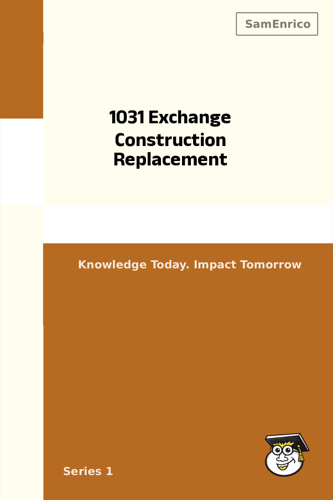
Non-FictionBusiness BriefConstruction Tax
1031 Exchange Construction Replacement eBook
Build replacement property using exchange funds wi
Build replacement property using exchange funds within 180 days.
Formats
Free sample
Chapter 1: The Asphalt Trap--–- Steve had done everything right. For fifteen years, he had bought, held, and improved rental properties across the suburbs of Atlanta. He had never missed a tax deadline, never cut a corner on a renovation, and never once considered that a parking lot would cost him $120,000.It was a Tuesday afternoon in late September when Steve sat down with his CPA to review the sale of his four-unit apartment building. The building had appreciated nicely—purchased for $600,000, sold for $1.2 million. After commissions and closing costs, Steve walked away with roughly $1 million in net proceeds.
His CPA, a careful man named Richard who had been preparing Steve's returns for a decade, laid out the options."You can pay the capital gains tax now," Richard said, sliding a piece of paper across the desk. "That's about $200,000 federal and state. Or you can do a 1031 exchange and defer the entire amount."Steve had heard of 1031 exchanges. Every real estate investor had. The basic idea was simple enough: sell one investment property, buy another of equal or greater value within a specific timeframe, and pay zero capital gains tax.
The government essentially said, "We'll collect our tax later when you finally cash out. In the meantime, keep your money working in real estate."But Steve had a specific vision for his next investment. He didn't want to buy an existing building. Existing buildings came with existing problems—old roofs, outdated electrical systems, tenants who had been there since the 1980s and paid below-market rent. Steve wanted to build.
He wanted a brand-new four-unit building on a piece of raw land he had been eyeing for months. The land was priced at $300,000. He had a contractor who would build the identical four-unit layout for $500,000. Total investment: $800,000, which was actually less than his $1 million sale proceeds. He planned to pocket the remaining $200,000 as cash—what his CPA called "boot"—and pay tax only on that amount."That's not how it works," Richard said.
And then Richard explained the rule that would cost Steve $120,000.The Receipt Rule, as Richard described it, was deceptively simple: in a 1031 exchange, you cannot have actual or constructive receipt of the exchange funds before the exchange is complete. The funds must be held by a neutral third party—a Qualified Intermediary—until the moment you acquire the replacement property. If you take possession of the money, even briefly, the exchange fails.Steve nodded. He understood that. He had no intention of touching the money.
He would sell the apartment building, have the proceeds sent to a Qualified Intermediary, and then use those funds to buy the land and pay the contractor. Simple.But then Richard dropped the bombshell. "The problem," Richard said, "is the land. If you take title to the land before the building is finished, the exchange is complete the moment you own the dirt. Every dollar you spend on construction after that point is considered boot, because you are improving property you already own personally."Steve blinked.
"So what am I supposed to do? Buy the land and the building on the same day? The building doesn't exist yet.""Exactly," Richard said. "That's why most investors don't do construction exchanges. The timeline is nearly impossible.
You have 180 days from the sale to finish the entire building and close on the completed property. And you cannot take title to the land until the building is done."Steve left Richard's office that afternoon with a decision to make. He could abandon the construction plan and buy an existing building, accepting whatever problems came with it. Or he could proceed with the construction exchange, but only if he could find a way to control the land and direct the construction without actually owning the dirt.He chose to proceed. He found a Qualified Intermediary who claimed to handle construction exchanges.
He sold the apartment building on October 15. The QI received the $1 million in proceeds. Within 45 days, Steve identified the raw land as his replacement property. Then he did what seemed logical: he bought the land. He took title in his own name.
He hired the contractor. He poured the foundation, framed the building, installed the plumbing, ran the electrical, hung the drywall, painted the walls, and paved a brand-new parking lot. The entire project took 165 days—well within the 180-day window.On day 172, Steve took title to the completed building. He had his brand-new four-unit property. He had his tax deferral.
Or so he thought.The IRS audit came eighteen months later. The agent asked a simple question: "On what date did you acquire the land?"Steve checked his records. "Day 30 after the sale.""On what date did you acquire the completed building?""Day 172."The agent nodded. "Then you completed the exchange on day 30, when you acquired the land. The building is not part of the exchange.
You built it on property you already owned."Steve's heart sank. He explained that the land was raw, worthless without the building. He explained that he had built the building within the 180-day window. He explained that his CPA had warned him about this but he had thought—incorrectly—that the QI would protect him.The agent was sympathetic but firm. The law was clear.
Under Section 1031, a taxpayer cannot take title to replacement property in stages. When Steve took title to the land, he received everything he was entitled to receive under the exchange agreement. The building was a subsequent improvement to his own property—a capital expenditure that increased his basis but did not qualify for tax deferral.The result: Steve had a $1 million exchange that deferred tax on the land's value—roughly $300,000 of the purchase price. But the $500,000 in construction costs was treated as boot. The $200,000 in cash he had pocketed was also boot.
Total boot: $700,000. At a combined federal and state capital gains rate of roughly 23%, Steve owed $161,000 in taxes. But because he had already spent the cash on construction, he had to write a check for $161,000 out of his personal savings.That parking lot—the one he had paved with such pride—cost him $120,000 in tax after accounting for the portion allocable to the land. He called it the Asphalt Trap.The Anatomy of the Asphalt Trap Steve's story is not an outlier. In my fifteen years of advising real estate investors on 1031 exchanges, I have seen this exact mistake made dozens of times.
Sometimes it is a parking lot. Sometimes it is a storage building, a medical office, a small retail strip, or even a single-family rental. The details vary, but the pattern is identical: an investor takes title to raw land within the 45-day identification period, begins construction, and assumes that because the building is finished within 180 days, the entire project qualifies for tax deferral.The IRS has litigated this issue repeatedly—and the taxpayer almost always loses.The leading case is Bloch v. United States, decided by the Ninth Circuit Court of Appeals in 1968. The Bloches sold a piece of property and entered into an agreement to buy raw land with the understanding that they would construct a building on it.
They took title to the land within the exchange period but did not complete the building until later. The court…
This is the end of the free sample. Get the eBook to keep going. Buy now
About this book
Details
- Author
- Pressley Walton
- Publisher
- SamEnrico
- Language
- English
- Genre
- Non-Fiction, Business Brief, Construction Tax
- Released
- 2026-06-08
- Pages (approx.)
- 154
- Available as
- eBook, Audiobook

Read better in the ZLOADR app
Your eBooks on your phone or tablet. Sign in with your SamEnrico account and start reading.
More by Pressley Walton
 Road Rage for CyclistsPressley Walton$11.99
 Nap Journal TrackerPressley Walton$11.99
 NVC For In LawsPressley Walton$11.99
 Working Memory TipsPressley Walton$11.99
 Opposition Master GuidePressley Walton$11.99
 Morning Stretching For ExecutivesPressley Walton$11.99
 Weapon Dream Jungian ViewPressley Walton$11.99
 Immigrant Digital Marketing Agency GuidePressley Walton$11.99
 The Unseen Hand: How Queen Elizabeth II Shaped Modern MonarchyPressley Walton$11.99
 Silk and Shadows: The Double Life of Mata Hari’s RivalPressley Walton$11.99
 Understanding Albinism Oculocutaneous, Hermansky–pudlak TypePressley Walton$17.99
 The Complete Guide to the Clean DietPressley Walton$11.99
You may also like
 Hong Kong Handover 1997Dunn Johnnie$11.99
 Zumba For Postnatal Recovery CourseNeal Christian$11.99
 Zumba for BeginnersLadner Nikia$11.99
 YouTube Comment Mining GuideHumes Pandora$12.99
 Worry Box MeditationCarlin Rudy$11.99
 Workplace Stress MeditationNguyen Lynn$11.99
 Workplace Stress and Sleep RepairHawley Ivory$11.99
 Workplace Perfectionism CureDelaney Jeffry$11.99
 Workplace Injustice Anger GuideWallen Isabelle$11.99
 Work Addiction and Burnout LinkGreenwood Ester$11.99
 Women in Yoga and WellnessBeattie Galina$11.99
 Women in Stand Up ComedyChun Evangeline$11.99