
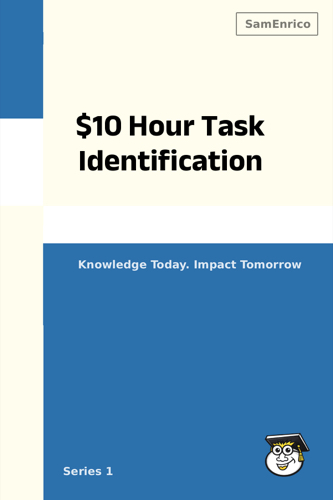
Non-FictionSelf-HelpValue Analysis
$10 Hour Task Identification eBook
Find low value tasks that cost more than $10 of yo
Find low value tasks that cost more than $10 of your time to keep.
Formats
Free sample
Chapter 1: The Invisible Expense...--You are probably losing money right now. Not because your business is failing, not because your prices are too low, and not because your competitors are beating you. You are losing money because you are doing work that is secretly costing you more to perform than the value it returns. And the most disturbing part? You have no idea it is happening.Let me show you something that will change how you see every single task on your to-do list.
Imagine you hire a plumber to fix a leaky pipe in your home. The plumber charges $150 per hour. After fixing the pipe, the plumber spends ten minutes sweeping up sawdust and wiping down the floor. You watch this happen and think, "That is nice of them." But then you receive the bill, and the plumber has charged you $150 for that ten minutes of sweeping. You would be furious.
You would say, "Why am I paying a $150-per-hour expert to do a $20 cleaning job?"Now look in the mirror. That plumber is you.Every day, you spend hours doing work that could be done by someone earning $10, $15, or $20 per hour. But because you are the owner, the founder, the expert, the professional, you tell yourself that doing these tasks is "responsible," "thorough," or "cost-effective." It is none of those things. It is financially irrational. It is the invisible expense that never appears on your profit and loss statement, yet it drains your business of its most valuable resource: your time at your highest value.This chapter is about seeing that expense for the first time.
It is about understanding the math that most successful people never stop to calculate. And it is about making a decision, right now, to stop being the $150-per-hour plumber who sweeps the floor.The Invisible Income Statement Every business has a profit and loss statement. It lists revenue, cost of goods sold, salaries, rent, marketing expenses, software subscriptions, and hopefully a net profit at the bottom. But there is another statement that never gets printed, never gets reviewed in board meetings, and never appears in your accounting software. I call it the Invisible Income Statement.The Invisible Income Statement tracks one thing: the value of your own time spent on tasks that do not require your expertise.Let me give you an example.
Sarah runs a consulting practice. She earns $200,000 per year in net profit working forty hours per week. Her effective hourly rate is approximately $96 per hour. Every week, Sarah spends eight hours on tasks like scheduling client meetings, organizing her email inbox, reconciling her bank statements, and formatting Power Point slides her team will present. None of these tasks require her specific expertise, her relationships with clients, or her strategic judgment.
Each of these tasks could be done by a competent virtual assistant earning $15 to $20 per hour.Every week, Sarah loses approximately $600 of her value. That is $600 she will never recover. Over a year, that is more than $30,000. Over a decade, it is a third of a million dollars. And Sarah has no idea it is happening because the Invisible Income Statement never shows her the math.This chapter will teach you how to build your own Invisible Income Statement.
But first, you need to understand the single most important number in your professional life.The Profit Hour: Your Real Hourly Rate Most people calculate their hourly rate by dividing their annual revenue by the number of hours they work. This is a mistake. Revenue is not profit. If you earn $500,000 in revenue but spend $450,000 on expenses, your profit is $50,000. Your time is worth your profit per hour, not your revenue per hour.I call this number your Profit Hour.Here is the formula:Profit Hour = Annual Net Profit ÷ Actual Hours Worked Per Year Let me show you how this changes the math.
Consider two very different professionals:Maria the Freelance Designer: Maria earns $120,000 in revenue. Her expenses (software, subcontractors, marketing, insurance) total $30,000. Her net profit is $90,000. She works forty-five hours per week, fifty weeks per year, for a total of 2,250 hours. Maria's Profit Hour is $90,000 divided by 2,250 hours, which equals $40 per hour.James the Boutique Agency Owner: James earns $600,000 in revenue.
His expenses (salaries, rent, software, advertising, legal fees) total $500,000. His net profit is $100,000. He works sixty hours per week, fifty weeks per year, for a total of 3,000 hours. James's Profit Hour is $100,000 divided by 3,000 hours, which equals approximately $33 per hour.James has a much larger business than Maria, but his Profit Hour is lower because his expenses are higher and he works more hours. This is surprisingly common.
Many business owners work enormous hours to generate impressive revenue while their actual profit per hour is lower than their admin assistant's wage.Now consider Elena the Strategic Advisor: Elena earns $250,000 in revenue. Her expenses are minimal—maybe $20,000 for a part-time assistant and software. Her net profit is $230,000. She works twenty-five hours per week, fifty weeks per year, for a total of 1,250 hours. Elena's Profit Hour is $230,000 divided by 1,250 hours, which equals $184 per hour.Elena earns less revenue than James but more profit per hour because she has ruthlessly eliminated low-value work from her schedule.
She spends her time on high-leverage activities: client strategy, business development, and relationship management. Everything else goes to someone else.Which of these three professionals would you rather be? If you said Elena, then you already understand the purpose of this book.Defining the $10 Task Before we go any further, I need to be absolutely clear about what we mean when we say "$10 task." This definition will be used throughout the entire book, and it will never change.A **$10 task** is any task that you can outsource to a competent freelancer or virtual assistant for $10 to $20 per hour, regardless of your personal hourly rate.Notice what this definition does not include. It does not include tasks based on how much you hate them. It does not include tasks based on how long they take to learn.
It does not include tasks based on your emotional attachment to them. It only includes one variable: the market rate to have someone else do the work.Why is this definition so important? Because it removes emotion from the equation. You might hate scheduling meetings, but that does not automatically make it a $10 task. You might love doing graphic design, but that does not automatically protect it from being a $10 task.
The only question that matters is: Can I pay someone $10 to $20 per hour to do this at an acceptable level of quality?If the answer is yes, it is a $10 task. If the answer is no—because the task requires your specific expertise, your established relationships, your professional license, or your unique creative voice—then it is not a $10 task. Those tasks belong to you.This definition creates a clean, objective filter. Throughout this book, when I say "delegate your $10 tasks," I mean exactly this: identify every task you are currently doing that someone else could do for $10 to $20 per hour, and stop doing those tasks.The Bus Test You need a simple, memorable way to apply this definition in real time. I have a question…
This is the end of the free sample. Get the eBook to keep going. Buy now
About this book
Details
- Author
- Pantoja Elodia
- Publisher
- SamEnrico
- Language
- English
- Genre
- Non-Fiction, Self-Help, Value Analysis
- Released
- 2026-06-08
- Pages (approx.)
- 144
- Available as
- eBook, Audiobook

Read better in the ZLOADR app
Your eBooks on your phone or tablet. Sign in with your SamEnrico account and start reading.
More by Pantoja Elodia
 Angel Investment AccountingPantoja Elodia$11.99
 Forgiveness Emotion RegulationPantoja Elodia$11.99
 Pelvic Floor Strengthening BasicsPantoja Elodia$11.99
 Gambling Addiction For Construction WorkersPantoja Elodia$11.99
 School of Diamond ThievesPantoja Elodia$11.99
 Anapanasati Beginner Breath GuidePantoja Elodia$11.99
 Eckhart Tolle PathPantoja Elodia$11.99
 The Spice King of the Gold Coast: John Holt’s Culinary EmpirePantoja Elodia$11.99
 The Ballad of the Last Wild Man: The Untold Story of the 'Wild Boy of Aveyron'Pantoja Elodia$11.99
 Mastering The Art of Istunka (Somalia)Pantoja Elodia$11.99
 How to Produce Hair CombsPantoja Elodia$11.99
 A Collector's Handbook to the Dodge D13 Standard SixPantoja Elodia$11.99
You may also like
 Hong Kong Handover 1997Dunn Johnnie$11.99
 Zumba For Postnatal Recovery CourseNeal Christian$11.99
 Zumba for BeginnersLadner Nikia$11.99
 YouTube Comment Mining GuideHumes Pandora$12.99
 Worry Box MeditationCarlin Rudy$11.99
 Workplace Stress MeditationNguyen Lynn$11.99
 Workplace Stress and Sleep RepairHawley Ivory$11.99
 Workplace Perfectionism CureDelaney Jeffry$11.99
 Workplace Injustice Anger GuideWallen Isabelle$11.99
 Work Addiction and Burnout LinkGreenwood Ester$11.99
 Women in Yoga and WellnessBeattie Galina$11.99
 Women in Stand Up ComedyChun Evangeline$11.99